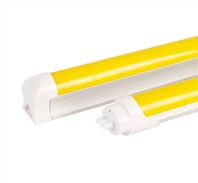
If you own T8 bulbs, there may come a time when you need to check if your bulb is still in good condition or needs to be replaced. It's important to know this, especially when you notice that your bulb is not producing as much light as it used to. In this article, we will discuss some of the things you can do to find out if your T8 bulb is bad or not.
One of the simplest ways to check if your T8 bulb is bad is to visually inspect it. Turn off the power and carefully remove the bulb from the fixture. Look for any signs of physical damage, such as cracks or discoloration. If you see any of these signs, you should replace the bulb immediately. Additionally, if the bulb appears blackened or discolored around the ends of the tube, this may indicate that the filament inside the bulb has burned out.
You can also check if your T8 bulb is bad by testing it with a multimeter. Set the multimeter to read volts and connect the probes to the pins at each end of the bulb. If the multimeter reading is close to 0, this means that your T8 bulb is bad and needs to be replaced. If the reading is a normal value (usually 110-120 volts), the bulb is still in good condition.
Another way to determine if your T8 bulb is bad is to switch it with a working bulb from another fixture. If the working bulb does not light up in the place of the suspected bad bulb, this could indicate that there is something wrong with the ballast or wiring in the fixture, rather than the bulb itself.
It's also important to note that some T8 bulbs come with an integrated starter. If your T8 bulb has one of these, you may need to replace the starter when you replace the bulb. Failing to replace the starter could cause the new bulb to fail prematurely.
In conclusion, there are several ways to check if your T8 bulb is bad. Visually inspecting the bulb for physical damage, testing it with a multimeter, swapping it with a working bulb, and replacing the integrated starter (if applicable) are all effective methods. By knowing how to check if your T8 bulb is bad, you can ensure that your fixture is producing optimal light and save money by replacing bulbs only when necessary.