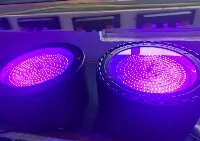
How is White Light Achieved in LEDs?
Introduction: The Challenge of Creating White Light
Unlike traditional incandescent bulbs that naturally produce white light by heating a filament, LEDs (Light Emitting Diodes) inherently emit monochromatic (single-color) light. To produce white light, engineers have developed several clever techniques that combine physics, chemistry, and materials science.
This article explores:
✔ The three main methods to create white LEDs
✔ How phosphors transform blue light into white
✔ Real-world applications & industry breakthroughs
✔ Future innovations in LED lighting
Method 1: Blue LED + Phosphor (The Most Common Approach)
How It Works:
A blue LED chip (typically InGaN-based) emits short-wavelength light (~450 nm).
A phosphor coating (usually YAG:Ce – yttrium aluminum garnet doped with cerium) absorbs some blue light.
The phosphor re-emits yellow light, mixing with the remaining blue to create white.
Color Mixing Example:
| Light Component | Wavelength | Resulting Perception |
|---|---|---|
| Blue LED | ~450 nm | Cool white (if dominant) |
| Yellow Phosphor | ~580 nm | Warm white (if adjusted) |
Case Study:
Nichia's 1996 Breakthrough – The first commercially viable white LED used this method, earning a Nobel Prize in Physics in 2014.
Advantages:
✔ Cost-effective
✔ High efficiency (up to 200 lumens/watt)
✔ Tunable color temperature (2700K–6500K)
Limitations:
❌ Lower color rendering in red/green (CRI ~70-90)
Method 2: RGB LED Mixing (Full-Color White)
How It Works:
Combines red, green, and blue LEDs in precise ratios.
Adjusting intensity creates different white tones.
Example Applications:
Philips Hue Smart Bulbs – Allow users to customize white light from warm to cool.
TV Backlights – Samsung's QLED TVs use RGB LEDs for accurate colors.
Advantages:
✔ Excellent color rendering (CRI >95)
✔ Dynamic color tuning
Limitations:
❌ More expensive
❌ Complex driver circuitry required
Method 3: Violet/UV LED + Multi-Phosphor (High CRI White)
How It Works:
A violet or UV LED excites red, green, and blue phosphors.
The mix produces a full-spectrum white light.
Case Study:
Soraa's Violet LED Tech – Uses a GaN-on-GaN violet LED + phosphors for CRI >95, ideal for museums.
Advantages:
✔ Best color accuracy (CRI up to 99)
✔ No blue light peak (better for eye comfort)
Limitations:
❌ Lower efficiency (more energy lost as heat)
Comparing White LED Technologies
| Method | Mechanism | CRI Range | Efficiency | Best For |
|---|---|---|---|---|
| Blue LED + YAG | Blue + yellow phosphor | 70-90 | High (200+ lm/W) | Household bulbs |
| RGB Mixing | Red + green + blue LEDs | 90-98 | Medium | TVs, smart lighting |
| Violet + RGB Phosphor | UV + multi-phosphor | 95-99 | Lower | Museums, hospitals |
Future Innovations in White LEDs
Quantum Dot LEDs (QLEDs)
Nanocrystals enhance color purity (used in premium displays).
Laser-Based White Lighting
BMW's laser headlights use blue lasers + phosphors for ultra-bright light.
Perovskite LEDs (PeLEDs)
Emerging tech for cheaper, high-CRI lighting.
Conclusion: Which White LED is Best?
For homes: Blue LED + phosphor (affordable, efficient).
For color accuracy: RGB or violet LED (museums, studios).
For smart lighting: RGB tunable systems.