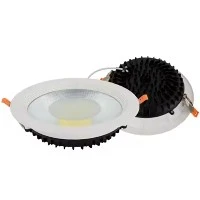
In the event of a power outage, fire, or other emergency, emergency lighting often serves as the final safeguard for the safe evacuation of personnel. When selecting products, many customers ask the same question: "Exactly how long will this LED emergency light board stay lit after the power goes out?" While the question seems simple, the answer depends on multiple variables, including battery type, load power, ambient temperature, and product design. In this article, we explain the technical details to help you avoid pitfalls when purchasing or designing emergency lighting solutions.
Basic Operating Principle of LED Emergency Light Boards
An LED emergency light board is essentially a dual-circuit system combining "mains power supply" and "battery backup." Under normal conditions, the light board is powered directly by the mains, while an internal charging circuit continuously replenishes the backup battery. Once a mains power interruption is detected, the control circuit automatically switches to battery power within a very short time (usually less than 0.5 seconds) to keep the LEDs illuminated. This logic dictates that the key factor determining runtime is not the LED itself, but rather the battery's capacity and discharge efficiency.
How Battery Type Determines Runtime
There are three main types of batteries commonly found in emergency light boards on the market today:
Nickel-Cadmium (Ni-Cd): Low cost and high-temperature resistance, but low energy density; they offer relatively short runtimes for a given size and suffer from the "memory effect."
Nickel-Metal Hydride (Ni-MH): Higher energy density than Ni-Cd; the mainstream choice for low-to-mid-range emergency light boards, typically offering 1.5 to 3 hours of runtime.
Lithium Iron Phosphate (LiFePO4): High energy density, long cycle life, and a more stable discharge curve; capable of longer runtimes (over 3 hours) in the same volume and better suited for high-load scenarios. This is the preferred technology for mid-to-high-end products.
Battery type affects not only runtime but also the product's service life and its ability to withstand high and low temperatures; this is a primary parameter we verify when making product selection recommendations.
Key Variables Affecting Runtime
In addition to battery type, actual runtime is influenced by the interplay of the following factors:
Load Power: The higher the power rating of the light board, the greater the power consumption per unit of time, naturally resulting in a shorter runtime. When using the same battery, the runtime can differ by as much as twofold depending on whether it is powering a 5W or a 10W light panel.
Ambient temperature: Battery discharge efficiency varies with temperature. In low-temperature environments (such as cold storage facilities or outdoors in winter), battery capacity drops significantly, and actual runtime is often lower than values measured at room temperature.
Battery aging: Batteries are consumable items; typically, after 2 to 4 years of use, capacity declines to 70%–80% of its initial value, resulting in a shorter runtime. This is why emergency light panels require regular maintenance and testing.
Charge/discharge management circuit efficiency: Low-quality control systems lead to additional energy loss; with the same battery capacity, different circuit designs can result in a 10%–20% difference in actual usable runtime.
Industry Standards for Runtime
Different countries and regions have specific mandatory standards regarding emergency lighting runtime; these serve as the primary benchmark for purchasers during product acceptance:
UL924 (North American Standard): Requires emergency lighting systems to maintain output for at least 90 minutes following a mains power failure.
EN 60598-2-22 / EN 1838 (EU Standards): Also mandate a minimum runtime of 90 minutes, though some locations (such as evacuation routes in high-rise buildings) may require longer durations.
GB 17945 (Chinese National Standard): Specifies tiered requirements for continuous emergency lighting power supply based on building type; the minimum is generally 90 minutes, with critical locations potentially requiring anywhere from 60 to 180 minutes.
This means that, regardless of battery type or product design, 90 minutes is the generally accepted industry "baseline," and this figure can be used as an initial screening criterion during procurement.
How to Assess the Actual Runtime of an Emergency Light Board
During actual testing and acceptance, we recommend focusing on the following quantifiable indicators rather than relying solely on the manufacturer's "nominal runtime":
Availability of a runtime test report issued by a third-party testing agency (e.g., UL, CE, CQC);
Clear specification of test conditions (full load vs. half load; ambient temperature vs. extreme temperatures);
A reasonable ratio between battery capacity (mAh) and light board power (this allows for a rough calculation of theoretical runtime);
Support for self-testing functions and the ability to monitor battery health status in real-time via the panel or a backend system.
Practical Tips for Extending the Service Life of Emergency Light Boards
Conduct a manual discharge test regularly (quarterly is recommended) to verify that the actual runtime meets the nominal specifications;
Avoid installing the light board in locations subject to significant temperature fluctuations or prolonged high heat; aim to keep the operating temperature within the battery's recommended range;
Replace the battery promptly once it reaches the end of its service life; do not wait until it fails completely;
Prioritize models that support capacity monitoring or early warning functions to facilitate the early detection of battery aging.
Summary
The runtime of an LED emergency light board is not a fixed figure; it is the result of the interplay between battery type, load power, ambient temperature, and circuit design. When purchasing, we recommend prioritizing the battery type (Lithium Iron Phosphate batteries generally offer superior overall performance), verifying third-party runtime test reports, and setting a minimum runtime of 90 minutes as the baseline for compliance. Regular maintenance and the timely replacement of aging batteries are equally crucial to ensuring that emergency lighting truly performs when it matters most.
If you are selecting emergency lighting products for a project, or wish to learn more about specific product parameters regarding battery options, runtime durations, and certification standards, please feel free to contact our technical team. We can provide tailored selection advice and detailed quotations based on your specific application scenarios (such as commercial buildings, industrial plants, or outdoor locations).