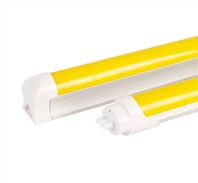
Because they were the most economical and energy-efficient lights available at the time, fluorescent tubes were formerly the preferred option for offices, warehouses, and other commercial and industrial spaces. But technology continues to advance, and people continue to seek for better solutions.
Then LED technology came along. There are several reasons why LED tube lights are currently becoming more and more popular in the commercial lighting industry (and beyond).
We offer you our guide on installing LED tubes if you are thinking about getting this kind of lighting or have already decided to do so after being persuaded by the numerous advantages of LED lights.
The LED Tube Lights: What Are They?
LED tubes are very effective, reasonably priced, and multipurpose. They are more dependable because they require less maintenance and still burn out less frequently, have better color rendering, and are even more economical and energy-efficient (standard T8 LED tubes are 30% more efficient than fluorescent T8 tubes). Additionally, they are compatible with the previous light fixtures, making it easy to swap out your fluorescent tubes for LED ones.
In contrast to fluorescent lights, LED tubes don't flicker and can have a variety of color temperatures. LED lights are less expensive than other tube types, and they can be installed with dimming capabilities. Because LEDs don't contain mercury, they are also more environmentally friendly.
LED tube lights are classified according to a "T" measurement; the larger the number, the thicker the diameter of the lamp. There are options for T5, T8, and T12 lights. "T" is precisely one-eighth of an inch, and the number that follows indicates how many eighths of an inch broad the light-or, more specifically, its bulb-is. Consequently, a T8 LED light, for instance, is precisely one inch (8/8ths).
The lower the number, the more efficient the light is with a fluorescent tube, but this isn't always the case with LEDs.
A Guide to Installing LED Tubes
Switch off the electricity. It's important. If not, you run the risk of getting electrocuted while working.
Take out the old tube. Simply detach all of the wires to complete the task after the power has been cut off. Be careful.
Hold the old tube in place. Particularly while working with fluorescent tubes, use caution because they contain levels of mercury, which can be toxic to humans if consumed.
Examine the ballast. Electronic or magnetic ballasts are found in all fluorescent tubes; if you hear buzzing or witness flickering, the ballast is magnetic.
If the ballast is electronic, remove it. If you leave it there, it can harm your LED lights. All you have to do is unplug the cables, take out the ballast, then reattach the cables. Verify that the connection is tight and that nothing is loose or broken.
If the ballast is magnetic, remove it or avoid it. To facilitate installation, many LED tubes come with their own starter. To minimize any risks, it is preferable to contact a specialist if it turns out that you need to avoid the magnetic ballast.
Attach the new LED tube. There's no need to hurry while attaching it to the fixture; take your time. Doing everything correctly and taking your time is preferable. The fitting wires must match the live and neutral connections on each LED tube. Rewiring will require a specialist if there is a short circuit (both links at one end).
Verify that you have followed every step. Make sure everything is connected correctly and that you followed the instructions before proceeding.
Activate the electricity. Check to see if it functions as intended. Although you might be accustomed to the tubes buzzing and flickering, LED tubes shouldn't do that. Repeat each step or contact a professional if you see or hear it.
Dispose of the outdated tubes properly. You can't just dump the tube in the trash, especially when it comes to fluorescent lights, which contain mercury. Look for recycling services that handle this type of rubbish in your community. You can dispose of the LED tubes in your usual trash, however recycling is a more environmentally responsible option.
Concluding remarks
LED tubes offer several benefits, including lower maintenance costs, longer-term cost savings, enhanced color, and greater environmental and financial benefits. Because LED tubes are also quite adaptable, you can be confident that you will find lights that meet your demands and that you won't have to worry about maintenance (at least not as frequently as with a fluorescent tube).
The best thing about them is that an LED tube can be readily installed in your existing fixtures and is very simple to perform on your own by following the basic instructions in this article. You may be sure of both achievement and delight!