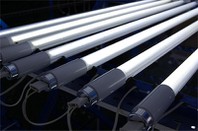
For a warehouse to be safe and productive, lighting is essential. Poor lighting in warehouses can result in mishaps, lower production, and greater electricity costs. The greatest option for your lighting system improvement is LED lighting.
Since LEDs use less energy than conventional light sources, they'll enable you to reduce your electricity costs. Additionally, LEDs deliver greater light quality, enhancing your warehouse's productivity and safety. Therefore, LED lighting is a simple decision when it comes to selecting the appropriate lighting for your warehouse.
Finding the ideal lighting solution for your house or factory might seem difficult. However, with a little information and investigation, you can locate the ideal lighting option for your requirements.
LED lighting is an excellent alternative for warehouse lighting if you're seeking for possibilities. LED lights are great for business settings since they are long-lasting and consume less energy. Additionally, because they generate minimal heat, they won't raise the warehouse's already high temperature.
Why is good lighting important for a warehouse?
Your employees' safety is ensured by effective, appropriate illumination. A warehouse is full with dangers, and good lighting may shield your staff from them. The following are the primary justifications for having a reliable, dependable warehouse lighting system:
Reduces worker errors — When dark areas are eliminated, employees stop straining to read their labels and paperwork. Your employees will make fewer errors if they can see well.
Reduces heavy machinery accidents — Heavy machinery operators are less likely to run into shelves or, even worse, people when they can see what they are doing. They can work effectively without endangering people or damage property.
Reduces drowsiness in workers — Employees are less likely to experience a dip around three o'clock when your warehouse has the appropriate lighting levels. When the lighting scheme produces the proper color temperature and amount of light, they are more likely to be attentive and productive (more on this later). Here is additional information about color temperature.
Reduces energy expenses — Traditional lighting solutions, such fluorescent lighting, emit heat, however LED warehouse lights are cool to the touch and don't. Your power account shows a lot of extra dollar signs due to the heat, so switching to LED lighting might result in significant cost savings for you.
How do I light the warehouse?
A particular difficulty arises with warehouse illumination. Contrary to the majority of other industrial lighting kinds, warehouses often feature higher shelves, open, spacious floors, high ceilings, and few windows.
Therefore, warehouse lighting must be sufficiently bright to guarantee that employees can see properly across the area. In order to save operational expenses, it should also be energy-efficient.
You shouldn't make a decision about the lighting of your warehouse hastily without first asking yourself a number of questions,
including:
How many fixtures are necessary?
The square footage alone is insufficient because every warehouse is unique. To determine the number of fixtures required to provide the recommended lighting levels for each location, you will need to utilize a light meter. You can validate the ideal lighting arrangement and the locations for each LED fixture by using a blueprint.
How high are your product stacks or shelves?
For optimal illumination levels, you will need more light the closer your items are to the building's ceiling.
What shade of hue should the lighting be?
The safety of your employees and productivity both greatly depend on color temperature. The ideal color temperature for warehouses is a bright, clear white light that is between 4000K and 5000K. Employees will get drowsy, less productive, and less able to see shelves and labels if your light output is too warm.
How far apart should the lights be placed?
If not done correctly, the distance between light fixtures causes glares or dark areas. You'll get hot patches where the light reflects off of adjacent LED light fixtures if they are placed too closely together. You will miss certain locations and leave dark regions if your LED lighting system is configured with the bulbs too widely apart.


Benwei warehouse led lights:
| Model | BW-002-S100W | BW-002-S150W | BW-002-S200W |
| Power(W) | 100W | 150W | 200W |
| Light Source | SMD | ||
| Input Voltage | AC220-240V/ AC100-305V / 480v 50/60Hz | ||
| Material | Aluminum+PC | ||
| Beam Angle | 60°/90°/120° | ||
| IP Rating | IP65 | ||
| CCT | 3000K / 4000K / 6000K | ||
| CRI | Ra>80 | ||