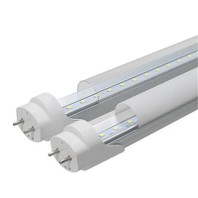
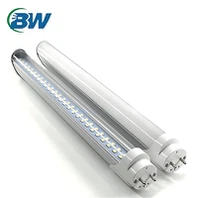
LED fluorescent tube harmonic <5%
What are power harmonics
The frequencies higher than the fundamental frequency are called harmonics, which are generally integer multiples of the fundamental frequency (or irrational multiples). The harmonics of integer multiples can be described by Fourier series.
Harmonics can cause waveform distortion. This distortion can be seen with an oscilloscope, such as a time-domain analysis instrument, but it is best to use a frequency-domain analysis instrument, such as a spectrum analyzer. Of course, some high-end oscilloscopes with spectrum analysis function can also be used.
Harmonics in the power supply system
The appearance of harmonic currents in power supply systems has been around for many years. In the past, harmonic currents were used by electric railways and industrial DC speed-regulating transmission devices, and produced by mercury rectifiers that convert AC to DC power. In recent years, the types and quantities of equipment that generate harmonics have increased dramatically and will continue to grow. Therefore, we must carefully consider the harmonics and its adverse effects, and how to minimize the adverse effects.
1 Harmonic generation
In an ideal clean power supply system, both current and voltage are sine waves. In a simple circuit containing only linear components (resistance, inductance, and capacitance), the current flowing is proportional to the applied voltage, and the current flowing is a sine wave.
In the actual power supply system, due to the existence of non-linear loads, when the current flows through the load that is not linear with the applied voltage, a non-sinusoidal current is formed. Any periodic waveform can be decomposed into a sine wave with a fundamental frequency plus a sine wave with many harmonic frequencies. The harmonic frequency is an integral multiple of the fundamental frequency. For example, the fundamental frequency is 50 Hz, the second harmonic is 100 Hz, and the third harmonic is 150 Hz. Therefore, the distorted current waveform may consist of second harmonic, third harmonic...maybe up to the thirtieth harmonic.
2 Types of equipment that generate harmonics
All non-linear loads can generate harmonic currents. The types of equipment that generate harmonics are: switch mode power supply (SMPS), electronic fluorescent tube ballast, speed control gear, uninterruptible power supply (UPS), magnetic iron core Equipment and certain household appliances such as televisions.
(1) Switch mode power supply (SMPS):
Most modern electronic devices use switched mode power supplies (SMPS). They are different from the old equipment. They have replaced the traditional buck and rectifier with the power supply directly through the controllable rectifier device to charge the storage capacitor, and then use a suitable output voltage and current. The method outputs the required DC current. The advantage of this for equipment manufacturers is that the size, price and weight of the device can be greatly reduced. Its disadvantage is that no matter which model it is, it cannot draw continuous current from the power supply, but can only draw pulses. Current. This pulse current contains a large number of third and higher harmonic components.
(2) Electronic fluorescent tube ballast:
Electronic fluorescent tube ballasts have been widely adopted in recent years. Its advantage is that it can significantly improve the efficiency of the tube when working at high frequencies, but its disadvantage is that its inverter generates harmonics and electrical noise in the power supply current. The use of models with power factor correction can reduce harmonics, but the cost is expensive.
(3) DC speed regulating transmission device:
The speed controller of a DC motor usually uses a three-phase bridge rectifier circuit, which is also called a six-pulse bridge rectifier circuit, because there are six pulses per cycle on the DC output side (one on the half wave of each phase) . The inductance of a DC motor is limited, so there is a 300 Hz pulsating wave in the DC current (that is, 6 times the power supply frequency), which changes the waveform of the power supply current.
(4) Uninterruptible power supply (UPS):
There are many different types of UPS according to the power conversion method and the conversion method used by the external power supply to the internal power supply. The main types are: online UPS, offline UPS and line interaction UPS. Loads powered by UPS are always electronic information equipment, which are non-linear and contain a large number of low-order harmonics.
(5) Magnetic core device:
The relationship between the magnetizing current and the magnetic flux density in a reactor with an iron core is always non-linear. If the current waveform is a sine wave (that is, the resistance in the circuit is large), there will be higher harmonics in the magnetic field, which is considered a forced magnetization process. If the voltage applied to the coil is a sinusoidal waveform (that is, the series resistance is small), the magnetic flux density will also be a sinusoidal waveform, and the current waveform contains higher harmonics, which is considered a free magnetization process.
3 Problems and solutions caused by harmonics
Harmonic currents can cause problems both in the power supply system and in the device. However, the effects and solutions are very different, and they need to be dealt with separately; the methods suitable for eliminating the harmful effects of harmonics in the device cannot reduce the distortion caused by the harmonics in the power system, and vice versa.
(1) Harmonic problems in the device and solutions:
There are several common and frequent problems caused by harmonics: voltage distortion, zero-crossing noise, neutral line overheating, transformer overheating, malfunctioning of circuit breakers, etc.
①Voltage distortion: Because the power system has internal impedance, the harmonic load current will cause the harmonic voltage distortion of the voltage waveform (this is the source of the "flat top" wave). This impedance has two components: the impedance of the internal cable line of the electrical device after the power interface (PCC) and the impedance of the power system before the PCC. The power supply transformer at the user is an example of PCC.
The distorted load current caused by the non-linear load produces a distorted voltage drop on the impedance of the cable. The synthesized distorted voltage waveform is added to all other loads connected to the same circuit, causing harmonic currents to flow, even if these loads are linear loads.
The solution is to separate the power supply line of the load that generates harmonics from the power supply line of the load that is sensitive to harmonics. The linear load and the nonlinear load are fed by different circuits from the same power interface point, so that the nonlinear load is generated. Distorted voltage will not be conducted to the linear load.
②Zero-crossing noise: Many electronic controllers need to detect the zero-crossing point of the voltage to determine when the load is connected. This is done in order to switch on the inductive load when the voltage crosses zero without generating transient overvoltage, thereby reducing electromagnetic interference (EMI) and voltage shocks on semiconductor switching devices. When there are high-order harmonics or transient overvoltages on the power supply, the rate of change of the voltage at the zero crossing is very high and difficult to determine, which leads to malfunctions. In fact, there can be multiple zero crossings in each half wave.
③Neutral line overheating: In a three-phase four-wire power supply system where the neutral point is directly grounded, when the load generates 3N harmonic currents, the neutral line will flow through the sum of the 3N harmonic currents of each phase. For example, when the three-phase load is unbalanced, the current flowing through the neutral wire will be greater. Recent research experiments have found that the neutral current may be greater than the phase current of any phase. Causes the neutral wire to heat up too high, increase the line loss, and even burn the wire.
The current solution is to increase the cross-sectional area of the neutral wire in the three-phase four-wire power supply system. The minimum requirement is to use a wire with the same cross-section as the phase wire. The International Electrotechnical Commission (IEC) has proposed that the cross-section of the neutral conductor should be 200% of the cross-section of the phase conductor.
④Transformer temperature rise is too high: When the transformer with Yyn wiring produces 3N harmonic current from the secondary side load, in addition to the sum of the three-phase load unbalanced current on the neutral line, the 3N harmonic current will also flow Algebraic sum, and the harmonic current flows into the grid through the primary side of the transformer. The easiest way to solve the above problems is to use a Dyn-connected transformer to make the harmonic current generated by the load circulate in the delta winding of the transformer without flowing into the power grid.
Regardless of whether the harmonic current flows into the power grid or not, all the harmonic currents will increase the power loss of the transformer and increase the temperature rise of the transformer.
⑤Causes the malfunction of the residual current circuit breaker: The residual current circuit breaker (RCCB) operates according to the sum of the currents passing through the zero sequence transformer. If the sum of the currents is greater than the rated limit, it will trip and cut off the power supply. There are two reasons for RCCB malfunction when harmonics occur: First, because RCCB is an electromechanical device, sometimes it cannot accurately detect the sum of high-frequency components, so it will trip by mistake. Second, due to the harmonic current, the current flowing through the circuit will be larger than the calculated or simply measured value. Most portable measuring instruments cannot measure the true root mean square value of the current but only the average value, and then assume that the waveform is pure sine, and then multiply a correction factor to get the reading. When there are harmonics, the result of this reading may be much lower than the true value, and this means that the trip unit is set to a very low value.
Now you can buy a circuit breaker that can detect the root mean square value of the current, coupled with the real root mean square value measurement technology, and correct the setting value of the trip unit to ensure the reliability of the power supply.
Benwei LED fluorescent tube harmonics are currently <5%