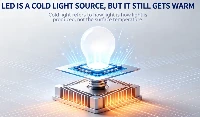
LED is a "Cold Light Source" – But It's Not Really Cold?
Have you ever had this experience: you buy a new LED bulb, leave it on for a few hours, then casually touch it – and it feels warm, maybe even a little hot. You think, "Wait, isn't LED supposed to be a cold light source? Did I get a fake one?"
Relax. Your light is fine. The problem is that we've all misunderstood what "cold light source" actually means. Let's unpack this little piece of knowledge that almost everyone gets wrong.

"Cold" Doesn't Mean Chill – It Means "Not Heated to Glow"
The term "cold light source" does make it sound like the bulb should stay cool from end to end. But scientifically, the word "cold" refers to the emission mechanism, not the surface temperature of the bulb.
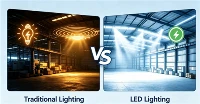
How does an incandescent bulb work? It passes electricity through a tungsten filament, heating it to over 2000°C until it glows white-hot, like a piece of iron in a forge. In that process, more than 90% of the electricity is turned into heat, and less than 10% becomes visible light. Touch an incandescent bulb while it's on – you'll get a burn.
What about an LED? It doesn't need to heat anything. It uses a semiconductor material where electrons "jump" between energy levels (band‑gap transitions). When they drop from a higher energy state to a lower one, they release energy directly as photons – light. The whole process skips the "heat‑first" step, so in principle, it does not rely on high temperatures to produce light. That's why it's called a "cold" light source.
Think of it this way: an incandescent bulb is like a fireplace – you have to get it red‑hot to get any light. An LED is like a firefly – it produces light through a chemical reaction in its body, no fire needed. But that doesn't mean the firefly doesn't produce a little heat – it does, just not as the source of its glow.
So Where Does LED's Heat Come From? Why Does It Still Get Warm?
If it doesn't produce light by heat, then why does it feel hot? The answer is electrical losses.
LEDs are much more efficient than incandescent bulbs, but they're still far from 100% efficient. Of the electrical energy you put in, a good portion is converted into light, but the rest – roughly 30‑40% – turns into Joule heat inside the LED chip itself. That chip is tiny (only a few square millimetres), and the power density is extremely high. If that heat isn't carried away quickly, the chip temperature can shoot up to over 100°C within seconds.
The warmth you feel on the bulb's housing is actually a good sign – it means the heat‑dissipation system is working hard to pull heat away from the chip and release it into the air. If the housing stayed stone‑cold, that would be more worrying – it would mean the heat is trapped inside, and the chip would soon overheat and fail.
Why Do All LEDs Need a Heat Sink? – It's Not Just a "Nice‑to‑Have", It's a Lifesaver
Take a look at any decent LED bulb. You'll see fins or ridges on the base or around the body – sometimes even a small fan, like on a computer CPU cooler. These aren't decoration; they're essential.
LED chips are extremely sensitive to temperature:
- For every 10°C rise in junction temperature, the luminous flux (brightness) drops by several percent.
- If the temperature goes above 85°C, the rated lifetime of 50,000 hours can plummet to less than 10,000 hours.
- Even higher, and the phosphor coating ages quickly, causing the colour to shift toward blue or green, or the chip simply "fades" to nothing.
So the heat sink doesn't "cool down" the LED in a magical way – its job is to move heat away as fast as possible, keeping the chip below its safe operating temperature (usually under 65°C at the chip surface). Without a proper heat sink, an LED is like being trapped in a steam room – it'll cook itself to death in no time.
How Can You Tell if an LED Light Has Good Heat Dissipation?
Next time you shop for LED bulbs, keep these tips in mind:
- Weight – For the same wattage, a heavier bulb usually means more metal (aluminium) for better heat sinking; a lighter one might be mostly plastic, which dissipates heat poorly.
- Temperature feel – After running for half an hour, touch the body (safely). If it's pleasantly warm, that's good – heat is being conducted out. If it's too hot to hold, the design may be inadequate. If it's completely cool, either the wattage is very low, or the heat is trapped inside – be cautious.
- Materials – Look for aluminium alloy heat sinks – they conduct heat much better than plastic or ceramic alternatives.
The Bottom Line
Yes, an LED is a "cold light source" because it doesn't rely on incandescence – it doesn't need to get red‑hot to shine. But it absolutely generates heat, and it hates heat just as much as any other electronic component. The "cold" label is about physics, not about how it feels to your fingers.
So next time a friend says "LEDs don't get hot", feel free to share this article with them – and maybe ask them to touch their own working LED bulb. It'll be gently warm, as if to say: "I may not glow by fire, but I'm working hard to stay cool – just so I can be your light for years to come."
Don't be fooled by the word "cold". Choosing an LED with good heat management is how you truly take care of it – and of your own peace of mind. 💡