LED stands for light-emitting diode and is a modern solution for artificial lighting. These lights continue to gain popularity because of their incredible features. LED lights have toppled down halogen and incandescent bulbs because of their better light quality and excellent benefits. If you’re conscious about using products that are harmful to the environment, then you really need to get LED lights. They do not contain any mercury or produce UV, making them eco-friendly. Aside from that, they are energy efficient, which can help you save up to 90% on your energy cost. Plus, it has an average lifespan of at least 20,000 hours, meaning that you won’t be worrying about changing bulbs for years. So, why don’t you start looking around your home and see which can switch to LED lights?
How important is the Base?
When talking about bulbs, we picture a round top and a screw bottom. What you have in mind is called the Edison bulb, which is named after its inventor Thomas Edison. But, did you know there are a lot of different fittings that you can get? Most people just look at the wattage and lumens when buying bulbs, but they forget the most important thing, the base. How can you make your LED lights work if they do not fit the bulb socket? To help you with this, we made a list of the most common household bulbs you are probably using.
Common Household Bulbs:
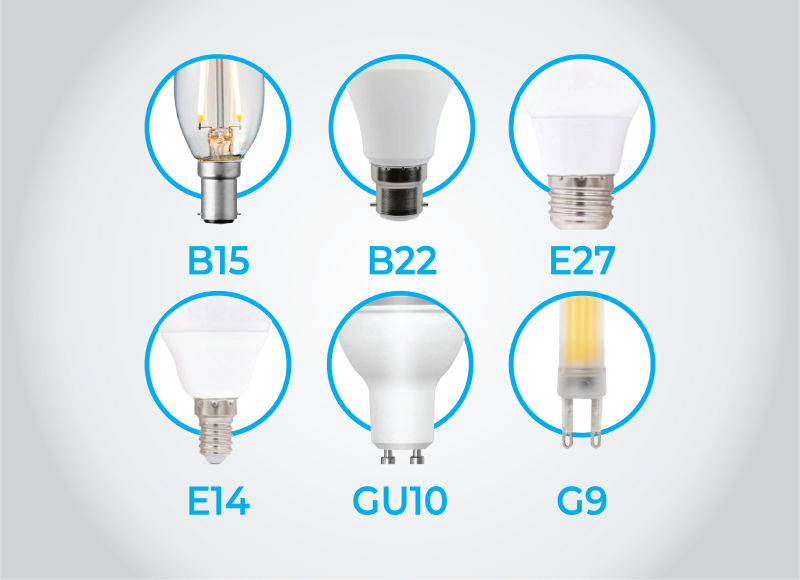
B15 – They are also called Small Bayonet Cap and are commonly used for mains voltage lamps. They have a base diameter of 15mm and can also be found in low voltage LED lights.
B22 – They are also called Bayonet Cap and are used for most regular light bulbs. It’s the bigger and more common version of the B15 with its 22mm diameter.
E14 – They are also known as Small Edison Screw and are usually used for small decorative fittings. It has a 14mm diameter and is mainly seen in chandeliers and appliance light bulbs. These bulbs are predominantly used in the UK and Europe.
E27 – This is the most popular Edison Screw variation and is used worldwide in various applications. It has a diameter of 27mm and is primarily used in the UK and Europe. Do not confuse this with the E26 bulb that is commonly used in the US.
GU10 – This type of base has two pins that twist and lock the bulb into the fitting. GU10 LED bulbs are primarily used in the UK. They are mains powered 240V, which was first made for halogens but now used for LEDs.
G9 – This base is designed explicitly for 240V capsule light bulbs. To measure this light bulb, you need to determine the distance between the centre points of the pins. The distance of this bulb is 9mm.