How to Choose an LED Stadium Light

Abstract
This technical document provides a comprehensive analysis of LED stadium light systems for professional and large-scale amateur sports facilities. It details critical photometric and electrical specifications, relevant international illumination standards, and a systematic methodology for evaluating and selecting fixtures. The content is structured to assist engineers, facility managers, and procurement officials in making evidence-based decisions grounded in technical data and established industry benchmarks.
Technical Specifications and Performance Benchmarks for Professional LED Stadium Lights
The selection of an LED stadium lighting system must begin with an evaluation of its core technical parameters. These specifications directly determine the system's ability to meet the rigorous demands of sports competition, broadcasting, and spectator experience.
Luminous Flux, Efficacy, and System Output: Luminous flux, measured in lumens (lm), quantifies the total visible light emitted by a fixture. The luminous efficacy, expressed in lumens per watt (lm/W), indicates energy conversion efficiency. For professional stadium applications, fixtures typically deliver 130-170 lm/W. A 1500W fixture with an efficacy of 160 lm/W produces approximately 240,000 lumens. The total system luminous flux must be sufficient to cover the playing area at required illuminance levels.
Optical Distribution and Beam Control: Beam distribution, classified by standardized systems such as IESNA (IES of North America) or BZ (British Zonal), is critical for field coverage and spill light control. Professional stadium lights utilize asymmetric (Type III, IV, V) or batwing distributions. These optical systems allow light to be projected from perimeter poles with high precision, maximizing useful light on the field while minimizing glare for players and light trespass into surrounding areas. Advanced secondary optics, such as compound curved reflectors or total internal reflection (TIR) lenses, are employed to shape the beam.
Colorimetric Parameters and Flicker: For television broadcast and player visual acuity, color rendering and consistency are paramount. The Color Rendering Index (CRI, Ra) should be ≥80, with a positive R9 value (saturated red) being increasingly important. Correlated Color Temperature (CCT) typically ranges from 4000K to 5700K, with 5000K being a common standard for professional venues. The system must be flicker-free, meeting standards such as IEEE 1789-2015, to prevent issues with high-speed cameras and ensure visual comfort.
Table 1: Key Performance Specifications for Professional-Grade LED Stadium Lights
|
Specification Category |
Parameter Range / Standard |
Significance & Impact |
|---|---|---|
|
Electrical & Efficacy |
Power: 500W – 2000W+; Efficacy: 130 – 170+ lm/W |
Determines total system output and energy consumption. Higher efficacy reduces operational cost. |
|
Photometric |
Luminous Flux: 65,000–350,000+ lm per fixture; Beam Type: IES Type III-V |
Directly impacts field coverage, uniformity, and throw distance from mounting poles. |
|
Color Quality |
CRI (Ra): ≥80 (≥90 for HDTV); R9: >0; CCT: 4000K – 5700K |
Essential for accurate color reproduction for broadcast, player performance, and spectator experience. |
|
Lifetime & Reliability |
L70/B50: 50,000–100,000 hours; Ingress Protection: IP65/IP66 minimum |
Predicts long-term performance and maintenance requirements. IP rating ensures environmental durability. |
|
Thermal & Electrical |
Operating Temperature: -40°C to +50°C; THD: <20%; Surge Protection: ≥10 kV |
Ensures stable operation in diverse climates, protects power quality, and safeguards against lightning. |
|
Control Compatibility |
Dimming: 0-10V, DALI, or proprietary protocols; Networked Controls |
Enables energy-saving scenarios (practice, maintenance), dynamic lighting shows, and centralized management. |
Industry Standards and Classification Systems for Illumination
Designing a compliant LED stadium lighting installation necessitates strict adherence to published international and national standards. These documents define the required illuminance levels, uniformity ratios, and glare limits based on the sport and level of play.
IES and International Classification Framework: The Illuminating Engineering Society's *ANSI/IES RP-6-22: Sports and Recreational Area Lighting* is the principal guideline in North America. It classifies facilities from Class I (Professional/Major National TV) to Class IV (Training/Recreational). Similar standards exist globally, such as UEFA's Football Stadium Lighting Guide for European soccer and the FIFA Quality Programme for Football Turf (Lighting). These standards specify maintained horizontal and vertical illuminance (in lux or footcandles) and uniformity ratios (U1 = E_min/E_avg; U2 = E_min/E_max).
Broadcast Requirements (HDTV & 4K/UHD): Broadcast standards, such as those from the International Telecommunication Union (ITR-R BT.2020) and major broadcasters, impose the most stringent requirements. These focus on high vertical illuminance levels (often >2000 lux on main camera planes) to eliminate shadows on players' faces, exceptional uniformity to prevent camera iris fluctuations, and specific color temperature and rendering for accurate color capture.
Design Methodology and Compliance Verification via Photometric Analysis
A professional lighting design is validated through a computer-simulated photometric study, which is mandatory for any Class I-III project. This study acts as a performance guarantee.
Case Study: A Class II Collegiate Football Stadium
Project Scope: Design for a standard NCAA football field (360 ft x 160 ft) to meet IES Class II (Collegiate/Varsity) standards for competition and regional TV broadcast.
Design Parameters: Target maintained horizontal illuminance of 500 lux (approx. 46 fc), uniformity U2 > 0.70. Mounting height: 80 ft poles.
Proposed System & Simulation Results:
Fixture: 1200W asymmetric LED floodlight (150 lm/W efficacy).
Layout: Eight (8) perimeter poles, four fixtures per pole.
Simulation Results Summary:
Average Horizontal Illuminance (Eh,avg): 525 lux
Uniformity (U2): 0.73
Average Vertical Illuminance (Ev,avg) - Main Camera Side: 750 lux
Glare Rating (GR): Calculated maximum of 48 (<50 limit)
Compliance Verification: The photometric study, conducted in software like Dialux evo or AGi32, generates point-by-point illuminance grids, iso-contour plots, and false-color renderings, proving compliance before installation.
Key Selection Criteria Beyond Luminous Output
Several factors beyond raw lumen output determine the long-term success of a stadium LED lighting project.
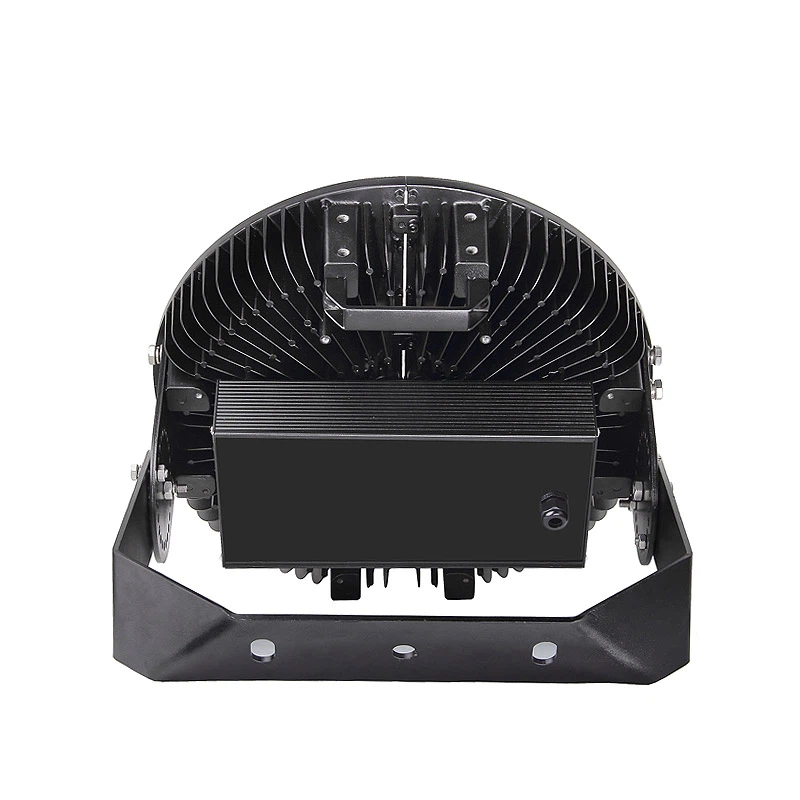
Thermal Management and Lifespan Assurance: The declared L70/B50 lifetime (time until 70% of initial light output for 50% of fixtures) is contingent on effective thermal management. High-quality fixtures utilize die-cast aluminum housings with extensive, optimized heat sink fins to maintain LED junction temperatures below critical thresholds, ensuring stable photometric and color performance over the product's lifetime.
Robustness and Maintenance Considerations: Fixtures must withstand harsh outdoor environments, including high winds, rain, and thermal cycling. Materials and finishes must offer high corrosion resistance. Design for maintainability is crucial; features like tool-less access to internal components, modular driver compartments, and options for interchangeable lenses or reflectors reduce long-term operational costs.
Glossary of Technical Terms
Luminous Flux (Φv): The total quantity of visible light emitted by a source, measured in lumens (lm).
Luminous Efficacy: The ratio of luminous flux (lm) to electrical power input (W), measured in lm/W. It indicates the energy efficiency of the light source.
Illuminance (E): The amount of luminous flux falling on a surface per unit area. Measured in lux (lx, lm/m²) or footcandles (fc, lm/ft²).
Uniformity (U1, U2): Ratios describing the evenness of illuminance on a surface. U1 = E_min / E_avg; U2 = E_min / E_max. Higher values indicate more uniform light.
Glare Rating (GR): A numerical metric (0-100) defined by CIE 112-1994 for evaluating discomfort glare from outdoor sports lighting installations. Lower values are better.
L70/B50 Lifetime: A measure of lumen maintenance where 50% of a population of light sources maintains at least 70% of their initial luminous output after the stated number of operating hours.

Common Industry Challenges and Technical Solutions
Challenge: Balancing High Vertical Illuminance for Broadcast with Glare Control. Achieving the high vertical lux levels required for HDTV broadcast, particularly on players' faces, often pushes lighting angles closer to horizontal, increasing glare for athletes.
Solution: Utilize fixtures with very precise, narrow beam optics (e.g., 10° x 30°) mounted at sufficient height. Combine this with a higher quantity of lower-wattage fixtures to build up vertical illuminance from multiple, less offensive angles, rather than relying on fewer, intensely glaring units.
Challenge: Ensuring Long-Term Performance Consistency (Lumen & Color Maintenance). Photometric designs are based on "initial" or "maintained" values. Poor thermal design can cause rapid lumen depreciation and chromaticity shift (Δu'v'), leading to under-illumination and color inconsistency across the field within a few years.
Solution: Select fixtures from manufacturers that provide third-party verified LM-80/LM-84 test reports for their LED packages and TM-21/TM-30 extrapolation reports. These reports provide data-driven predictions of lumen and color maintenance. The design should apply appropriate Light Loss Factors (LLF) based on this data.
References and Authoritative Sources
Illuminating Engineering Society. *ANSI/IES RP-6-22: Sports and Recreational Area Lighting*. New York: IES, 2022.
Union of European Football Associations (UEFA). UEFA Football Stadium Lighting Guide. Nyon: UEFA, 2022.
Fédération Internationale de Football Association (FIFA). FIFA Quality Programme for Football Turf: Lighting Handbook. Zurich: FIFA, 2015.
International Commission on Illumination (CIE). *CIE 112-1994: Glare Evaluation System for Use Within Outdoor Sports and Area Lighting*. Vienna: CIE, 1994.
National Electrical Manufacturers Association (NEMA). *NEMA LSD 75-2020: Recommendations for Evaluating Luminaire Light Output Depreciation*. Rosslyn: NEMA, 2020.
Zhaga Consortium. Book 18: LED Light Engines with Separate Control Gear. Zhaga, 2023. [Specifies interface standards for modular, maintainable LED systems].
https://www.benweilight.com/lighting-tube-bulb/led-stadium-flood-lights-1200w-equivalent.html