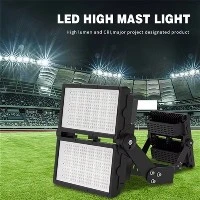
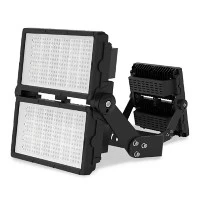
300-Watt Outdoor LED Stadium Lights: Elevating Play and Safety on Softball and Soccer Courts

Softball and soccer are sports defined by split-second decisions – whether a batter tracks a fastball, a goalkeeper dives for a penalty kick, or a fielder chases a loose ball. None of these moments are possible without reliable, high-quality illumination, especially for evening or nighttime games. Traditional stadium lighting, once dominated by metal halide or high-pressure sodium bulbs, often falls short: it's energy-inefficient, slow to reach full brightness, and prone to creating glare or dark spots that obscure play. Enter the 300-watt outdoor LED stadium light-a transformative solution engineered to meet the unique demands of softball and soccer courts. Combining intense brightness, uniform light distribution, and long-lasting durability, these fixtures are redefining how recreational and competitive fields are lit, enhancing both player performance and spectator experience while slashing operational costs.
At the heart of the 300-watt LED stadium light's appeal is its ability to deliver the precise illumination required for softball and soccer. Both sports have strict lighting standards set by organisations like the International Association of Athletics Federations (IAAF) and USA Softball, which mandate minimum light levels, uniformity ratios, and glare control to ensure fair play and safety. For recreational or community-level fields, the recommended horizontal illuminance (light on the playing surface) ranges from 100 to 200 lux; for competitive or tournament play, this jumps to 300 to 500 lux. A high-quality 300-watt LED stadium light typically outputs 24,000 to 30,000 lumens – enough to cover approximately 1,500 to 2,000 square feet of field at 200 lux, making it ideal for smaller softball diamonds or as part of a multi-fixture system for larger soccer pitches. Unlike metal halide bulbs, which lose 20-30% of their brightness within the first 1,000 hours, LEDs maintain consistent output over their lifespan, ensuring the field remains evenly lit season after season.
Uniformity is just as critical as brightness for softball and soccer, and 300-watt LED stadium lights excel here. Softball diamonds have distinct zones – the infield, outfield, and batter's box – each requiring consistent illumination to help players track the ball's trajectory. A poorly lit infield can make it hard for a shortstop to judge a ground ball, while uneven outfield lighting may cause a fielder to misjudge a fly ball's landing spot. Soccer fields, with their larger surface area (up to 8,100 square yards for professional pitches), demand even light across the entire field to prevent blind spots near the sidelines or goal areas. 300-watt LED fixtures address this with customisable beam angles – typically 60 to 120 degrees. Narrower beams (60-90 degrees) are used to target high-priority zones like the softball infield or soccer penalty areas, while wider beams (100-120 degrees) cover larger expanses like the softball outfield or soccer midfield. Many models also feature optical lenses or reflectors that distribute light evenly, reducing the uniformity ratio (the difference between the brightest and darkest spots) to 3:1 or better – well within the 4:1 maximum recommended for recreational sports.
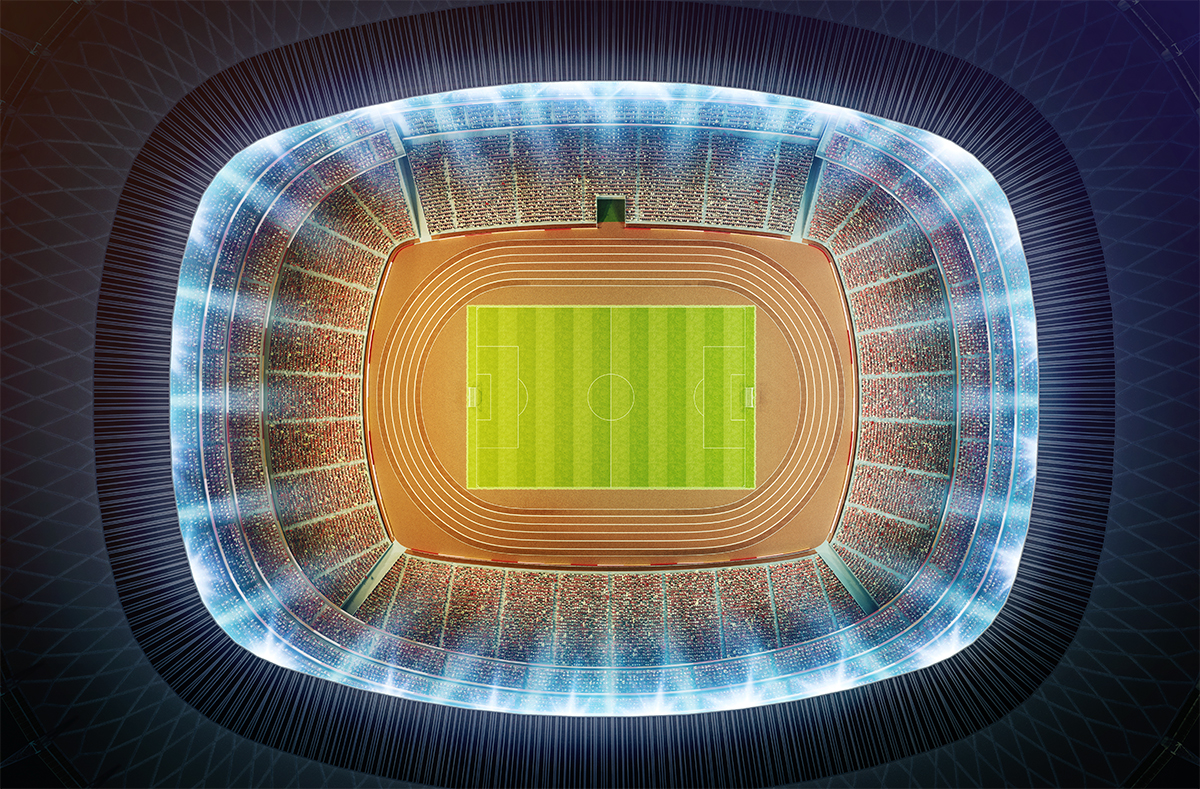
Glare reduction is another key advantage of 300-watt LED stadium lights, a critical factor for both players and spectators. Metal halide bulbs often produce harsh, uncontrolled glare that bounces off grass or synthetic turf, dazzling batters in softball or goalkeepers in soccer and making it hard for spectators to follow the action. LEDs, by contrast, use directional light emission, meaning they focus light downward onto the field rather than scattering it upward or outward. Premium 300-watt models also incorporate anti-glare shields or frosted lenses that soften light without reducing brightness, minimising discomfort for players and improving visibility. For softball, this is particularly important for batters, who rely on clear vision to track pitches travelling at 60+ miles per hour; for soccer, it helps goalkeepers see crosses and shots without squinting into the light. Spectators benefit too, as reduced glare makes it easier to watch games from the stands or bleachers, enhancing the overall viewing experience.
Energy efficiency is a game-changer for sports facilities, which often keep lights on for 4-8 hours per day, 5-7 days a week. 300-watt LED stadium lights consume a fraction of the energy of traditional alternatives. A 300-watt LED produces the same or more light than a 1,000-watt metal halide bulb – a 70% reduction in energy use. For a community softball complex with 8 fixtures running 6 hours a day, this translates to significant savings: at an average electricity rate of \(0.15 per kWh, the LEDs would cost approximately \)78 per month, compared to $260 for metal halides – a 70% reduction. Over a year, that's a savings of nearly \)2,200. For larger soccer facilities with 20+ fixtures, the savings can reach tens of thousands of dollars annually. These cost reductions are especially valuable for community parks, schools, and recreational leagues operating on tight budgets, as they free up funds for other improvements like field maintenance or equipment upgrades.
Durability and low maintenance are equally important for outdoor sports lighting, which must withstand harsh weather conditions – rain, snow, wind, and extreme temperatures – and constant exposure to dust, dirt, and even flying balls. 300-watt LED stadium lights are built to last, with most models featuring an IP65 or IP67 waterproof rating. IP65-rated fixtures are dust-tight and resistant to low-pressure water jets, making them suitable for most climates; IP67 models can withstand temporary submersion in water, ideal for regions with heavy rainfall or flooding. The housing is typically constructed from die-cast aluminium, which offers excellent corrosion resistance and heat dissipation – critical for LEDs, as excess heat shortens lifespan. Unlike metal halide bulbs, which need replacement every 10,000-20,000 hours, LEDs have a lifespan of 50,000+ hours (based on the L70 standard), meaning a 300-watt LED fixture will last 5-10 years with daily use. This eliminates the need for frequent bulb changes, which are not only costly but also dangerous, requiring workers to climb tall poles or use lifts to access fixtures. For schools or parks with limited maintenance staff, this low-upkeep design is a major advantage.
Instant-on performance and dimmability add further versatility to 300-watt LED stadium lights, addressing the unique needs of softball and soccer facilities. Metal halide bulbs take 10 to 15 minutes to reach full brightness and require a cool-down period before restarting, which is a frustration for fields that host back-to-back games or practice sessions. LEDs turn on at full brightness instantly, allowing facilities to switch lights on and off as needed without delays. Dimmable models offer even more control: fields can run lights at 50% brightness for practice sessions to save energy, then crank up to 100% for games. Some advanced fixtures also integrate with motion sensors or smart controls, automatically turning lights off when the field is unused – perfect for parks or schools that want to avoid wasted energy. For softball fields that host night tournaments, this instant-on and dimmable functionality ensures seamless transitions between games, keeping schedules on track.
The colour rendering index (CRI) is an often-overlooked but vital feature for sports lighting, and 300-watt LED stadium lights deliver here as well. CRI measures a light source's ability to accurately render colours, with a score of 100 being identical to natural sunlight. Traditional metal halide bulbs have a CRI of 60-70, which washes out colours – making it hard for softball players to distinguish between a white ball and the green grass or for soccer players to tell teammates apart by their jerseys. LEDs, by contrast, have a CRI of 80+ (with premium models reaching 90+), ensuring that colours appear vibrant and true. For softball, this means batters can track the white ball more easily against the field, while fielders can spot the ball's spin or trajectory with greater clarity. For soccer, it helps players identify passes and opponents quickly, reducing the risk of collisions. Spectators also benefit from a higher CRI, as it makes the game more visually engaging: colours pop, and details like player movements are easier to follow.

Real-world applications highlight the impact of 300-watt LED stadium lights on softball and soccer facilities. A community park in Ohio replaced 12 1,000-watt metal halide fixtures with 300-watt LEDs on its two softball diamonds. The park reported a 72% drop in monthly energy bills and noted that players complained less about glare and dark spots. A high school in California upgraded its soccer field to 16 300-watt LED lights, enabling it to host night games for the first time in years. Coaches praised the even lighting, saying it reduced player injuries from misjudged balls, while the athletic department saved $15,000 annually on energy and maintenance. A youth soccer league in Florida installed IP67-rated 300-watt LEDs on its four fields, and the fixtures remained fully functional even after a hurricane season that flooded parts of the park – something the old metal halide bulbs could not withstand.
While the initial cost of 300-watt LED stadium lights is higher than traditional bulbs, the total cost of ownership (TCO) makes them a smarter long-term investment. A typical 300-watt LED costs \(200-\)300, compared to \(50-\)100 for a metal halide bulb. However, when factoring in energy savings, reduced maintenance, and longer lifespan, the LED pays for itself in 1-2 years. Over a 10-year period, the TCO of a 300-watt LED is 70-80% lower than that of a metal halide fixture. For facilities planning long-term upgrades, this makes LEDs the clear economic choice.
In conclusion, 300-watt outdoor LED stadium lights are the ideal lighting solution for softball and soccer courts, combining the brightness, uniformity, and glare control required for optimal play with the energy efficiency and durability that facilities demand. They meet or exceed industry lighting standards, enhance player safety and performance, and deliver significant cost savings over time. Whether for a small community softball diamond or a large high school soccer field, these fixtures transform outdoor lighting from a necessary expense into an investment in better games, happier players, and more sustainable operations. As LED technology continues to advance, 300-watt stadium lights will remain at the forefront of sports lighting, proving that when it comes to illuminating the fields where we play, brighter, more efficient, and more reliable is always better.
Together, we make it better.
Shenzhen Benwei Lighting Technology Co.,Ltd
Mobile/Whatsapp :(+86)18673599565
Email:bwzm15@benweilighting.com
Skype: benweilight88
Web: www.benweilight.com
Add: F Building, Yuanfen Industrial Zone, Longhua, Bao'an District, Shenzhen, China