Multi‑Head LED Stadium Flood Lights: Why They Are the Top Choice for Venue Lighting
Upgrading the lighting in a large sports stadium is never as simple as swapping a few lamps. A standard football match requires lighting that meets the demanding standards of high‑definition television broadcasting – a minimum average vertical illuminance of 1400 lux on the field and a horizontal illuminance uniformity U₂ of at least 0.7. A professional event needs not just high brightness, but also uniform light, no shadows, low glare, and zone‑based control. Traditional metal halide (MH) lamps once dominated this market, but they suffer from high energy consumption, slow start‑up, short lifespan and frequent maintenance. LED flood lights, with their higher efficacy, precise light control and lower long‑term costs, are gradually replacing conventional solutions.
Why Do Sports Venues Need LED Flood Lights?
Traditional metal halide lamps have several persistent problems: they take several minutes after start‑up to reach stable brightness and cannot be turned on instantly; frequent switching greatly shortens their life; they have rapid lumen depreciation, often requiring replacement within one to two years; and most of the energy is lost as infrared heat, resulting in high power consumption and significant temperature rise. LED flood lights outperform them in all these aspects – instant start, over 50,000 hours of life, and energy savings of over 80%. More importantly, the multi‑head design with individually adjustable angles changes the lighting layout from "placing lights where they happen to shine" to "aiming each light precisely where it is needed", giving much more accurate field coverage.
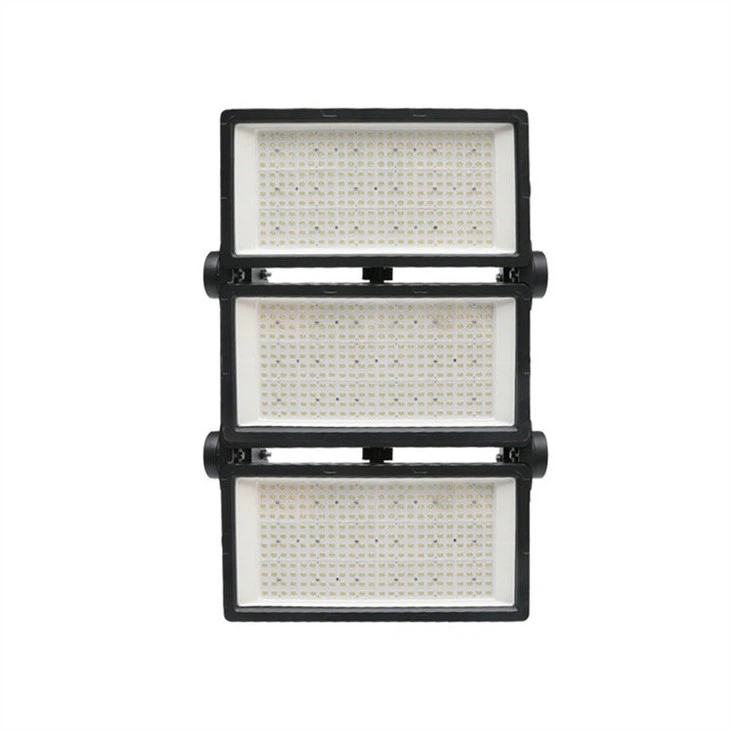
Model Comparison: Which One to Choose – 500W, 1000W or 1500W?
| Model | Power | Total Lumen Output | Efficacy per Head | Application Scenario |
|---|---|---|---|---|
| Single‑head | 500W | 65,000 lm | 130 lm/W | Small to medium stadiums, school playgrounds, training fields |
| Dual‑head | 1000W (500W×2) | 130,000 lm | 130 lm/W | Medium stadiums, sports centres, large squares |
| Triple‑head | 1500W (500W×3) | 195,000 lm | 130 lm/W | Professional football stadiums, multi‑purpose stadiums, major event venues |
Efficacy calculation: For the 1500W triple‑head model, 195,000 lm / 1500W = 130 lm/W, which meets the high‑efficacy standard of the LED industry. The default colour temperature is 5000K daylight white – ideal for high‑definition broadcasts and natural skin tone rendering – while custom options from 3000K to 6000K are available.
LED vs Metal Halide: Core Comparison
| Parameter | 1500W LED Flood Light | 4,500W Traditional Metal Halide |
|---|---|---|
| Actual power consumption | 1,500W | ~4,500W (including ballast losses) |
| Total lumen output | ≥195,000 lm | ~175,000 lm (lower after lumen depreciation) |
| Efficacy | ~130 lm/W | ~55 lm/W |
| Start‑up time | Instant (<0.5 sec) | 5–10 minutes warm‑up |
| Color Rendering Index (CRI) | >70 (sports grade) | ~65 |
| Rated lifespan | 50,000+ hours | 10,000–20,000 hours |
| Annual electricity cost (12h/day) | ~$2,000 | ~$6,000 |
| Maintenance frequency | Very low | Replace every 1–2 years |
Electricity cost calculation: Based on $0.15/kWh, 12 hours per day, 365 days per year. Traditional metal halide costs also include ballast losses (typically 10–15% of lamp power). Over five years, the LED solution costs about $10,000 in electricity, while metal halide costs about $30,000 – a saving of roughly $20,000 in electricity alone, not including labour and material costs for lamp replacement.
The comparison table clearly shows that LED flood lights offer enormous advantages in energy consumption and long‑term operating costs, with electricity savings of over 70%. The much longer light source life means extremely low replacement frequency – for stadiums where lights are installed on high masts or towers, the saved maintenance costs can be even more impressive than the electricity savings.
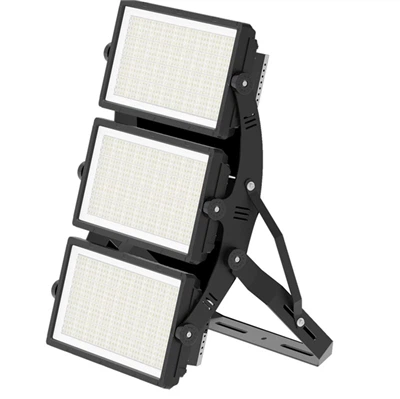
Core Advantages of Multi‑Head Design: Flexibility, Uniformity, Controllability
The most significant advantage of a multi‑head LED flood light is the individually adjustable angle on each head. In traditional large‑venue lighting, a fixed flood light typically illuminates only one predetermined area. Covering an entire field requires a large number of fixtures, often resulting in uneven brightness. The three‑head design allows each head to be independently adjusted with multiple beam angle options (15°/30°/60°/120°), achieving precise coverage – for example, the outer head uses a narrow beam to cover distant areas, while the middle head uses a wide beam for near areas, working together to create a highly uniform light field.
① Significantly improved lighting uniformity
Sports events have strict standards for illuminance uniformity. Independently adjustable heads mean that three lights on one pole can each cover different zones, eliminating the "dead spots" that a single head cannot address, and bringing the whole field's uniformity up to competition standards.
② Anti‑glare design meets event requirements
LED flood lights use deeply recessed light sources combined with precise optical design to keep the UGR (Unified Glare Rating) low. This is crucial for athletes running and jumping at high speed – protecting them from harsh glare – and also satisfies the demanding light quality requirements of television broadcasts.
③ Adaptable to multiple usage scenarios
A team training session, an amateur league match, and an international event with HD broadcasting all require completely different lighting solutions. An independent multi‑head control system allows the venue to flexibly adjust brightness and coverage according to needs – turning on only some heads for training, all heads for official matches, and even implementing zone control for large events, greatly improving energy efficiency.
How to Select the Right LED Flood Light for Your Stadium
Selection should be based on three main factors: venue classification, field dimensions, and pole height.
Selection by Venue Classification
| Venue Class | Typical Scenario | Recommended Total Power | Recommended Model | Reference Mounting Height |
|---|---|---|---|---|
| Amateur / Training | School playground, community sports field | 5,000–20,000W | 500W single‑head × 10–40 units | 8–12m |
| Professional (no HD broadcast) | Regional sports centre, county stadium | 20,000–50,000W | 1000W dual‑head × 20–50 units | 15–20m |
| Professional (HD broadcast) | Professional football stadium, multi‑purpose stadium | 50,000W+ | 1500W triple‑head × 30–80 units | 25–40m (mast mounted) |
| Large multi‑purpose venue | Multi‑sport centre, large athletics stadium | 80,000W+ | 1500W triple‑head × 60–120 units | 30–45m (mast array) |
When selecting, also pay close attention to lumen maintenance (L70/L80 data), colour temperature (5000K is mainstream for sports events), Color Rendering Index (professional events require CRI ≥80), and waterproof rating (outdoor venues need IP65 or higher). Benwei's flood light series covers power levels from 500W to 1500W, with flexible options for four beam angles (15°/30°/60°/120°), IP65 waterproof rating, wide voltage input (AC100‑480V), and custom colour temperature from 3000K to 6000K as well as higher CRI specifications – fully meeting the practical needs of all types of sports venues.
Conclusion
When energy efficiency is no longer the main concern, light quality and flexibility become the key battleground for sports venue lighting. LED flood lights, with their higher efficacy, better uniformity and lower long‑term operating costs, are comprehensively replacing traditional metal halide lamps and have become the preferred choice for professional stadium lighting. A good LED flood light is not just an energy‑saving replacement – it is a critical step in upgrading a venue from "being able to light up" to "professional‑grade lighting".
Looking for the right LED flood light solution for your stadium? Benwei offers multi‑head LED stadium flood lights from 500W to 1500W, with customisation options for power, beam angle, colour temperature and mounting type. 5‑year warranty, IP65 waterproof, full international certifications. Contact us for a free lighting design proposal and project quote.