Nine parameters for evaluating the quality of LEDs
1. LED current/voltage parameters (forward, reverse)
LEDs have typical PN junction volt-ampere characteristics. The passing current directly affects the luminous brightness of LEDs and is combined in PN series-parallel mode. The characteristics of the relevant LEDs must be matched, and their reverse electrical characteristics must also be considered in the AC working state. . Therefore, they must be tested for parameters such as forward current and forward voltage drop at the operating point, as well as reverse leakage current and reverse breakdown voltage.
2. Luminous flux and radiant flux of LED
The total electromagnetic energy emitted by an LED per unit time is called radiant flux, or optical power (W). For LED light sources for lighting, the visual effect of lighting is more concerned, that is, the part of the radiant flux emitted by the light source that can be perceived by the human eye, which is called luminous flux. The ratio of the radiant flux to the electrical power of the device represents the radiative efficiency of the LED.
3. LED light intensity distribution curve
The light intensity distribution curve is used to represent the distribution state of the light emitted by the LED in all directions in space. In lighting applications, the light intensity distribution is the most basic data when calculating the illuminance uniformity of the work surface and the spatial arrangement of LEDs. For LEDs whose spatial beams are rotationally symmetric distributions, it can be represented by a curve passing through the plane of the beam axis; for LEDs whose beams are elliptically distributed, the curves on two vertical planes passing through the beam axis and the long and short axes of the ellipse can be used. To represent; for asymmetric complex graphics, generally used to represent the plane curve of more than 6 cross-sections of the beam axis.
4. LED spectral power distribution
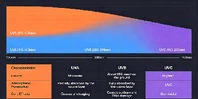
The spectral power distribution of an LED represents the function of the radiant power as a function of wavelength, which not only determines the color of the light, but also determines its luminous flux and color rendering index. Usually the relative spectral power distribution is represented by the text S(λ). When the spectral power drops to 50% of its value along both sides of the peak, the difference between the corresponding two wavelengths (Δλ=λ2-λ1) is the spectral band.
5. The chromaticity coordinates of LED
For the three primary colors red (R), green (G), and blue (B), x=R/(R+G+B), y=G/(R+G+B), z=(R+G+B) . Since x+y+z=1, only by giving the values of x and y, a color can be uniquely determined, which is usually called a chromaticity diagram. If x and y are used as the plane coordinate system, the x and y values of various colors in nature are measured by the colorimetric experiment method, and the chromaticity diagram can be obtained by drawing them in the coordinate plane. Any point on the tongue curve along the edge of the chromaticity diagram represents the hue of a certain wavelength of light, and any point within the curve represents the color of a certain mixed light that the human eye can see.
6. LED color temperature and color rendering index
For LEDs and other light sources whose luminous color is basically the same, the chromaticity coordinates can accurately express the apparent color of the light source, but the specific value is difficult to relate to the customary light color feeling. People often refer to the light color that is more orange-red as "warm color", and the more incandescent or slightly bluish color is called "cool color". Therefore, it is more intuitive to use color temperature to represent the light color of the light source.
7. Thermal performance of LED
The improvement of the luminous efficiency and power of LED lighting is one of the key issues in the development of the current LED industry. At the same time, the PN junction temperature of the LED and the heat dissipation of the case are particularly important, which are generally expressed by parameters such as thermal resistance, case temperature, and junction temperature.
8. LED radiation safety
At present, the International Electrotechnical Commission (IEC) equates LED products with the requirements of semiconductor lasers for radiation safety testing and demonstration. Because LED is a light-emitting device with narrow beam and high brightness, considering that its radiation may harm the retina of human eyes, international standards stipulate the limit requirements and test methods of effective radiation for LEDs used in different occasions. Currently in the European Union and the United States, the radiation safety of lighting LED products is implemented as a mandatory safety requirement.
9. LED reliability and life
Reliability index is used to measure the ability of LED to work normally in various environments. Life is a quality index to evaluate the usable cycle of LED products, usually expressed as effective life or end life. In lighting applications, the useful life refers to the time that the LED lasts when the luminous flux decays to a percentage (specified value) of the initial value under rated power conditions.
(1) Average lifespan: A batch of LEDs are lit at the same time. After a period of time, the proportion of non-lit LEDs reaches 50%.
(2) Economic lifespan: Considering the LED damage and light output attenuation at the same time, the time when the comprehensive output is reduced to a certain proportion, this proportion is 70% when used for outdoor light sources, and 80% when used for indoor light sources.

Shenzhen Benwei Lighting Technology Co., Ltd is a professional manufacturer in producing LED lighting products, Our main products T8 T5 LED Tube, LED Grow Light,Poultry LED Light,Tri-proof LED Light,LED Flood Light, LED Panel, LED Stadium Light, LED High Bay, LED Classing Room Light ,If you want to purchase a high-quality LED lighting products or have a more in-depth understanding of the application of LED lighting, please contact send us inquiry.