Recent research look into how lighting affects hens
According to two recent research, layer behavior is influenced by light wavelength, whereas broilers operate better under LED illumination than fluorescent lights.
Brazilian research examine illumination preferences for broilers
For the wellbeing and behavior of chickens, vision is crucial. According to Angélica Signor Mendes from the Technological Federal University of Paraná in Brazil and co-authors there, as well as at Purdue University in the US and Brazil's State University of Campinas, poultry have highly specialized visual systems and the majority of their behavior is mediated by vision.
They assessed the lighting preferences of broiler chickens exposed to various illumination sources and their production performance in a study1 that was published in the Journal of Applied Poultry Research.
Overall, birds raised under compact fluorescent lights fared worse than those exposed to light-emitting diode (LED) illumination (CFL). The feed efficiency of male broilers at seven days old under LED lighting was higher than it was for those at the same age under CFL lighting.
In the first trial, the researchers looked at how much birds preferred white and yellow LED illumination. Videos taken throughout the trial were used to determine the birds' preferences. In a second experiment, scientists looked at how broiler birds that had been exposed to LED and CFL performed.
The mortality rate, bird weight, daily weight increase, feed intake, and feed conversion were used to evaluate performance.
The hens distributed their time equally across surroundings with yellow and white LED lights, displaying no preference in their behavior. However, when exposed to white LED lights at 21, 28, and 35 days of life, birds ate more.
Mendes and his co-authors noted that, on general, birds exposed to LED lighting performed better in terms of output than did birds under CFL lighting. Male hens that were seven days old demonstrated improved feed conversion under LED light than they did under CFL illumination.
A Swiss research examines various light hues for laying hens.
According to the findings of an experiment in Switzerland2, laying hens under green light explored more, while red light made them less aggressive than white light. The findings also supported earlier research that indicated red light speeds up sexual development, however the impact was more a function of light wavelength than light intensity.
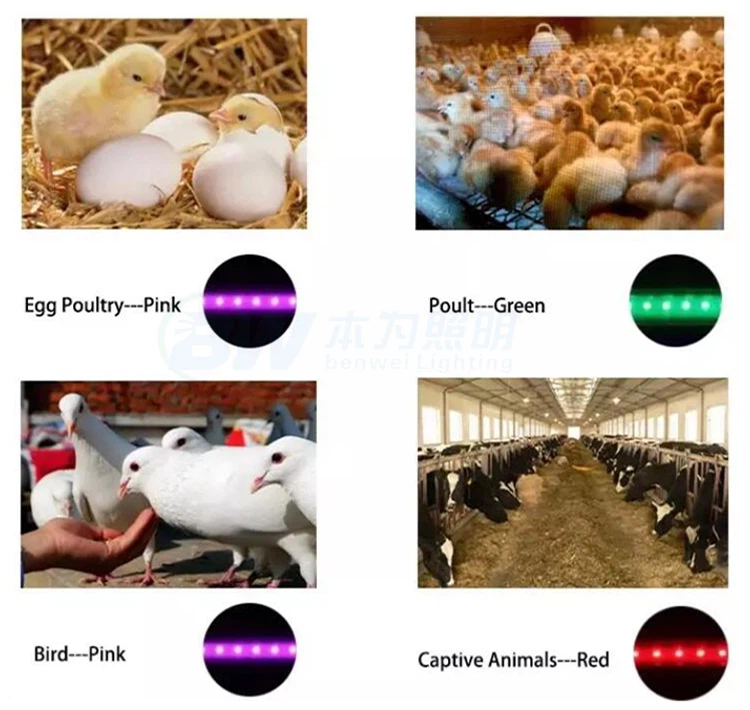
According to experts at Bern University of Applied Sciences, the optimum way for lighting poultry houses has been a problem for many years and is a topic that attracts a lot of attention as new systems become available. In their article published in Poultry Science, Beat Huber-Eicher and colleagues describe that poultry farmers are now employing colored LEDs to light hen houses more and more (for instance, in Germany, Austria, the Netherlands, and England). According to their assessment, all new systems in Switzerland now come with LEDs, most often green ones.
The benefits of LEDs over traditional illuminants are their great energy efficiency, extended lifespan, high reliability, and minimal maintenance costs. LEDs provide monochromatic light at various wavelengths.
They looked at how lighting using white, red, and green LEDs affected laying hen behavior and productivity metrics. In order for the chickens to perceive the light intensity in the three treatments equally, they were altered.
In similar compartments (5.0 x 3.3 meters) with a litter area, elevated perches, feed and water stations, and nest boxes, 24 groups of 25 laying hens were housed. They were first exposed to white LED for a two-week adaption period.
Eight compartments were selected at random and lighted with red LED (640nm) and eight more with green LED for the next four weeks (520nm). Throughout the trial's last two weeks, behavior was observed. Additionally, data on weight increase, feed intake, the beginning of ovulation, and laying efficiency were gathered.
The findings indicated that red light lowered aggression compared to white light, whereas green light had very small impacts on exploratory behavior. Huber-Eicher and colleagues found that the findings supported earlier studies showing that red light hastened the sexual development of laying hens. This study also showed that this impact was caused by the particular wavelength of light, not its intensity. They did, however, caution that it would be foolish to rule out another influence of light intensity.