Same LED Light, Why Does One Look Like a Flashlight and Another Like a Little Moon?
Have you ever noticed that two LED lights can look completely different? One goes on like a flashlight, throwing out a bright circle. Another is like a little moon, spreading soft light across a whole wall. The wattage is almost the same, but the effect is totally different. A big reason is the beam angle.

Beam Angle Is Really Just the "Width" of the Light Cone
Beam angle sounds technical, but you can think of it as how fat or thin the cone of light is. In the industry, it usually refers to the angle between the two sides when light intensity drops to 50% of its maximum-also called full width at half maximum, or FWHM. Common beam angles are 15°, 24°, 36°, 60°, and 120°. The smaller the number, the more concentrated the light. The larger the number, the more spread out it is.
Small Angles: The Spotlight Type
15° to 20° is like a stage spotlight. The light spot is small, the center is very bright, and it falls off quickly at the edges. It works beautifully for jewelry, displays, sculptures, and long-distance accent lighting. But if you use it for general lighting, the room will be bright in some spots and dark in others-like walking into an exhibition hall. Not ideal for everyday living.
Medium Angles: The All-Rounder for Spotlights
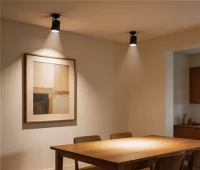
24° to 36° is a classic range for many spotlights. It's softer than a narrow beam, but still pulls attention to the focal point. Dining tables, coffee tables, wall art, and product displays usually work well in this range. For example, if you want to light a painting on the wall, 24° will make the painting more focused, while 36° will light the painting and some of the surrounding wall, giving a more relaxed atmosphere.
Wide Angles: The Soft, Even Ambience Makers
A bit wider, 36° to 60°, spreads the light out noticeably. It's common for wall washing, kitchen countertops, hallways, and local general lighting. It's not as "aggressive" as a narrow beam, and the light is more even-good for places where you want brightness without harsh glare.
60° to 120° is what you get with familiar downlights and panel lights. The light is broad, the edges are soft, and the whole space feels fairly even and comfortable. Above 120°, things like bulbs and LED strips are basically ambient and diffused lighting. They don't create a strong focal point, but they're soft overall.
Does a Smaller Angle Mean a Brighter Light?
Here's an easy misunderstanding: at the same wattage and luminous flux, a smaller angle doesn't mean the light saves energy, and it doesn't mean the total brightness is higher. It just concentrates the light into a smaller area, so the center illuminance is higher. A larger angle covers more area, but the illuminance per unit area is lower. One is like gathering light into a fist; the other is like spreading it out into a palm.
Change the Distance, and the Light Spot Changes Too
Distance also makes the light spot bigger. A rough formula: light spot diameter ≈ 2 × distance × tan(beam angle ÷ 2). For example, at a distance of 3 meters, a 24° beam creates a spot about 1.3 meters across, 36° about 2 meters, and 60° about 3.5 meters. So if the ceiling is high and the throw distance is long, you can go with a smaller angle. If the ceiling is low and you want even coverage, go with a larger angle. Don't just look at the light-look at where it's installed and how far it is from the object.
Glare and Labeling Have Their Own Little Quirks
Glare is related to beam angle too. A narrow beam has high center intensity, so it can be harsh if you look straight at it. A wide beam is softer, but if the fixture doesn't control glare well, it can still be uncomfortable when you look up. Also, different brands may label beam angle differently. Some specify it at 50% of peak intensity, others at 10%. So the actual edge of the light spot can vary. The edge is usually not a hard cut-it fades gradually.

How to Choose? Decide Whether You Want an "Accent" or "Overall Comfort"
If you want to highlight something, choose 15° to 24°. For dining tables, wall art, and product accents, choose 24° to 36°. For wall washing, hallways, and kitchen countertops, choose 36° to 60°. For general lighting throughout a room, choose 60° to 120°. With a high ceiling and long throw distance, go smaller. With a low ceiling and a desire for comfortable, even light, go larger. Remember one line: small angle concentrates, large angle spreads. Accent and ambience are two different ways of thinking.
Want to Get It Just Right? Send Us Your Space Details
If you're choosing LED lights, or you have a hotel, retail, or residential project that needs lighting layout, don't just focus on wattage and price. Send us your ceiling height, throw distance, what you want to light, and the atmosphere you want. We'll help you settle the beam angle, wattage, and installation position together. Feel free to send us an inquiry anytime-we'll help you get the light just right.