The Impact of LED Lighting on Pitaya Yield
This analysis synthesizes findings from multiple studies, including "India: LED Lighting Assists Pitaya Cultivation" and "Effect of LED Lighting on Flowering, Fruiting, Yield and Brix of Pitaya," to systematically examine the effects of LED supplemental lighting on pitaya (dragon fruit) yield, including its mechanisms and practical applications.
I. Pitaya's Biological Characteristics and Light Requirements
Pitaya (Hylocereus undulatus Britt) is a perennial vine of the Cactaceae family, classified as a typical tropical long-day plant. Its flower bud differentiation requires sufficient light, with a critical day length of approximately 12 hours. Under natural conditions, insufficient daylight hinders normal flower bud development, leading to reduced flowering cycles and lower yields.
In regions like Northern China, while greenhouse cultivation can meet the temperature requirements for pitaya, the short natural day length during spring and autumn severely limits flowering and productivity. Therefore, artificial supplemental lighting has become a key technology to overcome this limitation.
II. Mechanisms of LED Supplemental Lighting on Pitaya Yield Increase
1. Regulating Photoperiod to Promote Flower Bud Differentiation
Pitaya flowers and fruits in successive "cycles" or batches under suitable conditions. LED lighting extends the effective photoperiod, directly stimulating flower bud formation:
Spring Supplemental Lighting: Advances the first bud emergence to late February and the first flowering to late March, approximately 40 days earlier than non-supplemented plants.
Autumn Supplemental Lighting: Extends the final flowering period from late October to late November, effectively prolonging the fruiting season.
According to Gan Hailing's research, supplemental lighting increases the annual fruiting cycles by 4–5 batches in spring and 1–2 batches in autumn, significantly boosting yield per unit area.
2. Increasing Flower Bud Quantity and Quality
Experiments demonstrate that LED supplemental lighting significantly increases the number of flower buds per plant. Under four different LED types (L1–L4):
The maximum number of flower buds per plant reached 29.7, significantly higher than the control group.
The L1 lamp (dominant wavelength 596.2 nm, luminous efficacy 99.05 Lm/W) showed the best results, producing the highest number of flower buds and fruit set rate.
This increase in flower bud number lays the biological foundation for higher yields.
3. Enhancing Fruits per Plant and Overall Yield
Supplemental lighting not only increases the number of flowering cycles but also significantly raises the number of fruits set per plant:
Fruits per plant in supplemented groups reached 6.40–7.37, compared to only 1.40 in the control group.
The average yield per plant increased from 0.54 kg (control) to 2.37–2.82 kg.
The comprehensive yield increase rate reached 77%–81%, with the L1 treatment achieving the highest rate of 80.85%.
Notably, supplemental lighting did not significantly increase individual fruit weight, indicating that the yield boost primarily comes from a greater number of fruits rather than larger fruit size.
III. Performance Differences Among LED Light Sources
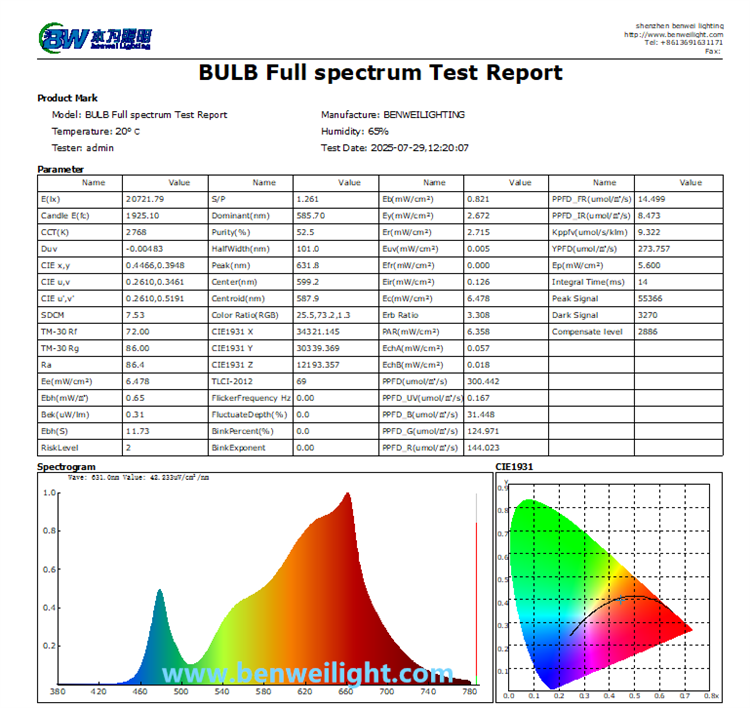
Research indicates that not all LED lights have the same effect on promoting flowering and yield in pitaya. Effectiveness is jointly influenced by light quality (wavelength), luminous flux, and luminous efficacy:
| Lamp Type | Dominant Wavelength (nm) | Luminous Flux (Lm) | Luminous Efficacy (Lm/W) | Flower Buds per Plant | Yield per Plant (kg) |
|---|---|---|---|---|---|
| L1 | 596.2 (Orange) | 1485.69 | 99.05 | 29.7 | 2.82 |
| L2 | 562.1 (Green-Yellow) | 1439.01 | 95.93 | 28.5 | 2.79 |
| L3 | 699.9 (Red) | 851.79 | 94.64 | 24.1 | 2.37 |
| L4 | 582.3 (Yellow) | 1360.50 | 90.70 | 28.3 | 2.74 |
| CK | - | - | - | 10.2 | 0.54 |
Conclusions:
L1 lamps in the orange light spectrum (around 596 nm) performed best, suggesting this wavelength aligns well with pitaya's photoreceptor absorption characteristics.
Higher luminous flux and efficacy correlate with better flower promotion effects.
L3 (Red light), despite reasonable efficacy, had significantly lower flower bud count and yield, likely due to its lower luminous flux.

IV. Practical Application Case Study and Economic Benefits
A practical application in Telangana, India, provides strong corroborating evidence:
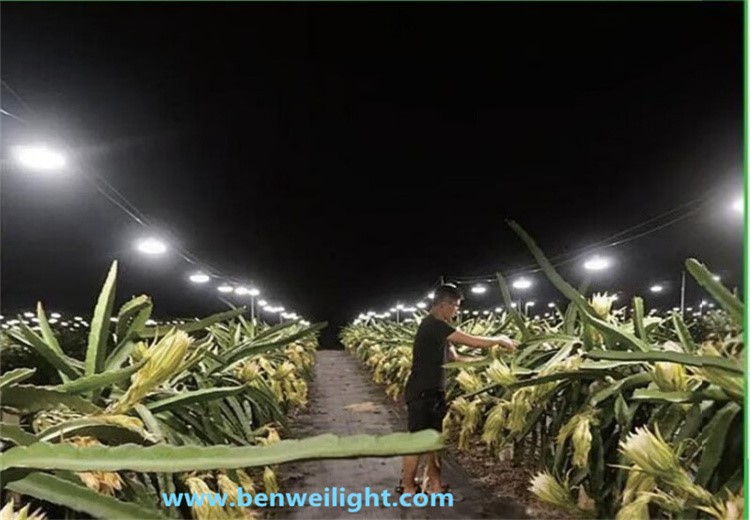
A grower installed hundreds of LED lamps on poles across a 3-hectare orchard, illuminating plants from multiple sides.
The off-season yield reached 1.6 tons/hectare. Although this was only 25% of the peak season yield, the off-season selling price was twice that of the peak season.
Implementing the system in phases before full rollout significantly enhanced the orchard's overall profitability.
This demonstrates that LED supplemental lighting not only increases total yield but also enables production timing adjustment and off-season marketing, leading to higher economic returns.

V. Impact of LED Lighting on Fruit Quality
It is important to note that while LED supplemental lighting significantly increases yield, its effect on intrinsic fruit quality is limited:
The Brix level (soluble solids content) across treatment groups remained between 19.21%–20.37%, showing no significant difference from the control group, and was sometimes slightly lower.
This suggests the lighting primarily promotes reproductive growth but does not significantly enhance photosynthate accumulation or sugar conversion.
With more fruits competing for the same total nutrient pool, the nutrient allocation per fruit may decrease, potentially leading to a slight reduction in individual fruit sugar content.
VI. Recommendations and Directions for Technical Optimization
Optimal Light Source Parameters: Recommended specs include luminous efficacy >95 Lm/W, luminous flux >1400 Lm, and a dominant wavelength around 596 nm (Orange light).
Scientific Layout and Installation:
Install lamps approximately 1.5 meters apart, 80–100 cm above the plant canopy.
Prevent interference between different light zones using partitions or shading screens if necessary.
Lighting Schedule Management:
Spring: Early February to Mid-April, daily from 18:00 to 22:00.
Autumn: Mid-August to Mid-October, daily from 19:00 to 23:00.
Integrated Agronomic Practices:
Supplemental lighting should be combined with balanced water and fertilizer management to prevent nutrient deficiency due to increased fruit set.
Integrate temperature control, such as providing slight heating in late autumn to sustain bud development.
Focus on Energy Efficiency and Cost-Effectiveness:
Select high-efficacy LEDs to reduce operational costs.
Consider integrating solar power systems for energy self-sufficiency.
VII. Conclusion
LED supplemental lighting technology, by extending the photoperiod, promoting flower bud differentiation, and increasing fruiting cycles, can significantly enhance pitaya yield by over 80%. It also enables production season adjustment, improving overall cultivation profitability. Future efforts should focus on optimizing light spectrum ratios, enhancing light-temperature synergy, and incorporating intelligent control systems to develop efficient and energy-saving supplemental lighting production protocols for pitaya, facilitating stable and high yields in non-traditional growing regions.
This analysis integrates case studies and experimental results published in 'China Fruit News' (2023) and 'Shaanxi Journal of Agricultural Sciences' (2022). It is intended for agricultural research and production reference. Practical application should be adjusted according to local climate and cultivar characteristics.
Tel/Whatsapp:+8619972563753
Email:bwzm12@benweilighting.com
Skype:bwzm32
Web:https://www.benweilight.com/