The Role and Application Prospects of UVC-LED Lamps in Water Sterilization
1. Introduction: A Technological Shift in Water Disinfection
In the fields of drinking water safety, industrial fluid processing, and daily water disinfection, ultraviolet (UV) disinfection technology is indispensable due to its high efficiency, absence of secondary pollution, and lack of disinfection by-products. For decades, traditional low-pressure mercury lamps, with their mature technology and stable 254-nanometer UV output, have dominated the market. However, the inherent drawbacks of mercury lamps-environmental risks from mercury content, fragility, long warm-up times, large size, and relatively high energy consumption-have led to their phased elimination under the global environmental framework of the Minamata Convention. Concurrently, technological advancements have spurred the development of a new generation of disinfection light sources: Deep Ultraviolet Light-Emitting Diodes based on aluminium gallium nitride materials. UVC-LEDs are leading water disinfection technology into a new era characterized by environmental friendliness and intelligence.
2. The Core Sterilization Mechanism of UVC-LED
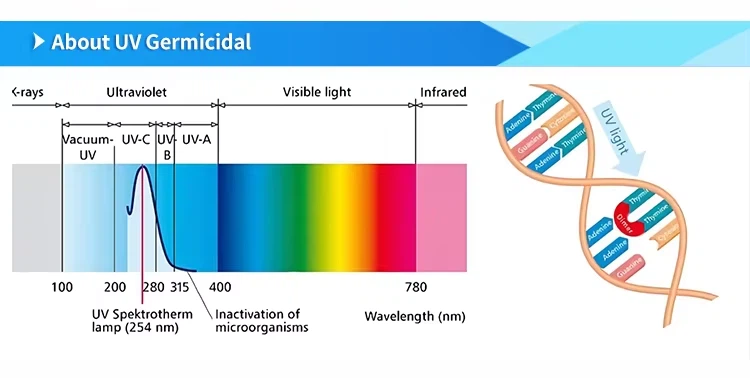
The fundamental action of UVC-LEDs lies in their photochemical inactivation effect on microorganisms. The ultraviolet light they emit, particularly photons near the 265 nm wavelength, is highly absorbed by the genetic material-DNA and RNA-of microorganisms (such as bacteria, viruses, and spores).
Destruction of Genetic Material: When DNA/RNA absorbs UVC photons, it causes adjacent thymine or uracil bases to form covalent bonds, creating dimers. This structural damage is like casting a "fog" over the blueprint for genetic code replication, preventing microorganisms from replicating and synthesizing proteins normally, thereby rendering them inactive and achieving sterilization.
Dose Determines Efficacy: The effectiveness of UV sterilization is not a simple matter of "on" or "off" but is determined by the UV dose. The dose is the product of irradiance and exposure time. The literature emphasizes that while inactivated microorganisms cannot revive under a sufficient dose, sub-lethal doses may allow some microbes to reactivate via photorepair mechanisms. This establishes the core design principle for UVC-LED sterilization equipment: it must ensure that the cumulative UV dose received by water flowing through the sterilization chamber exceeds the inactivation threshold for the target microorganisms.

3. The Technical Advantages and Functional Manifestations of UVC-LED vs. Traditional Mercury Lamps
UVC-LEDs represent not merely an "LED-ification" of the light source but a systemic transformation, with advantages manifested across multiple dimensions:
Environmental Friendliness and Safety: The complete elimination of mercury pollution risk is the most fundamental competitive advantage of UVC-LEDs, fully aligning with global sustainable development trends.
System Integration and Design Flexibility:
Miniaturization: UVC-LEDs can be over 80% smaller in volume than traditional mercury lamps, allowing them to be easily embedded into space-constrained devices like smart home water purifiers, portable water bottles, and automatic coffee machines.
Instant On/Off: They require no warm-up time, reaching full power output immediately upon activation and turning off instantly, facilitating on-demand disinfection, intelligent control, and energy savings.
Directional Emission: The inherent directional nature of LED light output facilitates efficient optical design, allowing for effective collaboration with lenses and reflectors to concentrate optical energy into the target water flow area.

4. The Key Roles and Technical Challenges in UVC-LED Water Sterilization System Design
Despite their clear advantages, several technical challenges must be overcome for UVC-LEDs to function ideally in practical applications, which is the focus of the research in the provided literature.
The Role of Optical Design and Light Concentration:
Challenge: UVC-LED chips typically have a large divergence angle, and their irradiance decreases exponentially with propagation distance. Direct irradiation inside a pipe can lead to uneven energy distribution, with insufficient doses at the edges, severely compromising sterilization efficiency.
Solution: The study utilized optical simulation software for optimized design, employing aluminum-coated reflectors to collimate the light. Simulation results showed that after using reflectors, the minimum irradiance on the receiving surface was even greater than the maximum irradiance achieved with bare LED chips, while the maximum irradiance increased approximately fourfold. This optical design ensures uniformity and high intensity of the light field within the chamber, which is the primary step in guaranteeing an adequate sterilization dose.
The Role of Fluidic Structure Design in Extending Exposure Time:
Challenge: Within a given chamber volume, a higher flow rate results in a shorter hydraulic retention time, potentially leading to an insufficient UV dose.
Solution: The literature innovatively designed a flow-promoting device and flow rectification structure. This structure divides the incoming water into multiple rectified channels after it enters the inlet, effectively reducing the flow velocity and guiding water from the edges towards the high-irradiance central zone near the UVC-LEDs. This design ingeniously transforms "laminar flow" into "turbulent or mixed flow," increasing the average exposure time of the water by 1.5 to 2.0 times while also raising the average irradiance, thereby doubly ensuring the sterilization dose.
The Role of Modular Series Connection in Power and Flow Scalability:
Challenge: The processing capacity of a single sterilization module is limited by the power density of individual UVC-LEDs and thermal dissipation issues.
Solution: The paper proposes a modular series connection scheme. The research indicates that one optimized sterilization module (with a 120 mm diameter, 40 mm length, and 13 UVC-LEDs) can handle a flow rate of 6 L/min, providing a sterilization dose of approximately 40 mJ/cm². By connecting multiple modules in series, the total sterilization task (i.e., the required UV dose) can be distributed across each sequential module. For instance, connecting two modules in series can increase the processing flow rate to 12 L/min, and multiple modules can meet the requirements for large flow rates exceeding 20 L/min. This modular architecture provides the system with high flexibility and scalability.

5. Current Limitations and Future Development Directions
The literature also objectively points out the current gaps between UVC-LED technology and traditional mercury lamp systems, as well as future directions for breakthrough:
Enhancing Power Density and Managing Thermal Dissipation: The current single-watt output power and wall-plug efficiency of UVC-LEDs still need improvement, with a significant portion of electrical energy converting into heat. Future efforts require the development of high-density packaging processes and innovative micro-channel cooling technologies to control junction temperature fluctuations within ±5°C, ensuring stable optical output and device longevity.
Establishing Comprehensive Standards: There is a need to establish complete industry standards covering irradiation dose benchmarks, biosafety protocols, and energy efficiency evaluation systems to regulate the market and promote healthy technological development.
Reducing Costs: The current cost of UVC-LEDs remains higher than that of traditional mercury lamps. Reducing manufacturing costs through mass production and material innovation is key to widespread adoption.

6. Conclusion
The role of UVC-LED lamps in water sterilization extends far beyond merely replacing mercury lamps as a light source. They represent a more environmentally friendly, flexible, and intelligent water disinfection solution. Leveraging their inherent photochemical inactivation mechanism, and synergized with advanced optical design, innovative fluidic structures, and a modular system architecture, UVC-LEDs can effectively overcome initial technical bottlenecks to achieve efficient and reliable inactivation of microorganisms in water.
Although challenges remain in matching the absolute flow capacity and cost of traditional technology, the immense advantages of being mercury-free, instant-start, and design-flexible give UVC-LEDs limitless application prospects across a broad spectrum, from household portable devices to large-scale industrial water treatment. With continued advancements in materials science, optical engineering, and thermal management technologies, UVC-LEDs are poised to become a cornerstone technology in the future of water safety, making significant contributions to global drinking water security and environmental protection.