Health problems
The two most well-known adverse consequences of excessive ultraviolet (UV) exposure on human health are sunburn and tanning (DWD, 2015). Long-term exposure to UV radiation can have a degenerative effect on blood vessels, fibrous tissues, and cells, which can eventually result in non-melanoma skin cancer. Malignant melanoma, a more dangerous form of skin cancer and one of the leading causes of cancer-related death, is associated to repeated exposure to high levels of UV radiation that produces sunburn, particularly in children (DWD, 2015), especially in people with skin types that are prone to burning (IARC, n.d.).
Long-term UV radiation exposure contributes to the development of cataracts and other eye conditions that account for a significant share of global visual impairment. Light sensitivity can also cause abnormal skin responses including photodermatoses and drug-induced phototoxic reactions (Lucas et al., 2019).
However, tiny levels of UV light are crucial for the production of vitamin D, which is necessary for bone health and immunological function and has advantages for skin conditions like psoriasis (SERC, n.d). (Lucas et al., 2019). As a result, modest sun exposure is good for your health, especially in higher latitudes. The health effects of exposure to UV radiation are summarized in the WHO et al. 2002 "Global Solar UV Index - A Practical Guide."
Observed outcomes
Malignant melanoma incidence has increased among fair-skinned populations during the past few decades, mostly as a result of individual sun exposure behaviors. UV radiation may be responsible for 76% of new instances of melanoma worldwide, particularly in North America, Europe, and Oceania. In 2018, the countries with the greatest number of new melanoma cases per 100,000 people were Norway, the Netherlands, Denmark, Sweden, and Germany. More than 20,000 people in Europe lose their lives to melanoma each year. Prolonged exposure to UV radiation has effects on the skin, but it is also linked to a significant amount of global vision impairment.
projected outcomes
Changes in the stratospheric ozone and changes in the earth's climate typically have an impact on UV radiation. More UVB (the higher-frequency, more dangerous kind of UV) may now reach the Earth's surface due to a decrease in stratospheric ozone. On the other hand, a reduction in UV light penetration is caused by climate change-related increases in cloud cover, pollution, dust, smoke from wildfires, and other airborne and waterborne particles.
Over the past few decades, UV radiation patterns have varied greatly across Europe. While UV radiation has been trending upward for southern and central Europe during the 1990s, it has been trending downward for higher latitudes, with cloud cover and aerosols (small solid or liquid particles in the air) influencing these patterns. Changes in aerosols were discovered to be the primary cause of decadal fluctuations in the amount of surface solar radiation reaching the Earth's surface in central Europe between 1947 and 2017. (Wild et al., 2021). Data collected at four European sites between 1996 and 2017 further shows that variations in cloudiness and surface albedo (the percentage of sunlight reflected by the earth's surface) are also important contributors to long-term changes in UV, with changes in total ozone having less of an impact. The erythemal daily dosage of UV radiation increased by up to 5-8% each decade in Eastern Europe between 1979 and 2015 as a result of both a decline in total ozone and a rise in cloud cover.
UV response in individuals and ecosystems is changing as a result of climate change. In the Nordic region, abnormally lengthy periods of clear sky and observed dry and warm temperatures appear to be the primary causes of the summer's extraordinarily high UVI readings. These extraordinary circumstances are a result of record-breaking heat waves that have been happening more regularly in recent years and have significantly affected portions of central and northern Europe. Investigations are being conducted to determine the underlying cause of the Arctic's warming and the rise in heat waves.
Forecasts of future regional UV radiation under climate change are primarily influenced by variations in clouds, aerosol and water vapour, and stratospheric ozone. Low confidence is given to an increase in surface radiation for Central Europe in the IPCC Assessment Report 6 due in part to differences in cloud cover across global and regional models as well as water vapor. However, regional and global studies show that there is only a moderate degree of certainty that radiation will increase over Southern Europe and decrease over Northern Europe.
In addition, the increased time spent outside and the shedding of protective gear brought on by rising temperatures as a result of climate change increase UV radiation exposure and the risk of skin cancer. Nevertheless, individuals spend less time outside during extremely high temperatures than they do during mild temperature rises, which lowers their exposure to UV light. The consequences of human behavior in reaction to temperature rises are probably a more significant determinant for skin cancer rates than the increase in UV radiation itself, notwithstanding the difficulty of predicting social behaviors.
Regulatory measures
A two-pronged approach to policy is used to avoid the harmful effects of UV radiation on human health. On the one hand, it aims to lessen UV radiation itself, and on the other, it raises public knowledge of the health hazards associated with UV exposure. First, the reduction of stratospheric ozone depletion is a goal of both the EU's 2009 "Ozone Regulation" and the 1987 Montreal Protocol. As a result of these laws, use of ozone-depleting compounds has decreased both globally and in the EU, which has already achieved its Montreal Protocol targets but is still aggressively phasing them out. The size of the ozone hole, or the area of the stratosphere above the Antarctic that is most severely ozone deficient, appears to be leveling off as a result. To lessen the usage of ozone-depleting compounds globally, additional work must be done.
Second, there are global educational programs being conducted to increase public knowledge of the risks linked to excessive UV exposure. As an illustration, the INTERSUN Programme, a partnership between the World Health Organization, the United Nations Environment Programme, the World Meteorological Organization, the International Agency on Cancer Research, and the International Commission on Non-Ionizing Radiation Protection, promotes and evaluates research on the health effects of UV radiation and develops an appropriate response through guidelines, recommendations, and information dissemination (WHO, N.D.). To help customers make educated decisions, the European Commission made a guideline on the labeling of sunscreen products in 2006.
Many EU member states offer UV Index (UVI) forecasts and related health warnings at the national level. During the summer, the UVI is frequently mentioned in newspapers, on TV, and on the radio along with the weather prediction. Many European nations' meteorological services offer UVI predictions in their respective national languages (see examples here). The German Meteorological Service, the Dutch Tropospheric Emission Monitoring Internet Service, and the Finnish Meteorological Institute, among others, offer UVI viewers in English and for the entirety of Europe.
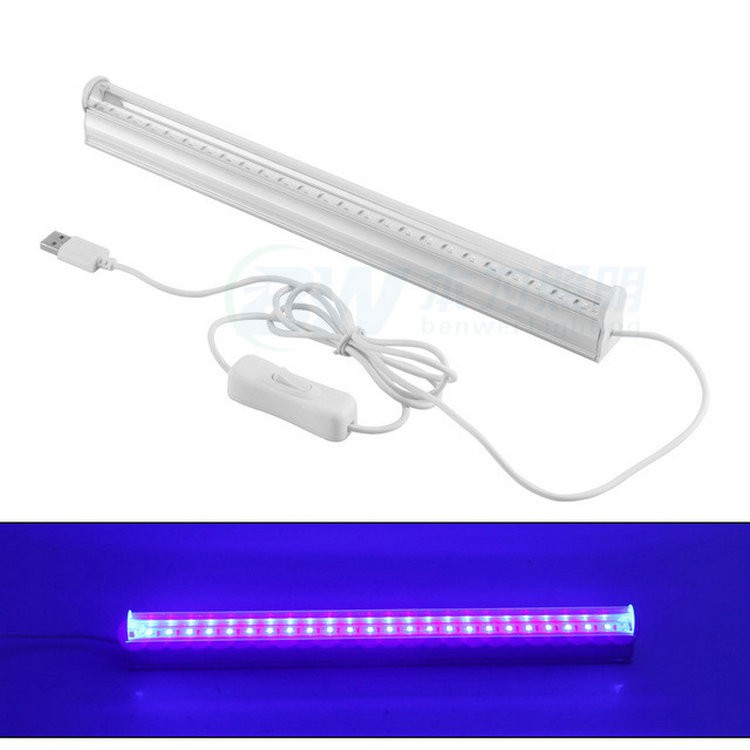
Benwei UV 120cm led tube black light Product Specification:
|
Item |
UV led light tube bulb T8 |
|
Input Volt |
AC85-265V |
|
Power |
10W,18W,24W |
|
Length |
60cm/2ft, 120cm/4ft, 150cm/5ft |
|
Bean Angle |
120°, 180° |
|
Lifespan |
50000 hrs |
|
Wavelength |
365nm 395nm 254nm 280nm |
|
Warranty |
3-5 years |