UV Photochemical Reaction LEDs: Why Laboratory Light Source Selection Is "Abandoning" Xenon and Mercury Lamps
In fields such as chemical synthesis, materials science, and environmental engineering, photochemical reactions have become an indispensable core technology. From photocatalytic water splitting for hydrogen production, advanced oxidation for wastewater treatment, to the directed synthesis of pharmaceutical intermediates, specific wavelengths of light are required to drive molecular-level reactions.
For a long time, xenon and mercury lamps were the mainstream light sources for photochemical reaction apparatus. However, a notable trend has emerged in recent years: a growing number of research institutions and companies are turning to UV LED light sources. What makes LEDs superior to traditional lamps? And how should key parameters such as wavelength, power, and thermal management be evaluated for photochemical applications? This article systematically examines the rationale for using UV LEDs in photochemical reactions-covering device principles, technology comparisons, application scenarios, and selection criteria-and uses the Benwei 10–1200W UV LED Lamp series (with its multi‑wavelength, customizable features) as a practical reference.
1. Why Do Photochemical Reactions Require Precise Wavelength Matching?
The essence of a photochemical reaction is that photon energy is absorbed by reactants or photocatalysts, exciting electronic transitions that initiate or accelerate chemical reactions. Therefore, the wavelength of the light source must precisely match the absorption spectrum of the reactants. An incorrect wavelength either fails to excite the reaction or triggers undesirable side reactions due to excess energy.
Ultraviolet light sources span a wide range of wavelengths, each corresponding to different reaction mechanisms:
- 254 nm (UV‑C): High photon energy capable of directly breaking chemical bonds. Used in DNA damage studies, photoresist exposure, UV disinfection, and direct photolysis of certain organic molecules.
- 265 / 275 nm (UV‑C): Close to the peak germicidal efficacy wavelength (~265 nm). Effective for microbial inactivation and for direct UV photolysis / advanced oxidation of specific organic pollutants.
- 310 nm (UV‑B): A recent research hotspot. In continuous‑flow synthesis, 308 nm UV‑B LED modules have been shown to effectively replace traditional medium‑pressure mercury lamps for the synthesis of trisubstituted oxazoles from isoxazoles, achieving high yields and multi‑gram scale‑up, demonstrating the feasibility of LED replacement.
- 365 nm (UV‑A): The most widely used standard wavelength in photochemistry. In photocatalytic systems, catalysts such as TiO₂ have strong absorption near 365 nm. A 365 nm UVA‑LED achieved 99.42% removal efficiency in rhodamine B degradation experiments. In toluene photocatalytic degradation, 375 nm UV light achieved ~99% removal within 1 hour. In addition, 365 nm plays a central role in UV curing, photopolymerization, and certain organic synthesis reactions (e.g., photochromic material synthesis).
- 395 / 405 nm (UV‑A): Closer to visible light, with stronger penetration. Commonly used in UV curing (inks, adhesives, 3D printing) and for novel photocatalytic materials (e.g., Bi₂WO₆) that require longer wavelength excitation.
- 420 / 440 nm (violet‑blue): Although in the visible range, they are also important in photochemistry. Studies have shown that 420 nm precisely activates valence band electrons of g‑C₃N₄, significantly improving its quantum efficiency in photocatalytic degradation. For CO₂ reduction, dual‑wavelength combinations-e.g., 650 nm for photocatalyst excitation and 450 nm for suppressing side reactions-have become a new research trend.

2. LED vs. Mercury/Xenon Lamps: A Generational Leap in Light Source Technology
Traditional photochemical reactors widely use xenon or mercury lamps. Xenon lamps offer a continuous spectrum (200–2000 nm) and high intensity (up to 300 mW/cm²), making them suitable for solar simulation. Mercury lamps are known for their monochromaticity at specific wavelengths (e.g., 254 nm, 365 nm). However, with the development of solid‑state light sources, LEDs offer several advantages that are rewriting industry standards:
2.1 Thermal Management: Cold Source Eliminates Thermal Disturbance
LEDs are classic "cold" light sources – typically less than 20% of the input power is converted to heat, whereas xenon lamps convert >70% to heat, and mercury lamps >60%. In traditional photochemical reactors, the large amount of heat released by xenon or mercury lamps must be removed via water‑cooled cold traps, which adds complexity and causes temperature fluctuations that affect quantum efficiency measurements. In contrast, LED‑based systems can control reaction temperature fluctuations to within ±0.5 °C, which is critical for kinetic studies and quantum yield measurements.
2.2 Spectral Purity: Narrow Band Emission Avoids Side Reactions
The spectral half‑width of a traditional xenon lamp exceeds 200 nm; for a mercury lamp it exceeds 100 nm. This means that while emitting the target wavelength, the source also produces many other spectral components. In multi‑component systems, these "useless" or "harmful" spectral components may induce side reactions or decompose products. An LED has a half‑width of only about 20 nm, delivering true monochromatic light output – a decisive advantage for improving reaction selectivity.
2.3 Lifetime and Maintenance: From "Replace after Each Use" to "Years of Maintenance‑Free Operation"
A xenon lamp typically lasts about 500 hours, and a mercury lamp about 800 hours, with rapid optical power degradation that makes it difficult to maintain experimental reproducibility. High‑quality LEDs, however, can last >10,000 hours; with forced‑air cooling architectures, lifetimes can exceed 50,000 hours. For long‑duration experiments such as photocatalytic evaluation or CO₂ reduction that require continuous operation, this difference dramatically reduces maintenance costs and equipment downtime.
2.4 Environmental Compliance: Mercury‑Free and Ozone‑Free
Mercury lamps contain highly toxic mercury metal and are facing global restrictions and phase‑out policies. Xenon lamps may generate ozone during operation, requiring additional ventilation. LED sources contain no mercury and produce no ozone, complying with RoHS and other environmental regulations. This makes them particularly suitable for laboratory environments with high cleanliness and safety requirements.
Performance Comparison: LED vs. Xenon vs. Mercury Light Sources
| Parameter | LED Source | Xenon Source | Mercury Source |
|---|---|---|---|
| Spectral half‑width | ~20 nm | >200 nm | >100 nm |
| Thermal radiation fraction | <20% | >70% | >60% |
| Start‑up time | Microseconds | Minutes | Minutes |
| Lifetime | >10,000 hours | ~500 hours | ~800 hours |
| Intensity stability | ±0.1% | ±2% | ±3% |
| Mercury content | None | None | Yes |
| Ozone generation | None | Possible | None |
| Primary limitation | Custom wavelengths needed | Broadband, low efficacy | Mercury hazard |
3. Application Scenarios: From Laboratory to Industrial Scale
3.1 Photocatalytic Environmental Remediation
Core need: Efficient degradation of organic pollutants in water or air. The light source wavelength must match the absorption peak of the photocatalyst.
Organic micropollutants (pharmaceuticals, industrial chemicals, dyes, etc.) are difficult to remove by conventional biological treatment. Advanced oxidation processes (AOPs) are a proven effective approach, and LED sources have solid academic validation in this area. Rhodamine B, a common dye pollutant from the textile industry, was degraded in a 365 nm UV‑LED photoreactor with ZnO as photocatalyst under stirring for 120 minutes, achieving 99.42% degradation efficiency – demonstrating the great potential of UV‑LED photoreactors for textile wastewater treatment.
In toluene photodegradation experiments (toluene being a representative VOC), a WO₃/TiO₂ photocatalyst under 375 nm UV‑LED irradiation achieved ~99% toluene removal after 1 hour. In a larger‑scale reactor (1 dm³), a catalyst containing 2 mol% WO₃ achieved >80% degradation after only 30 minutes under combined 365/400/450 nm irradiation.
Researchers using a four‑parallel photoreactor under 365 nm UV‑LED achieved 99.1% degradation of methylene blue at a flow rate of 3.0 mL/s, further verifying the engineering feasibility of LED photoreactors for scaled‑up water treatment.
3.2 Photochemical Organic Synthesis
Core need: Precise control of reaction pathways and product selectivity, demanding high wavelength purity and irradiance.
Organic photochemical synthesis is one of the areas where LED sources excel most. In a continuous‑flow synthesis of ketenimines, researchers compared a traditional mercury lamp with a newly developed 265 nm UV‑C LED module. The UV‑C LED not only outperformed the mercury lamp in reaction performance and efficiency, but also-because the LED emits monochromatic light-eliminated the need for optical filters, avoiding the side reactions caused by the broad‑spectrum emission of mercury lamps.
In the continuous‑flow synthesis of oxazole compounds, a 308 nm UV‑B LED module enabled multi‑gram synthesis of the anti‑inflammatory drug oxaprozin analogue from isoxazolone, fully demonstrating the industrial value of high‑power UV LED modules in pharmaceutical scale‑up.
3.3 Photocatalytic Energy Conversion
Core need: High light intensity, long‑term stability, and precise wavelength selectivity.
Photocatalytic water splitting for hydrogen production and CO₂ photoreduction to fuels (e.g., methanol, methane) are frontier research areas in renewable energy. These studies often require hundreds to tens of days of continuous testing, placing extreme demands on long‑term light source stability. The lifespan and intensity stability of LEDs (±0.1%) far exceed those of xenon lamps (±2%) and mercury lamps (±3%), making LEDs ideal for long‑duration photocatalytic evaluations.
In CO₂ reduction, researchers are increasingly adopting multi‑wavelength strategies-for example, simultaneously outputting 650 nm (to excite electron transitions in the photocatalyst) and 450 nm (to selectively suppress certain side reaction pathways). This "spectral programming" capability is difficult to achieve with traditional single light sources.
3.4 Surface Coating Curing and Photolithography
Core need: High irradiance, uniform light spot, and cold‑source characteristics.
In precision photolithography and UV curing, 365 nm and 395 nm are common curing wavelengths. The high heat radiation of traditional mercury lamps can damage heat‑sensitive substrates (such as thin films and flexible circuit boards). LED sources emit very little infrared radiation, enabling "cold curing," which is particularly important for precision micro‑ and nano‑fabrication.

4. Key Parameters and Selection Logic for UV LED Lamps
4.1 Wavelength Matching is the Highest Priority
When selecting a UV LED lamp for photochemical reactions, wavelength matching should be the primary consideration. For photocatalytic systems, confirm the absorption peak of the catalyst (e.g., TiO₂ has strong absorption near 365 nm; g‑C₃N₄ has a good response at 420 nm). For direct photolysis, confirm the optical absorption cross‑section of the pollutant (e.g., certain carcinogens like vinyl chloride have decomposition characteristics near 365 nm). For photochemical synthesis, identify the maximum absorption wavelength of the reactant or photosensitizer, and consider using multi‑wavelength arrays to suppress side reactions.
4.2 Power and Irradiance Determine Reaction Rate
In photochemical reactions, the core physical quantity affecting reaction rate is the photon flux reaching the reaction interface (usually expressed as optical power density in mW/cm² or irradiance in µW/cm²). Nominal power (e.g., 100 W) does not directly equal the irradiance inside the reactor – the optical system design, light path distance, and reactor geometry all significantly influence the actual light intensity received.
For photocatalytic degradation, a certain irradiance threshold is usually required to effectively excite the catalyst. For UV curing, irradiance levels of several W/cm² are needed for millisecond curing. For photochemical synthesis, excessively high light intensity can cause over‑decomposition of products, while too low intensity leads to excessively long reaction times. Therefore, in practice, simulation calculations or experimental calibration should be performed based on the reactor type (continuous‑flow vs. batch) and reaction volume.
4.3 Thermal Management Affects Long‑Term Stability
Although LEDs generate far less heat than traditional light sources, in high‑power applications (hundreds to thousands of watts) thermal design remains critical for device lifetime. Forced‑air cooling with physical separation of the light path and air path can keep the lamp housing temperature rise below 10 °C at full power, effectively avoiding spectral shift and lumen depreciation caused by high temperatures. For very high power configurations (e.g., 1000 W, 1200 W), active water cooling may sometimes be required to maintain long‑term operational stability.
4.4 Customization Defines Application Boundaries
Photochemical research objects vary widely, and off‑the‑shelf light sources cannot cover all needs. An ideal photochemical LED source should offer: interchangeable wavelengths to quickly switch between different reaction systems; continuously adjustable intensity (0–100%) to meet needs from kinetic studies to product screening; selectable illumination modes (continuous for steady‑state photocatalysis, pulsed for transient photovoltage analysis and other kinetic studies); and diverse light spot shapes and reactor interface compatibility.
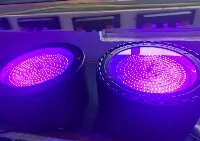
5. Benwei UV LED Lamp for Photochemical Reaction: Translating Core Specifications into Application Value
Designed for the photochemical reaction field, the Benwei UV LED Lamp series is built around the selection logic described above. It provides a product platform covering a wide range of wavelengths, a wide power range, and a high degree of customization. Key features include:
- Broad wavelength selection: Supports 254 nm, 265 nm, 275 nm, 320 nm, 365 nm, 395 nm, 420 nm, 440 nm, and more – covering the majority of photochemical needs from UV‑C to violet‑blue.
- Comprehensive power options: Available from 10 W, 50 W, 100 W, 200 W, 300 W, 400 W, 500 W, 600 W, 700 W, 800 W, 900 W, 1000 W, up to 1200 W – suitable for scales from benchtop small reactors to industrial pilot‑scale systems.
- Highly customizable: Wavelength combinations, intensity distributions, thermal architecture, and optical layouts can be tailored to specific application requirements.
- Broad application range: Directly applicable to photochemical reactions, UV curing, printing, coating curing, oil leak detection, photocatalytic oxidation, UV disinfection, forensic examination, anti‑counterfeiting, and more.
- Suitable for long‑duration experiments: With low infrared emission and long lifetime, the lamp significantly reduces maintenance costs and systematic errors in long‑term experiments such as photocatalytic evaluation and CO₂ reduction.
From laboratory‑scale catalyst screening to pilot‑scale continuous‑flow synthesis, Benwei can provide precise light source support-through flexible combinations of wavelength and power-for photochemical studies at different scales and with different mechanisms.
Final Thoughts
The transition from xenon and mercury lamps to LEDs is not merely a product upgrade; it represents a paradigm shift in photochemical light sources from "broadband projection" to "precise matching." With their precise wavelength control, low thermal interference, long lifetime, and environmental friendliness, LEDs are driving photochemical reactions toward a new era of higher efficiency, better controllability, and greater reproducibility.
In photochemical research, the light source is never just a device that provides "brightness" – it is a selector of reaction pathways. Wavelength, power, thermal management, and customization are the core metrics for evaluating whether a UV LED lamp is suitable for a particular research need. Choosing a UV LED lamp is, in essence, choosing the ability to deliver light "on demand."