Advantages over fluorescent and incandescent lighting of LED tubes
LED tube lights use less energy while still generating brilliant light with improved colouring and temperature control. They were created to replace the less efficient fluorescent tubes. Additionally, they have a far longer lifespan, burn out less frequently, contain no mercury, and frequently need less maintenance.
Another benefit is that certain LED tube lights may be dimmed, allowing for adjustment to the needs of the space. You may forget about dimmable tube lights if you have fluorescent lighting.
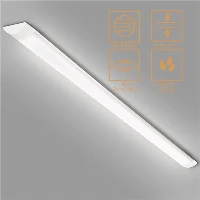
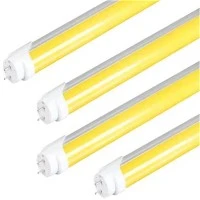
The greatest option for replacing your outdated fluorescent fixtures is LED tube lighting. Manufacturers have created many sorts of LED tube lights that are available in various types and sizes to fit the various purposes, which vary from accent lighting to brightening office spaces.
LED tube lights in a variety of sizes and forms
You can choose the ideal LED tube lights for your project far more easily than you would imagine. Your room will receive the appropriate lighting if you recognise and select the right kind of tube light. To help you choose what's best for you, we've included various varieties of LED tube lights below along with their typical applications.
T5 LED Tube Lights: T5 tube lights are typically used in tiny applications including grow lights, under-cabinet illumination, and table lamps. T5 tube light bulbs have a lamp diameter that is five eights of an inch, which makes them much smaller than T8 LED tube light bulbs and somewhat shorter. It's crucial to understand that these two tube lights cannot be switched out.
T8 LED Tube Lights: By far, these are the most typical kind of tube lights. The ceiling lights in offices, corridors, warehouses, parking lots, and grocery freezers are where you most frequently encounter them. T8 LED tube lights typically come in lengths of 4 feet and have a 1-inch diameter, although they may also be found in lengths up to 8+ feet. Both T8 and T12 tube lights may be used interchangeably as long as they have the same wattage and length and the ballast has been bypassed in the fixture. T8 tube lights are more energy-efficient and last longer than T12 tube lights.
Similar to T8 tube lights, T12 LED tube lights come in a range of sizes. They vary from T8 tube lights because they have a 1 12 diameter, which makes them bigger. However, due to a few drawbacks, T12 tube lights are increasingly being replaced with T8 ones. The majority of T12 technology is outdated, and it is currently difficult to get the magnetic ballasts that are utilised in T12s.
LED tube lights with a U-shaped construction are known as U-bend tube lights, which set them apart from the other LED tube lights on the list. The majority of their applications are in hospitals, retail establishments, light boxes, and department shops. T8 fluorescents or ballast-free LED fixtures may be directly retrofitted with new kinds of LED U-bend tube lighting.
The trouble involved in handling ballasts
A ballast is necessary for the operation of all fluorescent lighting. As the lamp heats up, the ballast assists in controlling the brightness. The drawback of this is that ballasts consume more energy and require replacement and reinstallation every time they eventually stop working. The good news is that LED lights don't even need a ballast!
There are several varieties of LED tube lights, each of which offers a distinct functionality with or without a ballast installed in the current fixture, in addition to various tube light sizes and forms.
The simplest way to replace fluorescent tube lights is using Type A (plug and play) bulbs, which are regarded as ballast-compatible lamps. Most T8s don't require rewiring and may be used as straight replacements for fluorescent tubes.
Direct wire lights of Type B (Direct) are incompatible with fluorescent ballasts. Before installation, the ballast must be removed from the installation for these tube lights.
Tube lights of Type C (Hybrid) can be installed in fixtures with or without ballasts. The same tube light may be utilised as a direct tube if the user finally wants to get rid of the ballast by bypassing it.