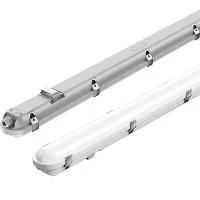
Based on the above search results and industry best practices, the following is a thorough guide on installing an LED batten light, complete with tools, procedures, and technical considerations:
Equipment Needed to Install LED Batten Lights
Prior to beginning, collect the necessary equipment and supplies:
Make sure the LED batten light fixture satisfies the voltage and wattage specifications of your area, such as 24V or 220–240V.
Drills and screwdrivers: For fastening fixtures and mounting brackets.
To make sure the power is off during installation, use a voltage tester.
For secure electrical connections, use wire strippers and connectors (such as M12 connectors for industrial systems).
For installations on high walls or ceilings, use scaffolding or a ladder.
Aluminium extrusion brackets or surface-mount clips, like those used in PowerFlex LED kits, are recommended for mounting.
High-power LED battens can be equipped with thermal paste/heat sinks to control heat dissipation.
Dimming Controller (Optional): For systems that need to be compatible with dimming between 0 and 10V
Detailed Installation Instructions 1. Safety Measures
Turn Off Power: Make sure the circuit is de-energised by using a voltage tester.
Examine IP Ratings: Confirm the IP rating of the fixture (for example, IP67 for industrial environments to provide resistance to moisture and dust).
Mounting and Positioning
Plan Layout: Take into account spacing according to lumens per square metre for consistent illumination. For accurate hole alignment in intricate patterns, use equipment such as LED equipment.
Mounting hardware installation:
Attach surface-mount clips or aluminium extrusion brackets to the wall or ceiling. Adjustable mounts for flat or inclined surfaces are included with PowerFlex systems.
Use threaded cable glands or M12 plug connections for safe wiring in industrial settings.
Wiring for electricity
Connect the drivers:
A constant voltage (CV) or constant current (CC) driver is usually needed for LED batteries. Use a CC driver when working with several LEDs to prevent overdriving parallel circuits.
Integrate a 0–10V dimmer or smart controllers such as Philips AntumbraTouch for scene customisation 49 for dimmable systems.
Wire Attachments:
Remove the insulation from the supply wires and attach them to the Line/L, Neutral/N and Earth terminals of the fixture.
To avoid reverse wiring mistakes, use connections with polarity protection.
Installation of Fixtures
To secure the LED batten, slide it into the brackets that are attached and fasten the screws. Make sure the aluminium frame of heavy-duty fixtures like MACH LED PLUS.seventy is resistant to vibration.
Attach Diffusers: To reduce light output, install frosted or transparent diffusers (found in kits like PowerFlex).
Calibration and Testing
Power On: Turn on the electricity again and check that everything works.
Diagnose problems: For NFC-based diagnostics (such as verifying firmware or DMX channels), use applications like Martin's Companion Mobile.
Modify Settings: Use online interfaces to set colour temperatures or timings for smart systems (e.g., Philips Light System Manager gen5).
Last-Minute Modifications
Thermal Management: Make certain that there is enough ventilation surrounding heat sinks, particularly in enclosed areas. If not controlled, the heat produced by high-power LEDs might shorten their lifespan.
Aesthetic Checks: Make sure diffusers are scratch-free and align fixtures uniformly.
More Complex Aspects to Take into Account
Astute Integration:
Connect battens to Internet of Things platforms (like Philips ActiveSite) for automation and remote monitoring.
To standardise DMX setups across lighting applications, use GDTF files.
Efficiency of Energy:
Examine lumen/watt ratios in comparison to fluorescent substitutes. The average LED battery saves 50–70% of energy.
Upkeep:
To make repairs easier, choose fixtures with modular designs (such as replacement LED strips).
Solving Typical Problems
Lights flickering: Look for unstable voltage or unsuitable dimmers.
Uneven Brightness: Verify that the current in parallel circuits is balanced (if necessary, add resistors).
Overheating: Make sure the ambient temperature is within acceptable bounds (such as 0–45°C) and that heat sinks are correctly installed.
It takes meticulous preparation, the right equipment, and respect to safety procedures to install LED batten lights. Every stage, from choosing drivers to incorporating sophisticated controls, guarantees longevity and peak performance. Use diagnostic tools such as Companion Mobile for complicated projects, and give priority to fixtures with high IP ratings for longevity. You may create effective, high-quality lighting for your home, business, or industrial needs by using this instructions.

https://www.benweilight.com/linear-lighting/led-batten-light/led-linkable-led-batten-light-ip65.html