Introduction: The Core Cause of Early Burnout in Traditional LED Downlights
The Inherent Heat Generation Principle of LED Downlights
Semiconductor lighting devices with electro-optical conversion properties include LED downlights. LED chips transform electrical energy into light energy, as contrast to conventional incandescent lights that produce light by thermal radiation. However, commercial-grade COB chips only have an electro-optical conversion efficiency of 70% to 85%. In the small chip cavity, the remaining 15% to 30% of electrical energy is fully transformed into heat energy. The installation space for integrated ceiling downlights is somewhat enclosed and has inadequate natural ventilation. Thermal energy will continue to build up within the lamp body in the absence of an effective heat dissipation mechanism, causing the internal temperature to increase sharply. The photoelectric performance of the chip will quickly deteriorate and, in extreme circumstances, permanent ageing and burnout will occur when the core working temperature of the chip reaches the safe threshold of 75°C for an extended period of time.
COB integrated light sources generate more concentrated heat and have a greater power density than SMD patch downlights. Higher standards are set for the lamp body structure's immediate heat conduction and continuous heat dissipation capabilities because the integrated packaging structure concentrates the heat produced by the chip in a compact area. The majority of common downlights on the market use single-layer aluminium plates, thin iron shells, or plastic heat dissipation components. These materials are unable to match the long-term steady heat dissipation requirements of high-power COB light sources, which is the primary cause of early burnout.
Harm of Heat Accumulation to LED Downlight Core Components
The COB light source, constant current driver, and internal circuit structure-the three essential parts of LED downlights-will be continuously harmed by long-term internal heat buildup. First, the fluorescent powder and packing colloid in the chip will age more quickly at high temperatures, causing fast luminous degradation, colour change, and light dimming. After 10,000 hours of usage, traditional, subpar downlights will have a luminous decay of more than 30% and the light colour will become yellow and black, totally losing the original lighting effect. Second, the constant current driver's electronic components will be harmed by high-temperature thermal radiation, which may also result in capacitor bulge, resistance attenuation, circuit short circuit, lamp stroboscopic, intermittent illumination, and direct burnout failure. Third, prolonged high-temperature baking will hasten the deterioration of internal insulating glue and sealing strips, diminish the lamp body's ability to withstand dust and moisture, and readily result in short-circuit faults brought on by dust and moisture infiltration, all of which will exacerbate the damage to the lamp body.
Downlights must operate constantly for eight to twelve hours per day in commercial settings including retail centers, hotels, and office buildings. The constant heat buildup impact is more noticeable, and the failure rate of subpar downlights within a year or two is as high as 60%, necessitating regular replacement and maintenance, which significantly raises the space's overall running costs. Frequent lamp replacement for homeowners poses a risk to electrical safety in addition to detracting from the overall aesthetics of the decorating.
Technical Defects of Traditional Downlight Heat Dissipation Structures
There are three deadly flaws in the heat dissipation architecture of the majority of conventional low-cost LED downlights. Inadequate heat conduction efficiency is the first. Heat retention occurs in the light source cavity because thin iron and plastic materials have very poor thermal conductivity and are unable to swiftly export the heat produced by the chip. Unreasonable structural design is the second. The heat produced by the light source will immediately radiate to the driver and internal circuit, producing synchronous ageing of electrical components. The majority of common downlights have an integrated light and heat mixing structure. The absence of active convection pathways is the third. Due to the closed lamp body structure's inability to provide air circulation and its reliance on passive heat dissipation, the lamp body operates at high temperatures for extended periods of time. Traditional downlights are unable to prevent early burnout due to these structural flaws, which has long been a significant industrial issue limiting the service life of LED lighting products.

Core Heat Dissipation Design of Premium COB LED Downlights
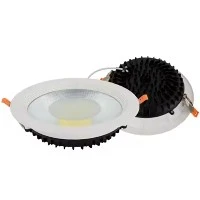
Aviation-Grade Thickened Aluminum Integrated Radiator
Our premium recessed COB LED downlight uses a customised aviation-grade 6063 aluminium alloy integrated radiator, which is the primary technological support to address early lamp burnout, instead of the subpar thin iron and regular aluminium heat dissipation structure of typical goods. The ultrahigh thermal conductivity of 6063 aircraft aluminium is 201W/(m·K), which is 300% greater than that of iron materials and 60% higher than that of regular cast aluminium. By avoiding the heat conduction loss resulting from splicing gaps of split heat dissipation structures, the thickened integrated moulding technique achieves zero-delay quick heat conduction of the chip heat source.
Our radiator has a thickened design with an average wall thickness of 3.2mm, in contrast to the thin and single heat dissipation shell of typical downlights. In addition to enhancing the lamp body's overall structural strength and preventing deformation and damage during installation and operation, the thicker aluminium construction also boosts the radiator's heat capacity. It can quickly absorb the immediate heat produced by the COB high-power chip, steer clear of the light source's local hot spots, and keep the chip's core operating temperature within a safe and stable range for an extended period of time. The issue of local heat buildup in conventional downlights is essentially resolved by the one-piece die-casting moulding method, which creates a seamless and integrated heat dissipation structure with uniform heat conduction and no dead ends.
Internal Vortex Convection Heat Dissipation Channel System
Our innovation creatively creates an integrated vortex air convection heat dissipation channel within the aluminium radiator to overcome the passive heat dissipation limitations of conventional flat radiators. With staggered guiding grooves positioned within the lamp body, the structural design uses a multi-layer, three-dimensional heat dissipation fin architecture that can automatically create up-and-down air convection based on the temperature differential between the interior and outside of the lamp body. A continuous and steady vortex air circulation system is created while the lamp operates and produces heat. The hot air within the cavity rises quickly along the guiding grooves, and the exterior cold air is immediately replenished from the bottom gap.
The passive heat dissipation problem of conventional closed lamp bodies is entirely resolved by this active convection heat dissipation approach. It achieves three-dimensional heat dissipation in all directions, speeds up internal heat discharge, and reduces heat residence time within the lamp body by about 70%. The surface area for heat dissipation is significantly increased by the multi-fin construction. The effective heat dissipation area is increased by 85% when compared to standard single-layer aluminium radiators of the same power. This maximises the radiator's contact area with the air, enhances heat exchange efficiency, and guarantees that the heat produced by the chip's long-term continuous operation can be fully exported in real time without accumulation.
Independent Heat and Light Isolation Heat Dissipation Structure
The majority of conventional LED downlights have a hybrid construction that integrates the motor and light source. The primary cause of driver ageing and circuit burnout is long-term high-temperature baking of the driver, which is caused by the high heat produced by the COB chip directly radiating and conducting to the integrated constant current driver. The interior lamp body is divided into two distinct closed cavities, the light source cavity and the power drive cavity, using our product's novel separated heat and light isolation construction.
In order to concentrate heat conduction and dissipation, the COB light source is positioned independently in the top heat dissipation chamber, which is fully connected to the thicker aluminium radiator. A high-temperature resistant heat insulation partition separates the constant current driver from the light source's high-temperature region in the bottom independent heat insulation cavity. This construction prevents the driver from ageing and failing due to high-temperature heat radiation, totally blocks the heat transfer channel from the light source to the electrical components, and provides comprehensive protection for the lamp body's core electrical system. It maximises the drive components' service life while guaranteeing the light source's heat dissipation efficiency, achieving the dual protection of the circuit system and light source.
High-Temperature Resistant Auxiliary Heat Dissipation Protection Design
Our product has a number of auxiliary heat dissipation and high-temperature resistant designs to further optimise the heat dissipation stability and anti-aging performance of the lamp body. Anodic oxidation and nano heat dissipation coating are applied to the aluminium radiator's surface to improve its anti-oxidation and anti-corrosion capabilities as well as its infrared heat radiation efficiency, which speeds up the outward diffusion of residual heat. High-temperature resistant insulating glue, which can endure prolonged high temperatures below 120°C, is applied to the internal circuit board and welding sites to prevent circuit oxidation and open circuit failure brought on by high temperatures.
The device also uses a low-power-loss constant current driver with an integrated overheat prevention chip. The driver will automatically detect an abnormal rise in ambient temperature or an unintentional blockage of heat dissipation. It will then initiate the overheat power-off protection mechanism, immediately cut off the power supply, and restart itself when the temperature falls to a safe level. By achieving dual protection of structural heat dissipation and intelligent temperature regulation, this intelligent protection design perfectly complements the physical heat dissipation structure and eliminates the possibility of light burnout due to heat failure.
Performance Advantages Brought by Efficient Heat Dissipation Design
Ultra-Low Luminous Decay, Long-Term Stable Light Output
The most obvious performance feedback of the lamp heat dissipation effect is luminous degradation. Our COB downlight achieves industry-leading ultra-low luminous decay performance because to its effective vortex heat dissipation technology and aluminium heat conduction construction. According to statistics from professional laboratory continuous ageing tests, the product's luminous degradation rate is less than 5% after 5,000 hours of continuous, uninterrupted operation-much lower than the industry norm of 15%. The luminous decay rate is just 18% after 30,000 hours of continuous use, but under the same service circumstances, the luminous decay rate of common downlights on the market surpasses 40%.
In addition to preventing the ageing and failure of fluorescent powder and packaging colloid due to high temperatures, the excellent heat dissipation effect guarantees that the COB chip operates at a constant low temperature and maintains long-term high brightness, high colour rendering, and zero colour shift light output. The product can really restore an object's colour since its CRI is consistently greater than 90. Long-term lossless lighting is achieved because it may retain the original lighting effect without fading, yellowing, or blurring light colour even after more than ten years of operation.
50,000 Hours Ultra-Long Service Life, Eliminate Early Burnout Risk
The heat dissipation performance of LED downlights strongly affects their service life. The majority of conventional downlights with inadequate heat dissipation will have burnout and failure issues after two to three years of usage, and their service life is just 10,000 to 20,000 hours. Our product has a rated service life of 50,000 hours, which is two to three times longer than that of standard goods, thanks to its all-around optimised heat dissipation construction. The device can operate steadily for over 17 years if it is used for 8 hours a day; in commercial settings, it can operate continuously for over 11 years without experiencing early burnout failure if it is used for 12 hours a day.
In addition to eliminating all early failure risks like chip burnout, driver short circuit, and circuit ageing due to heat accumulation, the long-term low-temperature working state achieves zero burnout rate throughout the product's life cycle. It significantly lowers the frequency of bulb replacement and on-site maintenance for engineering buyers and commercial users, as well as the cost of lighting engineering's subsequent operation and maintenance.
Wide Temperature Adaptability, Stable Operation in Complex Environments
The product's ultra-wide temperature adaptability is made possible by its excellent heat dissipation and high-temperature resistance design; the typical operating ambient temperature range is -20°C to +60°C. Ordinary downlights are prone to heat accumulation and burnout due to inadequate heat dissipation in high-temperature environments, such as summer indoor closed ceilings, shopping mall top floors, and hotel corridor closed spaces. However, our products can still maintain effective heat conduction and convection circulation, maintain a stable core temperature, and operate continuously and steadily.
Furthermore, the sealed heat dissipation structure is matched with IP40 dust-proof and moisture-proof performance, which can adapt to slightly humid environments like kitchen tops and bathroom dry areas. This prevents heat dissipation blockage and component corrosion caused by dust and moisture accumulation, further enhancing the product's environmental adaptability and service stability.
Improved Overall Safety Perormance of the Lamp Body
In addition to being the primary cause of bulb burnout, heat buildup is a significant hidden risk of electrical safety incidents. Long-term high temperatures will deteriorate the lamp body's insulation, ageing the circuit sheath and increasing the risk of electric leakage and short-circuit fires. Our superior heat dissipation design successfully protects the insulating structure and electrical components of the lamp body by maintaining a low and steady internal temperature for an extended period of time.
With its Class II double insulation construction and V0-grade flame-retardant PC outer frame, the product performs very well against electric shock and fire. Even if it comes into touch with the metal frame of the ceiling, there is no danger of electric leakage and no open flame combustion or pouring during high-temperature baking. The product may be utilised safely in high-standard settings like upscale villas, star hotels, and expansive commercial plazas because of the many safety features derived from the heat dissipation structure, which completely complies with international indoor lighting safety requirements.
Market Value and Purchasing Advantages of High-Efficiency Heat Dissipation Downlights
Reduce Comprehensive Cost for Commercial Lighting Projects
In commercial lighting engineering, the total cost of bulbs include not only the original purchase price but also subsequent labour, maintenance, and replacement costs. Traditional inexpensive downlights have cheap single-piece procurement costs, but their short service life and high failure rate need several replacements and annual manual maintenance, which raises overall running costs dramatically. Early burnout is a problem that our high-efficiency heat dissipation COB downlight successfully resolves. It may reduce maintenance expenses for engineering projects by over 80% because to its very long service life and early failure rate of zero.
The device also offers minimal power loss and great light efficiency. With a luminous efficiency of up to 105 lm/W, it uses 50% less power than regular energy-saving bulbs and 75% less energy than conventional halogen lamps. In addition to guaranteeing consistent, high-quality illumination, it significantly lowers the space's long-term power consumption costs, offering commercial projects the combined cost-saving advantages of energy conservation and maintenance reduction.
Improve Lighting Quality and Space Decoration Effect
The downlight's long-term illumination quality is determined by its heat dissipation design. After some time of use, products with inadequate heat dissipation will exhibit significant luminous decay and colour change, leading to dull illumination, ruined overall décor style, and inconsistent light colour over the whole area. With perfect heat dissipation control, uniform light spots, no black spots, no stroboscopic flicker, and RG0 low blue light grade, which is pleasant and eye-friendly, our products maintain long-term consistent light output.
The lighting requirements of various locations may be satisfied by a range of colour temperature choices (3000K warm white, 4000K natural white, and 6000K cool white). The high-color-rendering light source enhances the overall grade and texture of the area by restoring the real colour of furniture, business display items, and home décor. The ultra-slim seamless embedded design realises the integration of lamp and ceiling and enhances the space's minimalist and upscale decorative impact, making it ideal for a variety of ceiling types.
High Cost-Performance, The Preferred Choice for Long-Term Use
Our premium heat-dissipating COB downlight boasts ultrahigh cost performance while considering a long-term usage cycle. Regular downlights need repair every two to three years, and the total cost of labour and replacement over a ten-year period is much more than the cost of purchasing high-quality lamps. With one-time purchase and lifetime steady usage, our items may be used steadily for over ten to seventeen years without needing to be replaced. In terms of service life, stability, and usefulness, it is considerably better to comparable low-cost items due to its professional aviation-grade heat dissipation construction, safety protection performance, and outstanding lighting effect.
This product is an affordable and dependable long-term lighting solution that can perfectly adapt to the scenario demand, avoid the hassle of frequent lamp replacement and maintenance, and be used for home renovation, villa customisation, hotel engineering, office lighting, or commercial lighting in shopping malls.
Conclusion
In essence, early LED downlight burnout is a structural heat dissipation failure issue. The largest barrier to the long-term steady functioning of lights is the uncontrolled internal heat buildup caused by the backward heat dissipation design of old goods. This causes the ageing and degradation of essential components. With its integrated design of an aviation-grade thickened aluminium radiator, an integrated vortex convection heat dissipation channel, an independent heat and light isolation cavity, and an intelligent overheat protection system, our premium COB LED recessed downlight completely subverts the heat dissipation structure of conventional downlights. It provides ultra-low luminous decay, ultra-long service life, excellent safety performance, and efficient, continuous, and stable heat conduction and convection heat disposal. It also essentially resolves the industrial problem of early burnout of LED downlights.
For consumers, a high-quality LED downlight serves as both a long-term cost-saving and secure space matching solution in addition to being a lighting instrument. This product's expert heat dissipation technology guarantees that each lamp can maintain steady, high-quality lighting output throughout its entire life cycle, remove maintenance issues and safety risks, and provide a more energy-efficient, pleasant, secure, and superior lighting environment. For contemporary home décor and commercial lighting engineering, it is the most reputable and trustworthy option.

How To Cooperate With Us?
Because we have our own facilities, we are pleased to have complete control over the production process and the quality of our goods. We are committed to giving our clients the finest prices since we are manufacturers rather than just brokers. We encourage clients to look at our samples first since we are certain that the cost and quality of our items are transparent. Our dedication to excellence and client happiness motivates us to consistently provide superior products.
Our address
3rd Floor, 5th Building, Hebei Industrial Park, Hualian Community, Longhua District, Shenzhen, China