What is a high bay light? A Comprehensive Guide to Industrial and Commercial Lighting Solutions
In the realm of industrial and commercial lighting, the term "high bay light" is frequently used, yet its specific purpose, design, and applications are often misunderstood by those outside the lighting or facility management fields. Simply put, a high bay light is a specialized lighting fixture engineered to illuminate large, open spaces with high ceilings-typically defined as ceilings measuring 15 feet (4.5 meters) or higher. Unlike residential or small commercial lights, which prioritize aesthetics or localized brightness, high bay lights are built for two primary goals: delivering powerful, uniform illumination across expansive areas and operating efficiently in demanding environments. This article will break down the definition of high bay lights, explore their key design features, outline common types, detail their wide-ranging applications, highlight their benefits over traditional lighting, and provide guidance on selecting the right fixture for specific needs.
Defining High Bay Lights: Beyond Basic Illumination
To fully grasp what a high bay light is, it's essential to distinguish it from other commercial lighting options, such as low bay lights or general-purpose fixtures. Low bay lights, for example, are designed for ceilings between 8 and 15 feet (2.4 to 4.5 meters)-spaces like retail stores, gymnasiums, or small warehouses-where light doesn't need to travel as far to reach the ground. High bay lights, by contrast, are optimized for "throw distance": the ability to project light from a great height (15+ feet) while maintaining consistent brightness and minimizing shadows. This makes them indispensable in spaces where visibility directly impacts safety, productivity, or operational efficiency.
At their core, high bay lights are defined by three key characteristics: high lumen output, directional light distribution, and durability. Lumen output refers to the total amount of light a fixture emits; high bay lights typically range from 10,000 to 200,000 lumens, far more than the 800–1,500 lumens of a standard residential LED bulb. Directional distribution means the light is focused downward or in specific patterns (rather than diffused in all directions), ensuring it reaches work surfaces, equipment, or storage areas without wasting energy. Durability is critical because high bay lights are often installed in harsh environments-factories with dust or vibration, warehouses with temperature fluctuations, or gymnasiums with high humidity-so they must resist damage and operate reliably for years.
Types of High Bay Lights: From Traditional to Modern LED
High bay lights have evolved significantly over the past few decades, with technology shifting from energy-inefficient options to modern, eco-friendly solutions. The most common types include:

1. Metal Halide (MH) High Bay Lights
Metal halide fixtures were once the industry standard for high-ceiling spaces. They work by passing an electric current through a mixture of gases (including metal halides) to produce bright, white light. MH lights offer high lumen output and good color rendering (the ability to show colors accurately), which is important in settings like manufacturing facilities where workers need to identify product defects or equipment issues. However, they have major drawbacks: they take 5–10 minutes to reach full brightness (a "warm-up time"), they lose brightness over time (a phenomenon called "lumen depreciation"), and they consume much more energy than modern alternatives. They also have a short lifespan (typically 10,000–20,000 hours) and contain toxic materials like mercury, making disposal difficult.
2. High-Pressure Sodium (HPS) High Bay Lights
High-pressure sodium lights are another traditional option, known for their extremely high efficiency and long lifespan (up to 24,000 hours). They produce a yellow-orange light by ionizing sodium vapor, which is effective for outdoor areas like parking lots or sports fields, but less ideal for indoor spaces. The main issue with HPS high bay lights is their poor color rendering-objects appear washed out or discolored under their light, which can be dangerous in environments where color accuracy is critical (e.g., assembly lines, laboratories). They also have a warm-up time and take time to restart if the power is interrupted, which can disrupt operations in busy facilities.
3. LED High Bay Lights
Today, LED (Light-Emitting Diode) high bay lights are the dominant choice for most industrial and commercial applications-and for good reason. LEDs work by passing an electric current through a semiconductor, which emits light without generating excessive heat (unlike MH or HPS lights). LED high bay lights address nearly all the flaws of traditional fixtures: they have no warm-up time (they turn on instantly at full brightness), they have an extremely long lifespan (50,000–100,000 hours, or 5–10 years of continuous use), and they consume 50–70% less energy than MH or HPS lights. They also offer excellent color rendering (with Color Rendering Index, or CRI, values of 80+), meaning colors appear true to life, and they are available in a range of color temperatures (from warm white, 3000K, to cool white, 6500K) to suit different needs. Additionally, LED high bay lights are durable-they are resistant to vibration, dust, and moisture (often rated IP65 or higher for water and dust resistance)-and they contain no toxic materials, making them environmentally friendly.
4. Induction High Bay Lights
Induction high bay lights are a less common alternative, but they offer some unique benefits. They use electromagnetic induction (rather than a filament or gas) to produce light, resulting in a long lifespan (up to 100,000 hours) and low maintenance needs. They also have no warm-up time and good energy efficiency. However, they are more expensive upfront than LED lights and tend to be bulkier, which can make installation more challenging in tight spaces. They also have lower color rendering than LEDs, limiting their use in settings where color accuracy is important.
Key Applications of High Bay Lights
High bay lights are versatile fixtures, used in a wide range of indoor and outdoor spaces where high ceilings and large areas require powerful, uniform illumination. Some of the most common applications include:
Industrial Facilities
Factories, manufacturing plants, and assembly lines rely on high bay lights to ensure workers can see clearly while operating heavy machinery, handling small parts, or inspecting products. In these environments, bright, consistent light reduces the risk of accidents (e.g., trips, falls, or equipment malfunctions) and improves quality control (e.g., identifying defects in products). LED high bay lights are particularly popular here because their instant-on feature ensures operations don't slow down if the power is reset, and their durability resists the dust, vibration, and temperature changes common in factories.
Warehouses and Distribution Centers
Warehouses often have ceilings 20–40 feet (6–12 meters) high, with rows of shelving storing thousands of products. High bay lights must illuminate these shelves evenly, allowing workers to read labels, operate forklifts safely, and navigate the space efficiently. LED high bay lights are ideal for warehouses because they can be adjusted to focus light on specific areas (e.g., aisleways or shelving units) and their energy efficiency reduces electricity costs-critical for facilities that operate 24/7.
Gymnasiums and Sports Facilities
Indoor gymnasiums, basketball courts, and volleyball courts require bright, glare-free light to ensure athletes can see the ball and avoid collisions. High bay lights here must provide uniform illumination across the entire playing surface, with no dark spots. LED high bay lights are preferred because they produce minimal glare (thanks to advanced optics) and can be dimmed or adjusted to suit different sports (e.g., brighter light for basketball, softer light for yoga classes).
Retail and Commercial Spaces
Large retail stores, such as home improvement centers (e.g., Home Depot, Lowe's) or wholesale clubs (e.g., Costco, Sam's Club), have high ceilings and expansive floor plans. High bay lights in these spaces must highlight products effectively-making them look appealing to customers-while also providing enough light for shoppers to navigate aisles and read product information. LED high bay lights with high CRI values are ideal here because they make colors appear vibrant, helping to attract customers and boost sales.
Outdoor Applications
While high bay lights are primarily used indoors, some models are designed for outdoor use in spaces like loading docks, shipping yards, or outdoor stadiums. These outdoor high bay lights are weatherproof (rated IP67 or higher) to resist rain, snow, and extreme temperatures, and they provide bright light to ensure workers can load/unload trucks safely or spectators can see outdoor events clearly.
Benefits of High Bay Lights: Why They're Essential for Large Spaces
The primary benefit of high bay lights is their ability to provide effective illumination in spaces where standard lights would fail-but they offer many other advantages, especially modern LED models:
1. Energy Efficiency
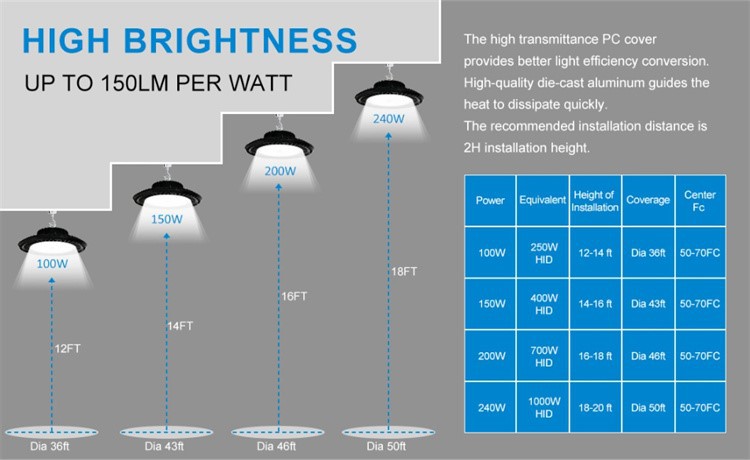
LED high bay lights consume significantly less energy than traditional MH or HPS fixtures. For example, a 100W LED high bay light can produce the same amount of light as a 400W MH fixture-a 75% reduction in energy use. This translates to lower electricity bills: a warehouse using 100 LED high bay lights instead of MH fixtures could save thousands of dollars per year in energy costs. Over the lifespan of the fixtures, these savings can far exceed the upfront cost of the LEDs.

2. Long Lifespan and Low Maintenance
LED high bay lights have a lifespan of 50,000–100,000 hours, compared to 10,000–20,000 hours for MH lights. This means LED fixtures need to be replaced much less frequently-often only once every 5–10 years, compared to every 1–2 years for traditional fixtures. Fewer replacements mean lower maintenance costs (no need to hire electricians to change bulbs regularly) and less downtime for facilities (no interruptions to operations while fixtures are being replaced).
3. Improved Safety and Productivity
In industrial and commercial spaces, poor lighting is a major safety hazard. Dark spots, glare, or dim light can lead to accidents, such as slips, falls, or equipment collisions. High bay lights-especially LEDs-provide uniform, bright light that eliminates dark spots and reduces glare, making spaces safer for workers. Better lighting also improves productivity: studies have shown that workers in well-lit environments are more focused, make fewer mistakes, and complete tasks faster than those in poorly lit spaces. For example, a manufacturing plant with LED high bay lights might see a 10–15% increase in productivity due to reduced errors and faster task completion.
4. Environmental Friendliness
LED high bay lights are more eco-friendly than traditional fixtures in several ways. They consume less energy, which reduces the demand for electricity from power plants (many of which burn fossil fuels, contributing to greenhouse gas emissions). They also contain no toxic materials like mercury (unlike MH or HPS lights), so they can be disposed of safely without harming the environment. Additionally, their long lifespan means fewer fixtures end up in landfills, reducing waste.
5. Versatility and Customization
Modern high bay lights-especially LEDs-offer a high degree of customisation to suit different needs. They are available in a range of lumen outputs (from 10,000 to 200,000 lumens) to match the size of the space, and they can be equipped with different optics (e.g., wide-angle lenses for open areas, narrow-angle lenses for shelving) to direct light where it's needed. Many LED high bay lights also come with smart features, such as dimming, motion sensors (to turn lights on/off when people are present), or connectivity to building management systems (to monitor energy use and schedule maintenance). These features allow facilities to tailor their lighting to their specific operations, further improving efficiency and convenience.
How to Select the Right High Bay Light
Choosing the right high bay light depends on several factors, including the height of the ceiling, the size of the space, the intended use, and the budget. Here are the key considerations to keep in mind:
1. Ceiling Height and Lumen Output
The height of the ceiling determines how many lumens the fixture needs to produce. For ceilings 15–20 feet (4.5–6 meters) high, a 10,000–20,000 lumen fixture is typically sufficient. For ceilings 20–30 feet (6–9 metres) high, a 20,000–40,000 lumen fixture is needed. For ceilings over 30 feet (9 metres) high, a fixture with 40,000+ lumens is required to ensure the light reaches the ground with enough brightness. It's also important to consider the "footcandle" level- the amount of light that reaches a surface (measured in lumens per square foot). Different applications require different footcandle levels: for example, warehouses need 20–50 footcandles, while manufacturing facilities may need 50–100 footcandles for detailed work.
2. Light Distribution (Beam Angle)
The beam angle of a high bay light determines how wide or narrow the light beam is. Wide beam angles (90–120 degrees) are best for open spaces with low to medium ceilings, as they spread light evenly across a large area. Narrow beam angles (30–60 degrees) are better for high ceilings or spaces with shelving, as they focus light downward onto specific areas (e.g., aisles or shelves) without wasting light on empty spaces.
3. Color Temperature and CRI
Colour temperature (measured in Kelvin, K) affects the "feel" of the light. Warm white (3000K–4000K) produces a soft, yellowish light that is comfortable for spaces where people spend a lot of time (e.g., gymnasiums, retail stores). Cool white (5000K–6500K) produces a bright, blueish light that is ideal for industrial spaces or areas where visibility is critical (e.g., manufacturing plants, warehouses), as it mimics natural daylight and helps reduce eye strain.
Color Rendering Index (CRI) measures how accurately a light source shows colors compared to natural light (on a scale of 0–100). For spaces where color accuracy is important (e.g., retail stores, manufacturing facilities, laboratories), choose a high bay light with a CRI of 80 or higher. For spaces where color isn't a priority (e.g., parking garages, loading docks), a CRI of 70+ may be sufficient.
4. Durability and Environmental Ratings
Look for high bay lights with high IP (Ingress Protection) ratings, which indicate their resistance to dust and moisture. IP65 is the minimum rating for indoor spaces with dust or humidity (e.g., warehouses, gymnasiums), as it means the fixture is dust-tight and protected against low-pressure water jets. For outdoor spaces or areas with heavy moisture (e.g., loading docks, pools), choose a fixture with an IP67 or IP68 rating, which offers better water resistance.
Also, consider the fixture's resistance to vibration (important for factories or facilities with heavy machinery) and temperature extremes (important for warehouses in hot or cold climates). LED high bay lights are generally more durable in these conditions than traditional fixtures.
5. Energy Efficiency and Certifications
Look for high bay lights with ENERGY STAR certification, which means they meet strict energy efficiency standards set by the U.S. Environmental Protection Agency (EPA). ENERGY STAR-certified fixtures use less energy and last longer than non-certified models, and they may qualify for rebates or tax incentives from utility companies or government agencies.
Also, check the fixture's efficacy (measured in lumens per watt, lm/W), which indicates how much light it produces per watt of energy. A higher efficacy means the fixture is more energy-efficient: look for LED high bay lights with an efficacy of 100 lm/W or higher.
6. Budget and Total Cost of Ownership
While LED high bay lights have a higher upfront cost than traditional MH or HPS fixtures, their long lifespan and low energy use mean they have a lower "total cost of ownership" (TCO)-the total cost of purchasing, installing, operating, and maintaining the fixture over its lifetime. When comparing options, calculate the TCO rather than just the upfront cost to get an accurate picture of value. For example, a \(200 LED high bay light may cost more upfront than a \)100 MH fixture, but the LED will save \(50–\)100 per year in energy and maintenance costs, making it cheaper in the long run.
The Future of High Bay Lights: Smart Technology and Sustainability
As technology advances, high bay lights are becoming even more efficient, intelligent, and sustainable. One of the biggest trends is the integration of smart features: many modern LED high bay lights can be connected to the Internet of Things (IoT), allowing facility managers to control them remotely via a smartphone app or building management system. For example, lights can be dimmed during off-peak hours, turned off automatically when no one is in the space (using motion sensors), or adjusted based on natural light levels (using daylight harvesting sensors). These features further reduce energy use-by up to 30% in some cases-and make it easier to monitor and maintain the fixtures.
Another trend is the use of advanced materials and designs to improve efficiency and durability. For example, some manufacturers are using heat-dissipating materials (like aluminum or ceramic) to keep LED chips cool, which extends their lifespan and maintains brightness over time. Others are designing ultra-thin, lightweight fixtures that are easier to install and require less space, making them ideal for tight or hard-to-reach areas.
Sustainability is also a key focus: manufacturers are using recycled materials in high bay light construction and designing fixtures that are easier to recycle at the end of their lifespan. Some companies are even offering "light-as-a-service" (LaaS) models, where customers pay a monthly fee for the use of high bay lights, and the manufacturer handles installation, maintenance, and replacement. This model reduces upfront costs for customers and ensures fixtures are properly maintained and recycled, further reducing environmental impact.
https://www.benweilight.com/industrial-lighting/led-high-bay-light/high-bay-led-shop-lights.html
Shenzhen Benwei Lighting Technology Co.,Ltd
Telephone: +86 0755 27186329
Mobile(+86)18673599565
Whatsapp :19113306783
Email:bwzm15@benweilighting.com
Skype: benweilight88
Web: www.benweilight.com
Our service:
1.Your inquiry related to our products or prices will be replied in 24 hours.
2.Well-trained and experienced staffs to answer all your enquires in fluent English.
3.OEM&ODM, we can help you to design and put into product.
4.Distributoership are offered for your unique design and some our current models.
5.Protection of your sales area, ideas of design and all your private information.