What is the Best Light to Penetrate Water?
The ability of light to penetrate water is a critical factor for a wide range of activities, from underwater photography and scientific research to diving and commercial fishing. Water is not a passive medium; it interacts with light through absorption and scattering, which vary based on the light's wavelength, water clarity, and environmental conditions. While no single light source works perfectly in all aquatic settings, certain types of light consistently outperform others in cutting through water. This article explores the science of light penetration in water, identifies the most effective light sources, and explains how to choose the right light for specific environments.
To understand which light penetrates water best, it is essential to first examine how light interacts with water molecules and suspended particles. When light enters water, two primary processes determine its fate: absorption and scattering. Absorption occurs when water molecules or dissolved substances-such as minerals, algae, or organic matter-absorb specific wavelengths of light, converting them into heat and reducing the light's intensity. Scattering happens when light hits suspended particles, like silt, plankton, or sediment, causing the light to bounce in random directions. This scattering blurs visibility and limits how far the light can travel. Together, these processes make water a far less transparent medium than air, with profound implications for which types of light are most effective.
Wavelength is the single most important factor in determining how deeply light penetrates water. The electromagnetic spectrum includes light with wavelengths ranging from long (red, orange) to short (blue, violet). In general, shorter wavelengths penetrate water more effectively because water molecules absorb longer wavelengths more readily. For example, red light (620–750 nm) is almost completely absorbed within the first 10–15 feet of clear water, making it useless for illuminating objects at greater depths. Orange light (590–620 nm) fares slightly better but is still absorbed within 25–30 feet. Yellow light (570–590 nm) can reach depths of 35–45 feet, but it is green (495–570 nm) and blue (450–495 nm) light that truly excel in penetrating water, often reaching hundreds of feet in clear conditions.
Blue light, with its short wavelength, is particularly effective in clear saltwater environments. In the open ocean, where turbidity (cloudiness from suspended particles) is low, blue light can penetrate to depths of 300 feet or more. This is why the ocean appears blue to the human eye-water scatters blue light more than other wavelengths, making it the most visible color at the surface. For deep-sea divers exploring clear ocean waters, blue light is indispensable, as longer wavelengths would be absorbed before reaching significant depths. Blue light's ability to minimize scattering in clear water makes it ideal for activities like deep-ocean photography, where preserving visibility at great depths is crucial.
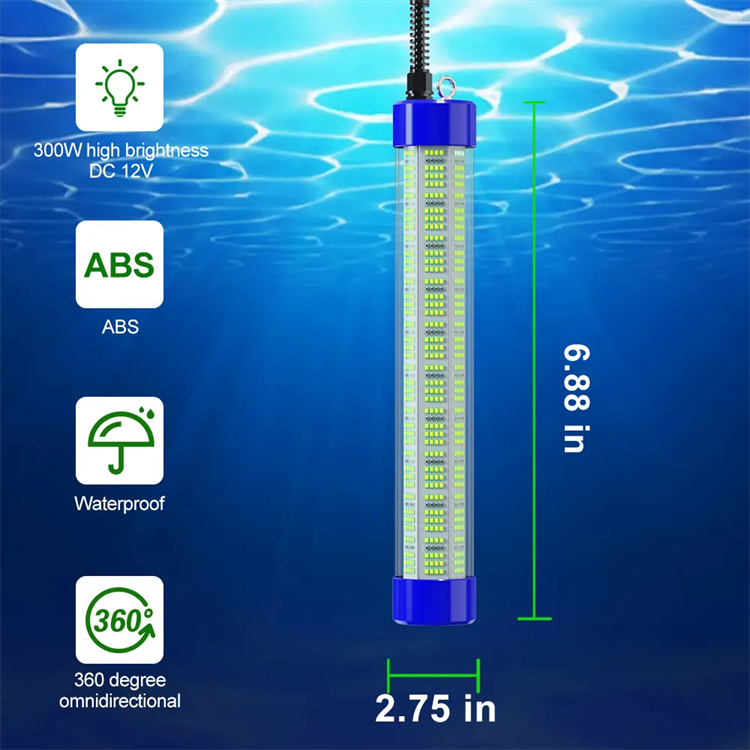
Green light, while having a slightly longer wavelength than blue, often outperforms blue in freshwater environments. Freshwater typically contains more algae, organic debris, and suspended particles than open saltwater, and these substances scatter blue light more aggressively. Green light, however, aligns with the absorption patterns of many aquatic plants and microorganisms, allowing it to pass through these particles more effectively. In a murky lake or river, green light can penetrate 20–30% farther than blue light, making it the preferred choice for freshwater fishing, inland diving, and lake research. For example, freshwater anglers use green LED lights to attract plankton and baitfish, as the light maintains visibility through the water's turbidity, creating a larger "light trap" for prey.
The distinction between freshwater and saltwater is key when selecting the best light for penetration. Saltwater, especially in open ocean settings, is often clearer with fewer suspended particles, creating optimal conditions for blue light. In these environments, blue light's short wavelength minimizes scattering, allowing it to travel farther and illuminate objects at greater depths. Deep-sea submersibles, for instance, rely on high-intensity blue LEDs to explore the ocean floor, where other colors would be absorbed long before reaching such depths.
Freshwater, by contrast, is frequently rich in organic matter and algae, which scatter blue light and reduce its effectiveness. Green light, with a wavelength that is less susceptible to scattering by these particles, becomes the better option. In a river with high levels of sediment or a lake during an algae bloom, green light can maintain visibility where blue light would be scattered into a useless glow. This is why many freshwater diving lights and fishing lanterns use green LEDs-they provide better penetration in the turbid conditions common in inland waters.
Turbidity, or the concentration of suspended particles in water, further influences which light is most effective. In highly turbid water-such as a silt-laden river after a storm or a coastal bay with heavy runoff-scattering dominates, and even short-wavelength light struggles to travel far. In these conditions, green light often remains more effective than blue because its wavelength is less likely to be scattered by larger particles like silt or sand. For example, in water with turbidity exceeding 50 nephelometric turbidity units (NTUs), green light can maintain visibility up to 5–10 feet, while blue light may be scattered to the point of uselessness within 3–5 feet.
In moderately turbid water (10–50 NTUs), such as a coastal estuary or a lake with moderate algae growth, the choice between green and blue light depends on the type of particles present. Algae, which contain chlorophyll, absorb blue light but reflect green light, making green the better choice in algae-rich water. Conversely, water with high levels of mineral particles (like sand or clay) may scatter green light more, giving blue a slight advantage. In many cases, a combination of green and blue light is used to balance penetration and visibility in these mixed conditions, ensuring that light can cut through different types of particles.
Beyond wavelength, the type of light source plays a significant role in penetration. Light-emitting diodes (LEDs) have revolutionized underwater lighting due to their efficiency and ability to emit specific wavelengths. Unlike incandescent or halogen bulbs, which produce a broad spectrum of light (including wavelengths that are quickly absorbed in water), LEDs can be engineered to emit only the most penetrating wavelengths-typically blue or green. This focused output ensures that no energy is wasted on wavelengths that do not contribute to visibility, making LEDs far more effective than traditional bulbs for underwater use.
LEDs also offer advantages in terms of intensity and durability. They produce more lumens per watt than other light sources, meaning they can deliver brighter light with less energy-a critical feature for battery-powered devices like dive lights. Additionally, LEDs are resistant to water pressure and vibration, making them suitable for deep-sea exploration or rugged freshwater environments. Many underwater LEDs are also dimmable, allowing users to adjust brightness based on turbidity and depth-reducing glare in shallow water and increasing intensity in deeper, darker conditions.
High-intensity discharge (HID) lights, while less common than LEDs, are another option for specialized applications. HID lights produce a powerful, focused beam that can penetrate water effectively, though they are bulkier and less energy-efficient than LEDs. They are often used in commercial settings, such as underwater construction or search-and-rescue operations, where maximum brightness is prioritized over portability. Like LEDs, HID lights can be filtered to emit blue or green light, enhancing their penetration in specific environments.
The angle of the light beam is another important consideration. A narrow, focused beam minimizes scattering by concentrating light in a specific direction, allowing it to travel farther than a wide, diffused beam. For example, a 1,000-lumen dive light with a 10-degree beam angle will illuminate objects farther than a 1,000-lumen light with a 60-degree angle, which spreads light over a wider area but with less intensity at a distance. Many underwater lights offer adjustable beam angles, combining the best of both worlds for versatile use-narrow for distance, wide for illuminating large areas in shallow water.
Practical applications highlight the real-world effectiveness of blue and green light. In recreational diving, blue LEDs are the standard for deep-ocean dives, where their ability to penetrate clear water ensures divers can navigate and observe marine life at depths of 100 feet or more. Green LEDs, on the other hand, are preferred for freshwater diving in lakes or rivers, where they cut through algae and sediment to reveal rocks, fish, and underwater structures.
Fishing provides another example of how light penetration influences performance. Anglers use green lights in freshwater to attract zooplankton, which in turn draw baitfish and larger predators. The green light's ability to penetrate murky water ensures the "light trap" extends far enough to create a feeding zone. In saltwater, blue lights are often used to attract squid and pelagic fish, which are sensitive to the short wavelengths that penetrate the open ocean.
Scientific research also relies on specific light wavelengths. Marine biologists studying deep-sea organisms use blue LEDs to illuminate their subjects without disturbing them, as many deep-sea creatures have evolved to detect blue light. Limnologists (scientists who study freshwater ecosystems) use green light to observe plant life and fish behavior in lakes, where green wavelengths better penetrate the organic-rich water.
It is important to note that no light can overcome extreme turbidity. In water so murky that visibility is limited to a few inches-such as a mudslide-affected river-even the best green or blue LEDs will struggle to penetrate. In these cases, proximity to the target is more important than the type of light; positioning the light close to the object of interest (e.g., a diver holding a light near a rock) is the only way to achieve visibility.
Environmental factors like depth and time of day also interact with light penetration. At extreme depths (200+ feet), even blue light is gradually absorbed, requiring very high-intensity LEDs or HID lights to maintain visibility. During daylight hours, sunlight supplements artificial light, with blue and green wavelengths from the sun enhancing the effectiveness of underwater lights. At night, artificial light must work alone, increasing the need for focused, high-intensity blue or green sources.
In conclusion, the best light to penetrate water depends on the environment: blue light excels in clear saltwater, where its short wavelength minimizes absorption and scattering; green light is superior in freshwater or turbid conditions, where it resists scattering by algae and sediment. LEDs, with their ability to emit focused wavelengths and high efficiency, are the most effective light sources for underwater use, outperforming traditional bulbs in both penetration and durability. By matching the light's wavelength to the water type and turbidity, users can maximize visibility for diving, fishing, research, or any other underwater activity.
https://www.benweilight.com/lighting-tube-bulb/underwater-fishing-light-15000-lumens-green.html