Luminous efficacy, usually measured in lumens per watt (lm/W), is a key metric for evaluating how efficiently a light source converts electrical energy into visible light. Its formula is:Luminous Efficacy=Power Consumption (watts)Total Luminous Flux (lumens)
Put simply, the higher this value, the more energy-efficient and brighter the luminaire. Under the LED technical standards for 2026, high-quality industrial-grade LED light sources typically achieve 150–180 lm/W, and laboratory results have even exceeded 220 lm/W.
Here are the core key points you must master about luminous efficacy:
Higher values mean lower costs: The higher the luminous efficacy, the less electricity is needed to achieve the same brightness, and the lower the heat dissipation costs will be.
It's more than a simple division: The system luminous efficacy of a complete luminaire is typically only 70%–85% of that of the LED chip, as the driver and lens consume part of the light output.
Temperature is a critical limiting factor: Every 10°C increase in junction temperature can reduce luminous efficacy by 3%–5%. This is why thermal design is critically important.
Color temperature comes with a trade-off: Warm white light (3000K) usually has lower luminous efficacy than cool white light (6500K), due to energy losses incurred during phosphor conversion.
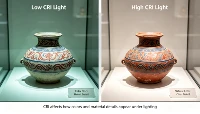
Balancing color rendering index: Pursuing a high color rendering index (Ra90+) will lower luminous efficacy by approximately 15%–20%, requiring trade-offs based on actual application scenarios.
The impact of driving current: Do not blindly increase the driving current to boost brightness. Excessive current not only causes light output degradation but also leads to a sharp drop in luminous efficacy, known as the LED droop effect.
Materials set the performance ceiling: High-quality silver-plated bracket layers and high-refractive-index silicone are key to improving the photon extraction efficiency.

Physical Definition and Logic of Luminous Efficacy
The physical definition of luminous efficacy is straightforward: it is the ratio of lumens to watts. If a 10-watt bulb emits 1000 lumens of light, its luminous efficacy is 1000 ÷ 10 = 100 lm/W. This ratio reveals how efficiently a light source converts electrical energy into light energy.
In physics, the theoretical maximum efficacy is 683 lm/W for 100% energy conversion into green light at a wavelength of 555 nm, which corresponds to the peak sensitivity of the human eye. Naturally, this is merely a theoretical value; in practical applications, our focus is on white light.
120 lm/W vs. 150 lm/W: What's the Difference?
Many clients ask me: "120 lm/W and 150 lm/W seem quite similar-why is there such a significant price gap?" In fact, this 30 lm/W difference represents a full generational leap in technology.
For engineering applications, if a shopping mall requires a total luminous flux of 1,000,000 lumens:
Lighting fixtures with 100 lm/W efficacy will require a total power consumption of 10,000 watts.
Lighting fixtures with 150 lm/W efficacy will only require a total power consumption of approximately 6,666 watts.
This translates to a 33% reduction in energy consumption! Not only are electricity costs reduced, but expenses for supporting equipment such as transformers, cables, and heat-dissipating aluminum profiles can also be significantly lowered. For factories and streetlights that operate 24/7, this difference in efficacy directly determines the return on investment (ROI) of the project.
Comparison of Luminous Efficacy Benchmarks for Common Light Sources

Key Points About Correction Factors
To accurately calculate the actual lumens per watt (lm/W) value, you must account for the following losses:
Driver Efficiency: Power drivers do not convert energy at 100% efficiency. High-quality drivers typically achieve 90%–95% efficiency, while low-quality ones may only reach 80%. This directly increases the denominator (power in watts).
Optical Lens Loss: Light covers and lenses block part of the light output. The light transmittance is usually between 85%–95%, which directly reduces the numerator (luminous flux in lumens).
Thermal Loss: The brightness of LED chips varies between cold state (25°C) and hot state (85°C). Generally, the brightness decreases by approximately 10% in the hot state.
Therefore, an LED chip rated at 160 lm/W may only have an actual measured luminous efficacy of around 116 lm/W when assembled into a finished luminaire, calculated as follows:160×0.9(Driver)×0.9(Lens)×0.9(Thermal Loss)≈116 lm/W
Understanding this conversion logic helps explain why some finished luminaire manufacturers hesitate to label actual measured values.

Phosphor Conversion Efficiency: The Magic of Light Color
Most white LEDs utilize blue LED chips to excite yellow phosphors. This process is called photoluminescence.
Formula is Critical: The ratio of aluminate phosphors to nitride phosphors directly affects luminous efficacy.
Conversion Loss: Blue light has a short wavelength and high energy, while yellow light has a long wavelength and low energy. This physical conversion process is inevitably accompanied by energy loss, known as the Stokes shift.
Technological Breakthrough: Our current chips adopt a high-temperature anti-settling process, which ensures the uniform distribution of phosphor particles, reduces the back-and-forth reflection and absorption of light internally, and thereby increases lumen output.
Many people overlook the role of adhesives and brackets.
High-Refractive-Index Silicone: LED chips have a high refractive index, while air has a low one. Light directly exiting the chip will be totally reflected back. High-refractive-index silicone acts like a bridge, guiding light out smoothly.
Silver-Plated Layer: The brighter and more oxidation-resistant the silver-plated layer on the bracket, the higher its reflectivity. At Hengcai Electronics, we adhere to the use of high-precision automatic production equipment to ensure the silver-plated layer thickness of every 5050 or 3535 LED chip bracket meets standards, preventing sulfidation and blackening, and maintaining long-lasting high luminous efficacy.
Why Doesn't Higher Wattage Equal Higher Lumens?
This is an extremely classic and persistent misunderstanding. Many non-professionals ask first when buying lights: "What's the wattage of this light?" as if higher wattage means brighter light. In fact, wattage only indicates how much "food" it consumes (power consumption), not how much "work" it does (light output).
The Invisible Killer of Luminous Efficacy
When you increase the power (wattage) of an LED, if heat dissipation cannot keep up, the junction temperature will rise rapidly. LED chips are semiconductors that are extremely sensitive to heat.
As temperature rises, lattice vibrations intensify, reducing the probability of electrons and holes recombining to generate photons.This is called thermal quenching.
The result is: you supply more electricity, but the brightness barely increases-instead, the luminous efficacy (lumens per watt) drops sharply.
The "Droop" Phenomenon of Luminous Efficacy
In semiconductor physics, there is a well-known Efficiency Droop curve. When the driving current density increases to a certain level, the internal quantum efficiency will decrease irreversibly. This is analogous to a person who can jog for a long time (high efficiency), but if you ask him to sprint 100 meters (high current, high wattage), he will quickly get exhausted (low efficiency).
Therefore, excellent LED designs often adopt "low current density" driving. For example, our SMD2835 series achieves the optimal lumens-per-watt ratio when operating at the rated current.
Differences in Packaging Types
Different packaging types vary in their capacity to handle wattage and luminous efficacy:
SMD2835: Featuring a large heat dissipation area, it is suitable for low to medium power applications. It boasts extremely high luminous efficacy and stands out as the king of cost-performance.
EMC3030: Adopting EMC thermosetting materials, it offers high temperature resistance and UV resistance. Ideal for high-power driving, it can still maintain excellent lumen output at high wattages.
Ceramic Series (1-5W): With superior thermal conductivity, it is specifically designed to address the thermal quenching issue under high wattage conditions.
Stokes Shift: The Cost of Warm Light
You may notice that for LED chips of the same specification, 6500K (cool white light) always has a higher lumen output than 3000K (warm white light). This is because generating warm light requires more red spectral components. The excitation efficiency of red phosphors is usually lower than that of yellow phosphors, and the energy loss (Stokes shift) is greater when converting high-energy blue light to low-energy red light.
Cool White Light: Less phosphor conversion, more blue light retained, and higher luminous efficacy.
Warm White Light: Thicker phosphor layer, more conversion processes, resulting in naturally lower luminous efficacy.