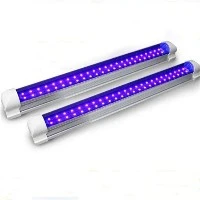
When purchasing UV lighting products, many customers ask the same question: UV blacklight lamps on the market all look similar, so why do some dim and yellow after only six months, while others can work stably for thousands of hours? The answer lies in several easily overlooked details: the lamp's material formula, the phosphor coating process, and the electrical design. This article will start from the principles and dissect how a truly "effective" UV Blacklight T8 lamp is made.
Core Light Emission Principle: Why 365nm/395nm?
The UV Blacklight T8 lamp is essentially a low-pressure mercury fluorescent lamp. Internally, it generates 253.7nm short-wave ultraviolet light through mercury vapor discharge. This is then converted into long-wave ultraviolet light (UV-A) by a special phosphor coating on the inner wall of the lamp. Common output wavelengths are concentrated around 365nm or 395nm.
The efficiency of this conversion directly determines the purity of the "black light effect" after the lamp is lit. Products with low conversion efficiency often have more visible light mixed in (manifesting as a purplish-white tint), resulting in insufficient actual UV intensity.
The Key Role of Glass and Phosphor Coating
High-quality UV black light tubes use specially made deep purple (Wood's Glass) or light-filtering glass tubes. Their function is to filter out most visible light, allowing only ultraviolet light and a very small amount of violet visible light to pass through.
The uniformity of the phosphor coating is equally important. Uneven coating thickness will lead to significant brightness differences at both ends of the tube, and over long-term use, it can easily cause accelerated local light decay. This is why industrial-grade tubes have strict control over the consistency of the phosphor coating process during production.
The Impact of Spectral Purity on Actual Results
Spectral purity can be understood as "how much stray light is mixed into the ultraviolet light." For applications such as banknote detection, fluorescence detection, pet urine stain detection, and stage effects, the more stray visible light there is, the worse the contrast of the fluorescence response, making the effect appear dull and lacking vibrancy.
High-purity spectral tubes produce brighter and clearer excited fluorescent substances, which is one of the most intuitive standards for judging whether a UV tube is "effective."
Electrical Compatibility and Start-up Stability
The T8 specification means the lamp tube diameter is 1 inch (approximately 25.4mm), requiring a compatible ballast (electronic or inductive). Incompatibility between the lamp tube and ballast electrical parameters can easily lead to flickering during startup, premature filament wear, or even failure to light up.
A well-designed UV Blacklight T8 lamp tube will typically have clearly marked electrical parameters (voltage, current, power), facilitating selection and compatibility by the purchaser based on existing luminaires or ballasts, reducing compatibility issues.
Lifespan and Light Decay Control
Light decay in UV lamp tubes is an unavoidable physical phenomenon, but the rate of decay can be controlled through manufacturing processes. The main factors affecting lifespan include:
Mercury dosage and release method (directly affecting long-term luminous stability)
Filament material and coating durability
Number of switching on and off (frequent start-stop cycles accelerate filament wear)
Generally, a stable UV T8 lamp has a rated lifespan of 8000-10000 hours, and the light output attenuation in the early and later stages is controlled within a reasonable range, rather than "getting dimmer with use."
Typical Application Scenarios
The effectiveness of UV Blacklight T8 lamps ultimately depends on their actual application scenarios. Common uses include:
Black light effect lighting in stage and entertainment venues
Counterfeit detection for banknotes and documents
Detection of pet urine and bodily fluid stains
Insect trapping lights
Morphological identification of minerals and gemstones
Industrial testing scenarios such as disinfection indicators and fluorescent flaw detection
Different scenarios have slightly different requirements for ultraviolet intensity and wavelength; parameters need to be confirmed based on the specific application when selecting a lamp.
Summary
The effectiveness of a truly high-quality UV Blacklight T8 lamp is not determined by a single factor, but rather by the combined effects of several factors, including phosphor conversion efficiency, glass filtering capability, spectral purity, electrical compatibility, and lifespan control. When purchasing, focusing solely on price and appearance can easily overlook these crucial manufacturing details that significantly impact actual performance.
If you are looking for stable and reliable UV Blacklight T8 lamps for stage effects, testing equipment, or special lighting projects, please contact us. We can provide recommendations on wavelength, power, lifespan, and other parameters based on your specific application scenario, and support sample testing and customization services. We look forward to receiving your inquiry.