Tomatoes have different requirements for spectrum at different growth stages. Reasonable spectrum matching can significantly improve their photosynthetic efficiency, flowering and fruiting rate, and fruit quality. The following is a detailed analysis of the spectrum required by tomatoes and suggestions for plant light selection:
1. Key spectrum components and functions
Function: Promote the robustness of stems and leaves, control leggy growth, enhance stomatal opening and chlorophyll synthesis.
Requirement stage: Seedling stage (accounting for 30%-40%) and growth stage (20%-30%), and the fruiting stage can be appropriately reduced.
Recommended wavelength: peak around 450nm.
Function: Drive the core reaction of photosynthesis, promote flowering, fruiting and sugar accumulation.
Requirement stage: A high proportion (50%-70%) is required throughout the entire cycle, and it can be increased to more than 70% during the fruiting period.
Recommended wavelength: 660nm (deep red light) has the highest efficiency.
Far-red light (700-800nm)
Function: Coordinate with red light to regulate light morphology (such as stem elongation, flowering time), and improve light energy utilization.
Recommended ratio: 5%-10% (red light: far-red light ≈ 4:1 can simulate natural light).
Other spectra
Green light (500-600nm): Penetrate the canopy to improve photosynthesis of lower leaves, accounting for 5%-10%.
UV-A (315-400nm): A small amount (<3%) can enhance stress resistance and secondary metabolites (such as lycopene).
Infrared light (>800nm): Usually no active addition is required, and excessive use may cause excessive growth.
2. Spectrum adjustment during the growth stage
Seedling stage:
Blue light is dominant (40% blue light + 50% red light + 10% others), preventing excessive growth and root development.
Growing period:
Balanced ratio (30% blue light + 60% red light + 10% far red light/green light) promotes leaf expansion.
Flowering and fruiting period:
High red light ratio (20% blue light + 70% red light + 10% far red light) improves fruit setting rate and sugar content.
3. Recommended plant light types
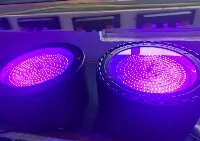
Preferred white light (including 450nm blue light + 660nm red light) + supplementary deep red/far red LED, close to sunlight, suitable for home planting.

Adjustable spectrum LED:
Applicable to professional greenhouses, dynamically adjust the blue-red ratio according to the growth stage (such as increasing blue light in the seedling stage).
COB integrated light source:
High light intensity and uniform distribution, suitable for large-scale planting, requires red light (660nm) module.
Fluorescent lamp (supplementary use):
Contains part of the blue-red spectrum, but the efficiency is low and is only used as an auxiliary.
4. Notes
PPFD (light intensity) requirements:
Seedling stage: 100-200 μmol/m²/s
Growing stage: 300-500 μmol/m²/s
Flowering and fruiting stage: 500-800 μmol/m²/s
Photoperiod:
Vegetative growth: 14-16 hours/day
Flowering and fruiting: 12-14 hours/day (too long may inhibit fruiting).
Thermal management: LED needs to ensure heat dissipation to avoid high temperature affecting light efficiency.
5. Example of economical solution
Household potted plants:
Choose 20W full-spectrum LED lamp (blue-red ratio 1:3), hanging height 30-50cm, supplement light for 12 hours per day.
Greenhouse planting:
Use adjustable spectrum LED strip lights, set the growth period (blue 30% + red 60%), and switch to (blue 20% + red 70% + far-red 10%) during the fruiting period.
By scientifically matching the spectrum and light intensity, the yield of tomatoes can be increased by 20%-30%, and the fruit flavor will be richer. In practical applications, it is recommended to optimize the lighting strategy in combination with environmental parameters (such as CO₂ concentration and temperature). for more tomato grow led light , you can check on http://www.benweilight.com