Why Do Cleanrooms Need "Yellow Light Tubes" to Block UV?
In cleanrooms for photosensitive industries such as semiconductor manufacturing, PCB production, and biopharma, workers often operate under yellow light. Why do such precision environments require yellow lighting instead of white or ordinary LED tubes? The answer lies in ultraviolet (UV) radiation – an invisible hazard present in daylight and most artificial light sources that can silently ruin product yields.
Photoresist, a key photosensitive material used in integrated circuit (IC) and printed circuit board (PCB) manufacturing, is typically sensitive to wavelengths below 450 nm. If UV or blue-violet light from ordinary white lighting is present in the cleanroom, the photoresist may undergo unwanted chemical reactions during non‑exposure steps, leading to loss of circuit pattern accuracy and scrapping of entire wafer batches. Data indicates that UV‑related illumination leakage accounts for a notable proportion of defects in photolithography processes. Therefore, strictly controlling the working light wavelength above 500 nm is a core technical requirement for ensuring high yield.

1. Technical Breakdown: Three Core Barriers of Anti‑UV LED Tubes
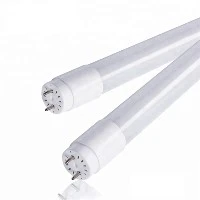
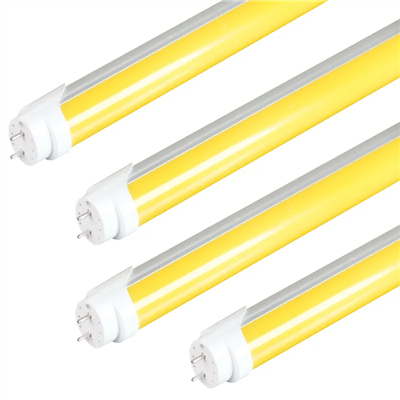
For semiconductor and cleanroom lighting, the Benwei T8 Yellow LED Anti‑UV tube incorporates the following three key technologies:
1.1 Spectral Cut‑off Technology – Blocking Wavelengths Below 500 nm
Ordinary LED tubes emit blue light (approx. 450–495 nm) and UV radiation, which are highly sensitive to photoresist materials. Yellow LED tubes use special phosphor formulations and optical filters to restrict the emission spectrum to the safe yellow range (approx. 565–590 nm), achieving zero transmittance for wavelengths below 500 nm. The light source contains only pure yellow spectrum within the safe band, causing no exposure interference to photosensitive materials.
1.2 High Efficacy & Low Thermal Management – Ensuring Stable Operation
With high‑efficacy LED chips (100‑120 lm/W) and isolated drivers, the tube maintains adequate illuminance for precision tasks after UV filtering, while reducing heat generation to avoid secondary interference from thermal radiation.
1.3 V2 Flame Retardancy & Long‑Life Materials – Compliant with Cleanroom Standards
Cleanrooms require dust‑proof, anti‑static, and anti‑fracture luminaires. The yellow LED tube uses virgin PC material and an aluminium alloy heat sink, achieving V2 flame retardancy and complying with GB/T 24461‑2023 technical requirements for cleanroom luminaires, preventing micro‑particle generation.
2. Application Scenarios – Which Industries Must Use Anti‑UV Yellow Light Tubes?
| Industry | Core Problem | Anti‑UV Yellow LED Solution |
|---|---|---|
| Semiconductor wafer fabrication | Photoresist highly sensitive to light <500 nm; ordinary lighting causes unwanted exposure | Delivers pure yellow spectrum (>500 nm), eliminates premature photoresist curing |
| PCB / FPCB production | UV leakage outside exposure tools causes pattern accuracy deviation | Provides complete blocking of wavelengths <500 nm, ensures alignment precision |
| LCD panel / OLED manufacturing | Photo‑alignment films and PI liquids sensitive to blue light, risking display defects | Safe yellow environment ensures liquid crystal alignment process integrity |
| Museums & archives | UV radiation accelerates fading of artefacts and embrittlement of paper | 100% UV elimination, extends preservation life of valuable collections |
| Biopharma & R&D labs | UV interference affects fluorescence detection and photosensitive reagents | Provides stable, UV‑free environment, ensuring data accuracy |
Photolithography areas in semiconductor cleanrooms typically require 500‑750 lx illuminance with uniformity above 0.7. Anti‑UV LED tubes fully meet these requirements.
3. How to Select the Right Tube for Your Cleanroom
Compared with ordinary white/cool white LED tubes – which carry risks of blue light and potential UV leakage for photoresist – the T8 Anti‑UV Yellow tube eliminates process hazards at the source, while still providing adequate visibility for basic operational tasks.
4. Industry Trend – Why Upgrade Your Lighting Solution Now?
According to the LED Tube Light Market report, the global market reached US$5.0 billion in 2025 and is projected to grow to US$10.5 billion by 2034, at a CAGR of 8.40%. The Asia‑Pacific region, with its high concentration of semiconductor and panel manufacturing, shows particularly rapid demand growth for special anti‑UV lighting.
On the regulatory front, China national standards GB/T 39771.1‑2021 (Photobiological safety of LED – classification) and GB/T 30117.7‑2026 (Photobiological safety of lamps and lamp systems) have set strict requirements on UV and blue light radiation limits. The industry is accelerating towards safer, more specialised lighting solutions.
5. Buying Guide – 4 Key Parameters When Selecting T8 Anti‑UV Yellow Tubes
| Parameter | Recommended Specification | Reason |
|---|---|---|
| Wavelength cut‑off | Strictly <500 nm (preferably ≤500 nm full blocking) | Core indicator of anti‑UV performance; directly determines photoresist safety |
| Efficacy & illuminance | ≥100 lm/W; design for cleanroom needs (500‑750 lx for photolithography area) | Ensures sufficient working brightness after UV filtering, prevents eye fatigue |
| Driver & thermal design | Isolated driver + aluminium heat sink | Guarantees 24/7 operational stability, extends service life |
| Certifications & warranty | CE, RoHS, etc.; warranty ≥3 years (5 years recommended) | Lowers long‑term maintenance costs, ensures compliance and reliability |
It is also advisable to request third‑party photobiological safety test reports from suppliers, confirming that UVA radiation intensity meets GB/T 39771.1‑2021 requirements.
Conclusion
Anti‑UV yellow LED tubes are not just "changing the colour" – they are a systematic solution combining spectral cut‑off technology, cleanroom‑compatible design, and high‑efficiency LED lighting. From semiconductor wafer fabrication and museum conservation to PCB production and biopharma R&D, they are becoming the industry standard for photosensitive environments.
With the global LED lighting market expected to grow from US$123.24 billion in 2026 to US$336.9 billion by 2034 (CAGR 13.40%), and the UV LED market expanding at over 10% CAGR, the technical upgrade and market penetration of anti‑UV specialised lighting will continue to accelerate.