When you attend a night baseball game, you may have observed that metal halide (MH) bulbs don't start off with their maximum light intensity. Because of this, stadiums usually switch them on before dusk when it's not quite dark enough to need their illumination. Rensselaer Polytechnic Institute's Lighting Research Institute reports:
"[Metal halide (MH) lamps] take one to fifteen minutes to produce 90% of their maximum amount of light. The term "warm-up" (or "run-up") time" refers to this time. A light cannot be turned back on right away after being lit for a while and then turned off. The arc tube needs time to cool down before the lamp can be turned back on; otherwise, the light won't restart. The restrike time is the name given to this time frame. Restrike periods for conventional probe-start MH lamps can last up to 15 minutes, although they are often significantly shorter for pulse-start MH lamps. Manufacturer's documentation states that pulse-start MH lamp restrike times can be more than twice as quick as probe-start MH lamp restrike timings.
The warm-up phase being discussed is similar to what you would often witness in a huge stadium or on a recreational field when the metal halide lights are first switched on. A very faint glow emanates from the bulb, which gradually gets brighter when it is left on for extended periods of time. The mechanical design of the light itself is the cause of this. The arc lamp type is metal halide. Similar to mercury vapor, high pressure sodium, and fluorescent bulbs, it operates as a high intensity discharge (HID) light. During bulb operation, special salts inside the tube—a combination of mercury and metal halides—vaporize into plasma. A temperature of several thousand degrees Celsius must be reached for the bulb to work. The internal salts evaporation and resulting change in light output quality occur when the light warms up. To reach its maximum strength, something needs time (thus the warm-up period).
While being commonplace in stadiums all around the country, metal halide lights are increasingly being replaced with LED lighting. Although metal halide does offer high-quality illumination, there are some significant disadvantages to its use, such as the inability to turn the lights back on once they have been turned off. Also, they use a lot of energy and take time to warm up. These problems can be solved with LED illumination, and many sporting arenas have already made the move.
Although completing a large-scale retrofit is a huge job, it will quickly pay for itself via savings on maintenance and consumption expenses as well as any applicable rebates. Also, there are several methods to pay for an LED upgrade (read here to learn more). Examining an LED conversion is definitely worth the effort for governments that manage recreational grounds or for companies that run athletic venues. Years ago, metal halide lights could have been the best option, but LED technology is the way of the future.
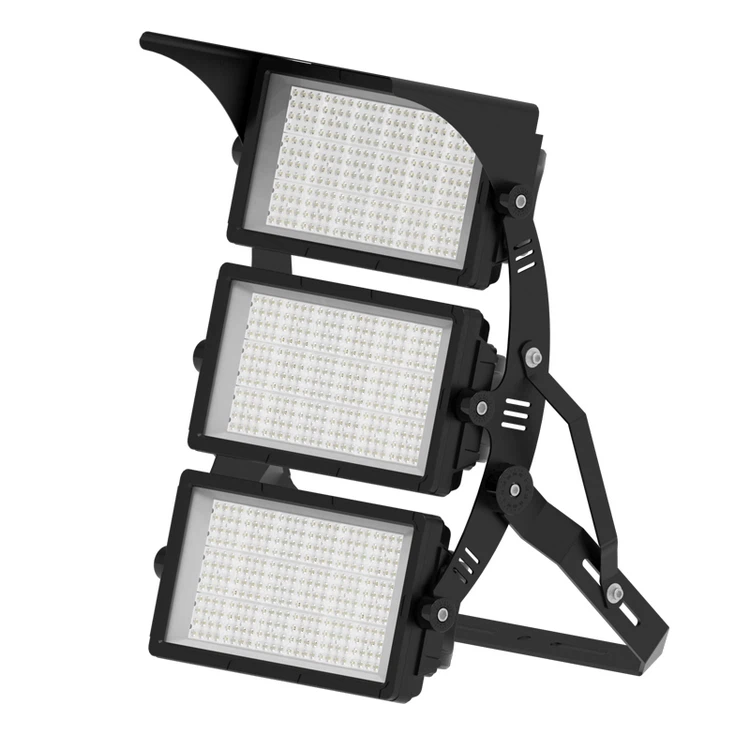
Benwei stadium flood light
【Power】500W
【Input Voltage】AC85-265V,400V
【Lighting Effect】150lm/W
【CRI】Ra≥70
【IP Rate】IP66
【Beam Angle】30°/60°/90°optional
【CCT】2700-6500K
【PF】PF≥0.95
【Surge Protection】≥4KV