Why Do Photochemical Reactions Need "Custom Wavelength" UV LED? Key Data Reveals the Answer
In laboratories, industrial production lines, printing, curing, disinfection, and inspection, ultraviolet (UV) light is an indispensable tool. However, traditional mercury lamps emit a broad spectrum of UV light, and often only a small portion of the wavelengths is actually used. The rest either wastes energy or causes unwanted side reactions.
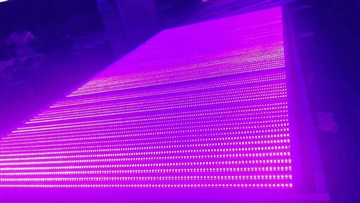
Today, customizable wavelength and power UV LED lamps are replacing mercury lamps as precision tools in the photochemistry field. Using real measured data from a specific product as an example, this article explains why "accurate wavelength, narrow half-width, and adjustable power" are the core values of UV LEDs.
1. Wavelength Is Not "The More Purple, the Better" – It Must Be Precisely Matched
Different photochemical reactions require different photon energies. The shorter the wavelength, the higher the energy per photon, but the lower the penetration depth. This product offers multiple wavelength options from 254nm to 440nm, covering UVC, UVB, UVA, and near‑UV bands:
| Wavelength Range | Typical Wavelengths | Main Applications |
|---|---|---|
| UVC (200–280nm) | 254nm, 265nm, 275nm | Disinfection, DNA/RNA damage, mineral fluorescence |
| UVB (280–315nm) | 320nm | Phototherapy, specific photochemical synthesis |
| UVA (315–400nm) | 365nm, 395nm | Curing, ink drying, oil leak detection, forensic inspection |
| Near‑UV (400–440nm) | 420nm, 440nm | Photocatalytic oxidation, specialty photosensitive material reactions |
✅ Selection tip: First identify the absorption peak of the photoinitiator or target molecule in your reaction system, then select the corresponding wavelength. A deviation of ±5nm is acceptable; more than 10nm will significantly reduce effectiveness.

2. Half‑Width (FWHM) – A Key Indicator of UV LED "Purity"
Many users look only at the peak wavelength but ignore Full Width at Half Maximum (FWHM) . FWHM indicates the width of the spectral peak – the smaller the value, the "purer" the spectrum and the more concentrated the energy.
From the measured spectral data (OHSP350UVS) provided for the product:
| Parameter | Measured Value | Meaning |
|---|---|---|
| Peak wavelength | 256.5 nm | Point of highest energy |
| Center wavelength | 257.6 nm | Symmetry center of the spectrum |
| Half‑width (FWHM) | 12.1 nm | Extremely narrow spectrum; energy is highly concentrated |
| UVC irradiance | 18,241.94 µW/cm² | Effective intensity for sterilization/reaction |
For reference: The UV band of a traditional mercury lamp typically has an FWHM of 20–40nm and contains many useless spectral lines. A 12.1nm FWHM means over 90% of the UV energy is concentrated near the target wavelength, greatly improving reaction efficiency.
For photochemical experiments or industrial curing that require precise control of reaction rates, a narrow‑FWHM UV LED offers an irreplaceable advantage.
3. Customizable Power: From 10W to 1200W, Covering Lab to Mass Production
This product offers multiple power options: 10W, 50W, 100W, 200W, 300W, 400W, 500W, 600W, 700W, 800W, 900W, 1000W, 1200W.
| Power Range | Suitable Applications |
|---|---|
| 10–100W | Laboratory trials, sample testing, localized curing |
| 200–500W | Pilot scale, small production lines |
| 600–1200W | Industrial mass production, large‑area irradiation, high‑speed curing |
High‑power UV LEDs must be paired with efficient thermal management (such as copper substrates, fan cooling, or water cooling). Otherwise, rising junction temperature leads to wavelength shift and rapid light decay. This product supports customized cooling solutions.
4. Application Scenarios: From Disinfection to Photocatalysis – One Light, Many Uses
According to the product description, this UV LED lamp is suitable for the following fields:
- Photochemical reactions – e.g., photocatalytic degradation of organics, photosynthesis
- UV curing – Inks, adhesives, coatings cure in seconds under 365nm/395nm
- UV disinfection – 254nm/265nm/275nm UVC efficiently kills bacteria and viruses
- Mineral detection – 254nm excites fluorescence
- Oil leak detection – 365nm/395nm makes oil stains emit visible fluorescence
- Forensic / anti‑counterfeiting – 365nm reveals latent fingerprints and security marks
- Photocatalytic oxidation – 365nm excites TiO₂ and similar catalysts
The same device can be adapted to different reaction needs by simply swapping LED modules of different wavelengths – a level of flexibility impossible with traditional mercury lamps.
5. Customization Capability: Wavelength, Power, Size, Cooling – All Tailored
This product explicitly supports full customization:
- Wavelength combination (multiple wavelengths can be mixed)
- Power density (W/cm²)
- Emission area (point source, line source, area source)
- Cooling method (passive, fan‑cooled, water‑cooled)
- Packaging (IP rating, housing material)
For equipment integrators or R&D institutions, this means you can seamlessly embed the UV LED into your own equipment rather than buying standard lamps and modifying them.

6. Summary: How to Choose a Reliable UV LED Lamp for Photochemical Reactions?
| Parameter | Recommended Standard |
|---|---|
| Wavelength accuracy | Center wavelength deviation ≤ ±5nm |
| Half‑width (FWHM) | ≤ 15nm (the narrower, the purer) |
| Irradiance | Calculate based on reaction needs; request a measured spectral report from the supplier |
| Power | 10–100W for lab use; >200W for production lines |
| Thermal design | Active cooling mandatory for high power; otherwise severe light decay |
| Customization | Wavelength, power, size, interface should all be adjustable |
| Safety certifications | CE, RoHS, etc. UVC products must have safety interlock design |
A UV LED is not a "lighting tool" – it is a precision photochemical process component. When selecting one, remember the four essentials: accurate wavelength, narrow half‑width, sufficient power, and good thermal management – none can be overlooked.
Need the most suitable UV LED solution for your specific photochemical reaction? Provide your target wavelength, irradiation area, and required irradiance intensity, and we will deliver a customized spectral solution and quotation.