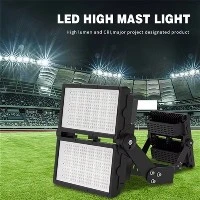
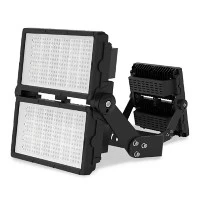
Why the 1000W LED Floodlight Is the First Choice for Professional Football Stadium Lighting?
Sports lighting demands are far higher than ordinary outdoor lighting. Players need a clear, glare‑free view; spectators expect bright, uniform illumination; broadcasters require flicker‑free, high‑definition images; and facility operators want energy savings, durability, and low maintenance.
When a 1000W LED floodlight can meet all these requirements at once, it is no longer just "a lamp" – it becomes a complete sports lighting system. Using a professional football stadium LED floodlight as an example, this article explains the key technologies that truly determine quality in sports lighting.

1. 150–180 lm/W: Brighter Light, Less Energy
Traditional 1000W metal halide lamps deliver only 80–100 lm/W and suffer from rapid lumen depreciation. This fixture uses Lumileds 5050 SMD chips, achieving 150–180 lm/W:
| Comparison | Traditional 1000W Metal Halide | 1000W LED Floodlight |
|---|---|---|
| Actual power | ~1000W | 1000W |
| Luminous flux | ~80,000–100,000 lm | 150,000–180,000 lm |
| Annual electricity cost (12h/day @ $0.12/kWh) | ~$1,314 | Same power, but significantly higher illuminance |
| Replacement ratio | Baseline | 1 LED replaces 1.5–2 metal halide units |
Result: To achieve the same illuminance standard (e.g., FIFA 200–500 lux for training), the number of LED fixtures can be reduced by 30%–50%, and overall energy consumption is cut by more than 50%.
2. Professional Anti‑Spill Light Shield: Solving "Light Pollution"
Football stadiums are often located near residential areas or within urban environments. Upward or sideways light spill from conventional fixtures causes light pollution, leading to complaints from neighbors and even violations of local lighting regulations.
This fixture features a professional anti‑spill light shield that:
- Precisely controls light within the target area
- Drastically reduces light above the horizontal plane (upward spill)
- Minimizes impact on nearby homes and the night sky
For contractors working on municipal or commercial stadium projects, this design is critical for passing environmental inspections.
3. Multiple Beam Angles: Adaptable to Different Mounting Positions
A stadium requires different beam angles to cover various areas – the field, stands, running tracks, etc. This product offers 25°, 45°, and 60° as standard (plus a custom 10° narrow beam with CREE chips).
| Beam Angle | Best‑suited Application |
|---|---|
| 10° | Long‑distance projection (high‑mast poles, tower lighting) |
| 25° | Center of the field, key focus areas |
| 45° | Mid‑field and lower stands |
| 60° | Wide area coverage – edges, corners, running tracks |
By combining different beam angles, overall uniformity >0.7 can be achieved, meeting professional training and amateur competition requirements.

4. MEANWELL Driver + IP67 + IK08: Industrial‑Grade Reliability
Stadium lights are exposed to wind, rain, thunderstorms, and extreme temperatures. The driver and housing protection are crucial.
| Component / Parameter | Specification | Why It Matters |
|---|---|---|
| Driver | MEANWELL ELG series | Globally recognized high‑reliability brand; high constant‑current accuracy; >50,000h lifetime |
| Ingress protection | IP67 | Fully dust‑tight; can be immersed in 1m of water for 30 minutes – heavy rain and power washing are no problem |
| Impact resistance | IK08 | Withstands 5 joules (equivalent to a 1.7kg weight dropped from 30cm) – protects against hail or vandalism |
| Operating temperature | -30℃ to +50℃ | Suitable for most climates worldwide |
For buyers: This means even when installed on exposed high masts or rooftops, the fixture runs reliably for years, greatly reducing the risk of maintenance at height.
5. CRI ≥ 80: More Than Brightness – Visual Quality
The Color Rendering Index (CRI) of stadium lighting directly affects the visual experience of players and spectators. When CRI < 70, colors are distorted – players may struggle to distinguish team jerseys from the grass.
This product offers CRI ≥ 80, which is above the acceptable threshold for sports lighting. For venues requiring HD broadcasting, higher CRI versions (e.g., 90+) are available.
💡 Note: The product FAQ includes a reminder – "Some suppliers may falsely advertise high CRI values, so be careful." This confirms the transparency and credibility of the specifications.
6. 50,000h Lifespan + 5‑Year Warranty: Predictable Total Cost of Ownership
- L70 lifetime: 50,000 hours (~22 years at 6 hours/day)
- Warranty: 5 years (covers both driver and light source)
- Certifications: CE, RoHS, EMC, LVD, ISO9001
For stadium operators, this means:
- Accurate calculation of annual lighting costs
- No unexpected maintenance budget during the warranty period
- Full certifications to meet tender and insurance requirements

7. Typical Applications
| Venue / Scenario | Why It Fits |
|---|---|
| Professional football (training / amateur matches) | 1000W × multiple beam angles achieve 200–500 lux |
| Rugby / hockey fields | Wide beam angles cover large areas |
| Outdoor basketball / tennis courts | Lower wattage versions available |
| Equestrian arenas | Anti‑spill shield reduces glare and startle to horses |
| Large squares / ports / mining sites | IP67 + IK08 withstand harsh environments |
8. Key Purchasing Considerations
| Factor | Recommended Standard |
|---|---|
| Efficacy | ≥150 lm/W – essential for energy savings |
| LED brand | First‑tier brands such as Lumileds, CREE – ensures lumen maintenance |
| Driver | MEANWELL or equivalent – the foundation of long‑term reliability |
| Ingress protection | IP65 minimum; IP67 recommended for stadiums |
| Anti‑spill design | Must be included, otherwise risk of light pollution complaints |
| Beam angle options | At least 2–3 options to fit different mounting positions |
| Certifications | CE, RoHS, EMC, LVD – mandatory for export |
| Warranty | 5 years or more |
Bottom Line: Stadium Lighting Is Not "The Brighter, the Better" – It's "The More Precise, the Better"
A professional 1000W LED floodlight, with its high efficacy, precise optical control, reliable driver, and robust protection, can significantly improve athlete performance and spectator experience without increasing electricity bills. For contractors, stadium operators, or municipal procurement teams, choosing proven products and brands means long‑term economic benefits and a strong project reputation.
Need a custom lighting plan for your sports venue? Provide us with the field dimensions, pole height, and target illuminance level, and we will deliver IES files and a layout simulation report.