A Practical Guide to LED Strip Wiring & Power Supplies

While wiring and power supplies may not be the most glamorous aspects of LED strip lighting, they form the critical foundation of any successful installation. Proper electrical setup ensures not only optimal performance but also long-term reliability and safety.
This guide breaks down the essentials of LED strip power and wiring in clear, actionable terms.
Understanding LED Power Supplies
The Role of Power Supplies
LED strips operate on low-voltage direct current (DC) - typically 12V or 24V - while household outlets deliver high-voltage alternating current (AC). The power supply (also called an LED driver or transformer) bridges this gap by converting 230V AC to a stable DC voltage that your LEDs can safely use.
Attempting to connect LED strips directly to mains power will instantly destroy them. The power supply acts as a protective intermediary, ensuring your LEDs receive clean, regulated power.
Selecting the Correct Voltage
Always match your power supply voltage to your LED strip's requirements. Using a 12V power supply with a 24V strip will result in poor performance, while connecting a 24V supply to a 12V strip will permanently damage the LEDs.
Calculating Power Supply Capacity
To determine the appropriate power supply size:
Calculate total wattage: Strip wattage per metre × total length
Add 20% safety margin: Total wattage × 1.2
Select a power supply with equal or greater capacity
Example:
5 metres of 9.6W/m strip = 48W
With 20% buffer: 48W × 1.2 = 57.6W
Recommended: 60W power supply
Pro Tip: Never round down when selecting power supply capacity. Operating at 80% of maximum capacity or less extends component lifespan and improves safety.
Efficiency Considerations
High-efficiency power supplies (85-95% efficiency) convert more electricity into usable light while generating less heat. This reduces operating costs and improves system longevity.
Wiring Fundamentals
Wire Gauge Selection
Wire thickness (measured in AWG - American Wire Gauge) directly impacts performance. Thinner wires have higher electrical resistance, causing voltage drop over distance.
General guidelines:
Short runs (under 3m): 18-20 AWG
Medium runs (3-8m): 16-18 AWG
Long runs (over 8m): 14-16 AWG
Remember: Lower AWG numbers indicate thicker wires with lower resistance.
Wiring Configurations
Series Wiring

Connects strips end-to-end in a single chain
Suitable for short runs (under 3m for 12V, 5m for 24V)
Voltage drop becomes significant in longer runs
Single point of failure can affect entire chain
Parallel Wiring
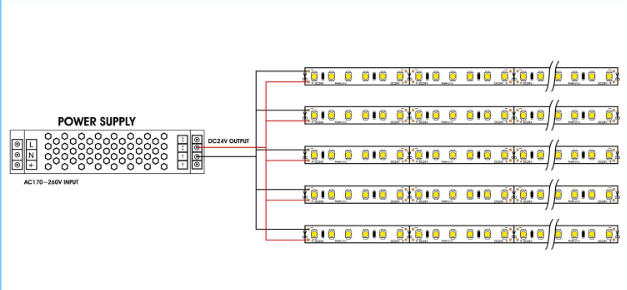
Connects each strip directly to power supply
Maintains consistent brightness across all sections
Prevents single failures from affecting other strips
Requires more wiring but offers superior performance
Connecting Multiple Strips
Maximum recommended run lengths:
12V strips: 3-5 metres
24V strips: 5-10 metres
For longer installations:
Use parallel wiring from the power supply
Employ signal amplifiers for RGB/RGBW systems
Power from both ends to minimize voltage drop

Managing Voltage Drop
Voltage drop manifests as progressive dimming along an LED strip, particularly noticeable in longer runs. This occurs due to natural electrical resistance in the wires and strip circuitry.
Prevention Strategies:
Choose 24V systems for longer runs
Position power supplies close to installation points
Use appropriate wire gauges
Implement parallel wiring configurations
Power long single runs from both ends
Safety Considerations
Despite operating at low voltages, proper safety practices remain essential:
Circuit Protection
Install fuses or breakers rated slightly above your system's current draw
Example: 3A fuse for a 2.5A system
Load Management
Maintain the 20% power buffer
Avoid daisy-chaining multiple strips to a single power supply
Connection Security
Use insulated connectors or proper soldering techniques
Secure all connections against vibration or movement
Environmental Protection
Use IP-rated components in damp locations
Keep wiring away from heat sources
Seal outdoor connections against moisture
Regulatory Compliance
All mains voltage work should comply with local electrical codes
Consult qualified electricians for mains connections

Common Installation Mistakes
Voltage Mismatch
Always verify strip and power supply compatibility
Undersized Power Supplies
Calculate total load including safety margin
Improper Connections
Ensure solid mechanical and electrical connections
Maintain correct polarity (+ to +, - to -)
Excessive Series Length
Use parallel wiring for runs exceeding manufacturer recommendations
Inadequate Wire Sizing
Select appropriate gauge for run length and current load
Key Takeaways
Match power supply voltage exactly to LED strip requirements
Calculate total wattage and add 20% safety margin
Select appropriate wire gauge for your installation
Prefer parallel wiring for multiple strips or long runs
Implement proper fusing and circuit protection
Use IP-rated components in moisture-prone areas
Consult professionals for mains electrical work
By following these guidelines, you can create LED lighting installations that deliver consistent performance, long service life, and professional-quality results.
Note: This information provides general guidance for low-voltage DC installations. Always consult manufacturer specifications for your specific components and local electrical codes for compliance requirements.