Agricultural LED lighting employs a driverless AC system.
Companies like Once Innovations are advancing with energy-efficient LED-based agricultural lighting that improves animal wellness and increases productivity at a lower cost, regardless of official performance criteria and rebate incentives.
When proprietary technology uses a color-mixing strategy to blend monochromatic hues to boost reds and greens and generate a more consistent, adjustable, dimmable light throughout the whole spectrum, it will outperform generic white LED technology (Fig. 1 here). The traditional RGB arrays used in displays are powered by pulse-width modulated DC pulses; the duty cycle of the DC pulses is adjusted to regulate the turn-on time for each LED. In contrast, AgriShift directly drives its LEDs using a patented stepped AC voltage. This method saves money and space while enhancing dependability since it does not need an AC/DC switch-mode driver or an EMI filter. Due to the fact that all birds, including fowl, are particularly sensitive to EMI noise, the low-EMI method is equally significant from the standpoint of animal welfare.
The AgriShift product's AC technology is distinctive in that it uses a straightforward analog architecture to achieve a rather challenging goal. The circuitry removes the need for complicated digital switching circuitry by stringing together LEDs at different specified voltage levels and connecting it with a proprietary switching FET. This allows it to provide the necessary driving current waveforms without the need of such equipment. In essence, the LEDs respond to the provided AC voltage by producing their own current waveform. The color spectrum may be altered by adjusting the kind of LEDs in each string (using a mixture of monochromatic color and white LEDs) and by using various voltage settings. Using conventional dimming technologies, this design makes it simple to create a color-shifting light fixture. It also does away with the intricate DC control circuitry that color-changing lighting systems have often employed. The resultant light fixtures work seamlessly with current barn lighting management systems, making the transition to the new technology simple for farmers.
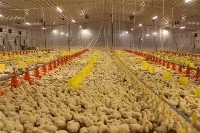
In addition to a sunrise/sunset mode that changes the spectrum toward red as the light is dimmed, AgriShift lamps may be dimmed from 2% to 100%. The lamp generates a complete spectrum with no fading, which is perfect for promoting growth throughout the early stages of chicken development (brood lighting). Blues, greens, and increased reds can all still be present to support muscle development during grow-out, although dimming may be reduced to 30%. Full dimming is utilized for moonlight, and monochromatic blue is used to soothe hens, curb their aggressive feeding tendencies, and make capture easier. The spectral change from white to monochrome that takes place when a typical triac dimmer is used to dim an AgriShift VOBF (Variable Output Broiler Fixture) chicken light is shown in Fig. 2.

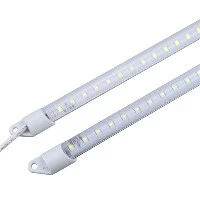
AgriShift lights use only 2–14W and produce 200–950 lm with less than 20% total harmonic distortion and a power factor of over 97%. (THD). Another benefit of the analog AC design, which offers smooth transitions and controls transient reactions, is its low THD. Depending on the animal behavior being addressed, the individual lights may be configured with a range of LEDs, form factors, and input voltages.