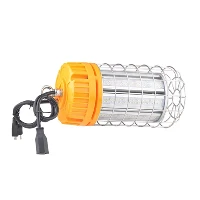
Temporary work lights are widely used on construction sites, in interior renovations, for emergency repairs and maintenance, and in temporary exhibition spaces. These lights need to be frequently moved, hung, and subjected to impacts, as well as dust, rain, and vibration. Traditional halogen temporary lights are prone to burnout and have fragile glass, leading to frequent replacements and project delays.
Many engineering procurement and trading clients are concerned about the actual durability of LED temporary work lights. Can they truly withstand the harsh environments of construction sites? What structural features determine their lifespan? What are the differences between low-priced and industrial-grade models?
This article analyzes the durability advantages, weaknesses, key hardware components, and selection recommendations of LED temporary work lights based on actual construction site usage conditions, helping you quickly determine if a product is suitable for your project.
Durability Advantages of LED Temporary Work Lights Compared to Traditional Lighting Fixtures
Traditional halogen and metal halide temporary lights rely on filaments for light emission, and their fragile glass casings are easily damaged by impacts or voltage fluctuations. LEDs, on the other hand, have a much stronger impact resistance.
Filament-free structure: LEDs are solid-state light-emitting chips without easily broken filaments. They are less likely to be directly extinguished or damaged by minor impacts or vibrations, making them suitable for construction site handling and suspended, swaying conditions.
Theoretically, the light source lifespan can reach 50,000 hours. With prolonged continuous lighting, the failure rate of the light source itself is far lower than that of halogen lamps.
Lower heat generation: Unlike halogen lamps, they do not generate high temperatures, reducing the risk of high-temperature aging and melting of the casing and wiring.
Industrial models are equipped with a metal protective cage to shield against impacts from gravel, protecting the light-emitting surface and reducing the probability of on-site damage.
Common Losses and Weaknesses of LED Temporary Work Lights
While LED chips have a long lifespan, the durability of the entire light does not mean that all components are durable. Most construction site failures are not due to chip burnout, but rather to damage to related components.
Repeated pulling, crushing, and bending of the power cord can easily cause outer sheath cracking and internal wire breaks, making it the most common point of failure.
Poor sealing allows dust and rainwater to seep into the cavity, causing the driver power supply to short-circuit and burn out due to moisture.
Poor heat dissipation design leads to prolonged full-power operation and sustained high internal temperatures, accelerating the aging of the driver and LED chips.
The hooks and protective cages are made of flimsy materials, easily deformed by repeated impacts, and lose their protective effect.
Four Core Hardware Indicators Determining the Durability of Lighting Fixtures
To buy truly durable temporary work lights, don't just look at the wattage; focus on checking the following parameters:
IP Protection Rating: For outdoor and humid environments like construction sites, IP65 and above are preferred; for dry indoor construction sites, at least IP54 is required to withstand dust and rain.
Protective Cage and Shell Material: Choose a thickened steel protective cage and a flame-retardant, impact-resistant plastic shell. Thin sheet metal cages are easily deformed and fail.
Power Cord Specifications: Frequent dragging on construction sites requires oil-resistant and wear-resistant rubber cables; ordinary PVC cables are easily cracked and damaged.
Driver Power Supply Quality: Use a wide-voltage driver with overvoltage and overload protection. Voltage fluctuations on construction sites are large, and inferior drivers are easily burned out.
Which usage scenarios accelerate lamp failure?
Even the best lamps will fail quickly if overloaded. Purchases should be evaluated based on site conditions:
Prolonged exposure to heavy rain and mud splashes, yet using low-IP indoor models: Water ingress significantly increases the failure rate.
Repeated vehicle traffic over power cables:The internal copper core of the cable breaks, causing intermittent lighting.
Multiple lamps cascaded in series: Overloading the power supply leads to unstable voltage and burnt-out drivers.
Lamps directly exposed to sunlight and stored in enclosed spaces: Heat dissipation is hindered, and internal high temperatures accelerate component aging.
Summary
Qualified industrial-grade LED temporary work lights offer significantly better overall durability than halogen temporary lights. They have longer light source lifespans, are resistant to vibration and shock, and can greatly reduce the frequency of replacements on construction sites, minimizing downtime losses.
However, durability is a result of the entire system, not just the LED chip alone. Choosing low-priced, low-configuration products with substandard wiring, sealing, and drivers will still result in frequent failures.
Prioritize IP rating, protective cage, rubber cables, and protective drivers when sourcing to match on-site dust, rain, and dragging conditions to fully leverage durability.
If you are looking for high-durability LED temporary work lights for construction sites or renovation projects, we offer industrial-grade protective models that support cascading of multiple units. We provide complete specifications, samples, and bulk wholesale quotes. Please contact us for detailed solutions.
https://www.benweilight.com/lighting-tube-bulb/100w-led-hid-temporary-work-light-5000k-12.html