The See‑Saw Effect of CRI and Luminous Flux: Why High‑CRI LEDs Are Inherently Dimmer?
In the LED lighting industry, there is a long‑standing point of debate: Why do high‑CRI LED lights always appear dimmer than standard LEDs of the same power rating?
This is not a case of manufacturers cutting corners – it is an inevitable consequence of the laws of physics.
1. How White LEDs Produce Light: From "Efficiency First" to "Quality First"
Most white LEDs generate white light by combining a blue chip with yellow phosphor. The core advantage of this approach is high efficiency – the blue chip excites the yellow phosphor, and the resulting spectrum delivers strong energy in the yellow‑green band (545–555 nm), where the human eye is most sensitive, thus yielding high luminous flux.
However, this method has an inherent flaw: the spectrum is severely deficient in red components.
As a result, the colour rendering index (CRI) of standard white LEDs is typically limited to 70–80. Under such lighting, red objects appear greyish and dull, and colour fidelity is significantly compromised.

2. Why Does Improving CRI Necessarily Sacrifice Brightness?
To raise the CRI from 80 to 90 or above, manufacturers must add red phosphors (and sometimes green phosphors) to the phosphor blend in order to fill the missing red portion of the spectrum.
The problem is that red phosphors have much lower conversion efficiency than yellow phosphors. The additional phosphors not only convert light less efficiently, but they also absorb part of the optical energy rather than transmitting it fully.
At the same time, the human eye is far less sensitive to red light than to yellow‑green light. Even with higher red‑light energy, the perceived visual brightness does not increase proportionally.
This is the well‑known "see‑saw effect" in the LED industry – when you push the CRI side up, the brightness side inevitably goes down.
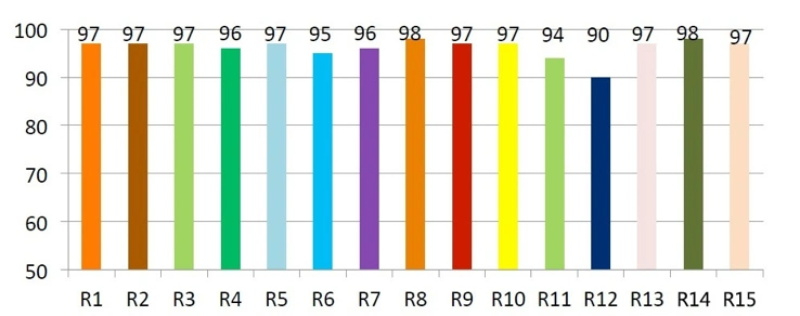
3. Quantitative Data: How Much Brightness Is Actually Lost?
Industry data and estimates from reputable institutions provide clear quantitative insights:
- From CRI 80 to CRI 90, luminous efficacy (lm/W) typically drops by 10%–20%.
- CRI > 90 tape/strips are 15%–25% dimmer than their CRI > 80 counterparts.
- The California SSLEC Center estimates that each 1‑point increase in CRI results in roughly 2% efficacy loss.
- Moving from CRI 90 to 95 further reduces efficacy by an additional 5%–8%.
| CRI Range | Relative Brightness Loss | Typical Applications |
|---|---|---|
| CRI 70–80 | Baseline (highest brightness) | Warehouses, corridors, outdoor accent lighting |
| CRI 80–90 | 10%–15% loss | Residential, office, general commercial lighting |
| CRI 90+ | 15%–25% loss | Museums, art galleries, premium retail, photography studios |
4. It's Not About "Better" – It's About "What Fits"
Once you understand this trade‑off between CRI and brightness, the core logic for selecting LEDs becomes clear: there is no absolute "better" – only "more suitable".
Prioritise high brightness with CRI 70–80 for:
- Warehouse aisles, car parks, outdoor landscape lighting
- These applications only require basic visibility; colour fidelity is not critical
- Higher luminous output per watt means lower electricity bills
Prioritise high CRI (90+) and accept moderate brightness loss for:
- Museums and galleries: colour accuracy of artworks and artefacts is vital
- Premium retail and clothing stores: colour distortion can directly harm sales
- Photography studios and operating theatres: accurate colour discrimination is a professional necessity
- High‑end residential and hotels: comfortable light quality outweighs sheer brightness

As industry experts often point out: "Blindly pursuing high luminous efficacy may lead to low CRI, excessive blue‑light components, and severe glare. Poor lighting environments can impair visual health, affect mood, and reduce work efficiency." Luminous efficacy and CRI are never mutually exclusive opposites – the key is to find the optimal balance for each specific scenario.
5. Emerging Trends: From "Either‑Or" to "Both"
It is worth noting that the LED industry is actively working to break this physical limitation. Recent innovations – such as multi‑band blue‑chip designs combined with customised phosphor blends, and full‑spectrum LED technology – are narrowing the gap. Some leading manufacturers now achieve CRI 90+ while maintaining efficacy close to that of traditional 80‑CRI products.
Nevertheless, the fundamental physical trade‑off between CRI and brightness has not been completely eliminated. Under comparable technology levels, higher CRI still entails a certain brightness penalty – and this remains a basic reality of LED lighting.
6. Leave It to the Professionals
The trade‑off between CRI and brightness has no one‑size‑fits‑all answer – it calls for a tailored solution based on the application. Over‑specifying wastes your budget; under‑specifying compromises the experience. Every project deserves a customised lighting plan.
We have been deeply engaged in the LED lighting industry for many years, with full in‑house capabilities from chip packaging to finished luminaires. Whether you need high‑brightness industrial lighting solutions or museum‑grade, high‑CRI light‑quality products, we can provide professional technical recommendations and customised solutions that are right for your project.
📞 Contact us today – let us help you find the sweet spot between CRI and brightness for your specific needs.
- --Using professional light to illuminate every space.