Lighting plays a crucial role in our daily lives, influencing both our comfort and energy expenses. Among the various lighting options available, LED (Light Emitting Diode) lights have gained significant popularity due to their energy efficiency and longevity. This article explores the energy consumption of LED lights in comparison to traditional incandescent and fluorescent bulbs, analyzing their efficiency, power usage, lifespan, and overall impact on energy savings.
1. Introduction to Lighting Technologies
Lighting technology has evolved over the years, with three primary types being widely used:
Incandescent Bulbs – These bulbs produce light by heating a filament until it glows. They are the oldest form of electric lighting.
Fluorescent Bulbs – These work by passing an electric current through a gas, which emits ultraviolet light that is then converted into visible light by a phosphor coating inside the bulb.
LED Bulbs – LEDs generate light through electroluminescence, where electrons pass through a semiconductor material, producing light efficiently.
Each of these technologies has different energy consumption characteristics, which significantly impact electricity costs and environmental sustainability.
2. Energy Efficiency Comparison
One of the primary factors influencing energy consumption is efficiency-how much electricity is converted into visible light rather than wasted as heat.
2.1 Incandescent Bulbs
Incandescent bulbs are the least energy-efficient of the three lighting types. About 90% of the energy consumed by an incandescent bulb is lost as heat, with only 10% being used for illumination. For example, a 60-watt incandescent bulb typically produces around 800 lumens of brightness.
2.2 Fluorescent Bulbs
Fluorescent bulbs, including Compact Fluorescent Lamps (CFLs), are more efficient than incandescent bulbs. They convert about 25% of energy into light, significantly reducing waste heat. A 13-15 watt CFL can produce the same 800 lumens as a 60-watt incandescent bulb, consuming around 75% less energy.
2.3 LED Bulbs
LED lights are the most energy-efficient among the three, with approximately 80-90% of energy converted into light and minimal heat loss. An 8-10 watt LED can produce the same 800 lumens of brightness as a 60-watt incandescent bulb, using up to 85% less electricity.
3. Power Usage and Electricity Cost
Since energy consumption directly affects electricity bills, let's compare power usage for equivalent brightness levels:
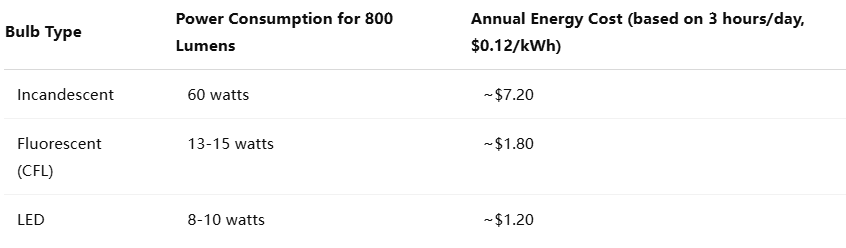
Since LED lamps use the least amount of power, electricity bills will eventually go down. LED bulbs are the most economical choice because of the long-term energy bill reductions, even if their initial cost is greater.
4. Lifespan and Long-Term Savings
A light bulb's lifespan is also a major factor in maintenance expenses and energy efficiency. The average longevity of each kind is contrasted below:

One LED bulb may last three to five times as long as a CFL and 25 to 50 times longer than an incandescent light. This lowers the frequency of replacements considerably, which results in further labor and material cost reductions.
5. Environmental Impact and Sustainability
The choice of lighting also affects environmental sustainability in terms of energy usage and waste production.
Carbon Footprint Reduction: LED bulbs reduce carbon dioxide emissions by consuming less electricity. According to the U.S. Department of Energy, widespread LED adoption could reduce lighting energy consumption by nearly 50%.
Hazardous Materials: CFLs contain mercury, a toxic element that requires special disposal procedures, whereas LEDs do not contain hazardous substances, making them more environmentally friendly.
Reduced Waste: Due to their long lifespan, LEDs contribute to significantly less waste compared to incandescent and CFL bulbs, which need more frequent replacements.
6. Performance in Different Conditions
Depending on the application and the surrounding environment, lighting performance can change:
Heat Emission: In warm climates where extra cooling is needed, incandescent bulbs are inefficient due to their excessive heat generation.
Cold Weather Performance: While CFLs may have trouble starting in extremely cold conditions, LEDs thrive in low temperatures, making them perfect for outdoor and refrigerated applications.
Dimmability: While certain CFLs and LEDs require suitable dimmer switches, incandescent bulbs may be dimmed naturally.
7. Initial Cost vs. Long-Term Savings
The long-term advantages of LED bulbs exceed the initial cost, even though they are more expensive than incandescent and CFL lights.

8. Future Trends in LED Lighting
As LED technology develops further, its usefulness, affordability, and efficiency all increase. Among the new trends are:
Smart LEDs: They integrate with home automation systems, enabling scheduling and remote control.
LEDs with tunable color temperature may be used for a variety of activities and moods.
Energy-efficient options for off-grid and outdoor applications are solar-powered LEDs.
OLED Technology: Ultra-thin, flexible lighting panels with improved aesthetics are made possible by organic LEDs.
9. Conclusion: The Clear Winner
The future of lighting is definitely moving towards more sustainable and efficient solutions as LED technology continues to advance. When comparing LED lights to incandescent and fluorescent bulbs in terms of energy consumption, LEDs are the better choice because they use significantly less power, reduce electricity costs, last much longer, and have a lower environmental impact. Although the initial investment may be higher, the long-term savings and benefits far outweigh the initial costs.