Is "Full-Spectrum" LED Healthier for Your Eyes? Is It Better Than High CRI?
Recently, while shopping for lighting, you've probably noticed the term "full-spectrum" popping up everywhere in product descriptions. Brands claim it simulates natural light and is gentler on the eyes-some even call it "the pinnacle of eye-protective lighting." But is that really true? Between full-spectrum and high Color Rendering Index (CRI), which one truly matters most for eye health?
1. What Is Full-Spectrum LED, and How Is It Different from Ordinary LED?
In simple terms, a full-spectrum LED has a spectral energy distribution that closely resembles sunlight, covering a broad wavelength range from ultraviolet (below 380nm) to infrared (above 780nm). In nature, sunlight has a continuous, smooth spectrum that includes all bands-red, orange, yellow, green, blue, indigo, violet-in balanced proportions.
Conventional LED lamps, however, are designed for high luminous efficacy and low cost. They typically use a "blue chip + yellow phosphor" approach, which results in an unusually strong blue light peak while red and green wavelengths are comparatively weak. This "incomplete" spectrum may look white to the naked eye, but it has poor color rendering and can easily cause visual fatigue over extended use.
Full-spectrum technology, on the other hand, uses a blend of multiple phosphors (such as red, green, and blue phosphors) or even multiple chip combinations, so the emitted light spectrum is much closer to natural sunlight. Simply put: ordinary LED is "assembled white," while full-spectrum LED is "natural white."
2. The Real Eye-Health Benefits of Full-Spectrum Light-More Than Just a Concept
2.1 Significantly Reducing Blue Light Hazard and Protecting the Retina
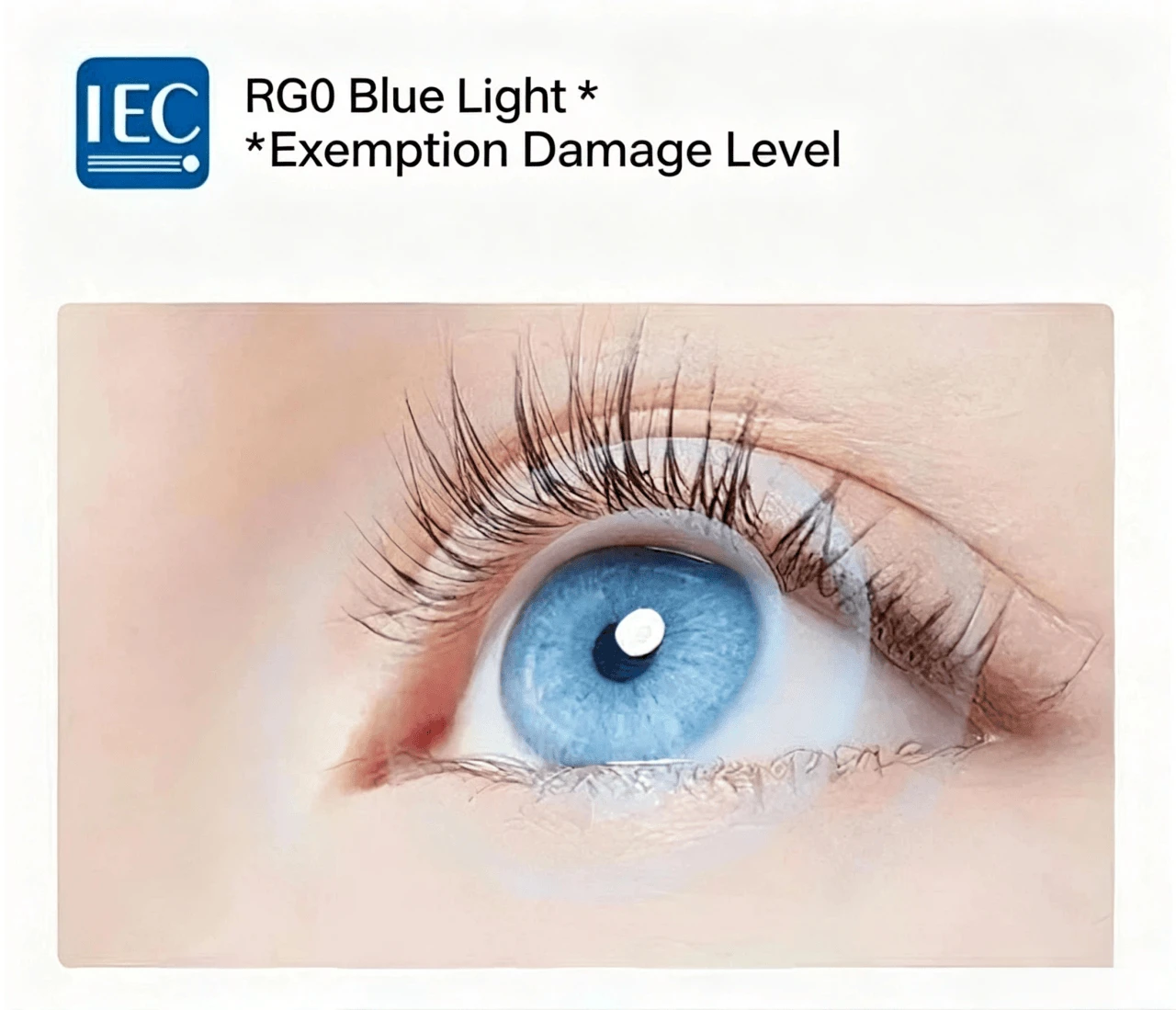
A large body of research shows that blue light in the wavelength range of 415nm–455nm can cause potential damage to retinal cells, and long-term exposure may increase the risk of macular degeneration. Full-spectrum LEDs optimize the spectral structure by shifting the blue light peak from around 450nm (typical of ordinary LEDs) to a safer wavelength above 460nm, while also reducing the overall proportion of blue light energy. According to the IEC 62471 photobiological safety standard, high-quality full-spectrum LEDs can typically achieve RG0 (exempt / no risk) classification, whereas ordinary LEDs often only reach RG1 (low risk) or even RG2 (moderate risk).
2.2 Easing Visual Fatigue and Enhancing Viewing Comfort
The most comfortable visual experience comes from natural light because it provides rich spectral information. When the light spectrum is incomplete, your eyes constantly adjust-the ciliary muscles keep contracting and the pupils keep changing size-just to make out colors and details. That's the root cause of "visual fatigue." Full-spectrum LEDs reproduce object colors more faithfully, especially warm tones like red and orange, significantly reducing the strain on your eyes during tasks such as reading, drawing, or detailed handiwork.
2.3 Regulating Circadian Rhythm for Better Daytime Focus and Nighttime Sleep
The blue light component (especially around 480nm) in full-spectrum lighting plays a key role in regulating melatonin production. Using full-spectrum lights during the day can simulate midday sunlight, helping your brain stay alert and focused. At night, if you need lighting, you can choose full-spectrum options with lower color temperature and lower blue light to minimize interference with sleep. According to industry research, after continuous use of full-spectrum lighting for four weeks, users' subjective sleep quality scores improved by an average of about 15%.
3. High CRI vs. Full-Spectrum: Which Is More "Eye-Protective"? - The Key Differences
High Color Rendering Index (CRI) measures how accurately a light source reveals the true colors of objects. The maximum is 100, and Ra ≥ 90 is generally considered "high CRI." Full-spectrum LEDs usually also have high CRI values (Ra ≥ 95 or even Ra ≥ 97), but the two are not the same thing.
Key Differences:
| Comparison Dimension | High CRI (Ra ≥ 90) | Full-Spectrum |
|---|---|---|
| Core indicator | Focuses only on color rendering accuracy | Focus on spectral integrity, continuity, and balance |
| Blue light control | Not guaranteed; some high-CRI lamps still have high blue peaks | Typically optimizes blue light distribution and reduces harmful blue light |
| Wavelength coverage | Mainly covers visible light (380–780nm) | May extend to ultraviolet and near-infrared |
| Direct impact on eyes | Improves visual clarity, but limited relief from fatigue | Comprehensively improves visual comfort, circadian rhythm, and blue light safety |
Conclusion: From an eye-protection standpoint, the overall spectral balance of full-spectrum lighting is more valuable than simply pursuing a high CRI. Eye health depends not only on accurate color rendering but also on blue light proportion, spectral continuity, and the impact on your eyes' focusing system. High CRI means "great picture quality"; full-spectrum means "great picture quality plus a healthy picture."
However, it's important to note: "Full-spectrum" is not a national mandatory standard, nor is it a unified certification system. Many products on the market claim to be "full-spectrum," but the actual spectral quality varies greatly-some merely boost the Ra value while blue light control remains substandard; others are just marketing gimmicks. Consumers should look for third-party test reports with actual spectral distribution graphs, as well as key indicators such as blue light radiance, color temperature, color rendering index, and flicker percentage.
4. Buying Guide: Don't Be Fooled by Concepts-Let Data Speak
4.1 Look at Measured Data, Not Marketing Slogans
Choose products that can provide test reports from CNAS, CMA, or other accredited institutions. Focus on: blue light hazard rating (RG0 is best), color rendering index (Ra ≥ 95, R9 ≥ 90 is even better), color temperature (3000K–4000K is best for reading), and flicker (depth < 5%).
4.2Choose According to Your Specific Use Case
- Children's reading, drawing, and handicrafts: Prioritize full-spectrum high-CRI products (Ra ≥ 97, R9 ≥ 95), with a color temperature below 4000K, preferably with dimmable and color-adjustable features.
- Office work, design, and photography: Full-spectrum + high CRI (Ra ≥ 95) is the basic requirement, with a color temperature of 4000K–5000K to balance clarity and comfort.
- Bedrooms and nighttime lighting: Choose full-spectrum lights with low color temperature (2700K–3000K), low blue light, and no visible flicker to avoid affecting sleep.
4.3 Beware of "Fake Full-Spectrum" Traps
A truly full-spectrum lamp should have a spectral curve close to natural light-smooth and continuous, without obvious spikes or dips, especially without a sharp peak in the blue band. If the blue peak in a spectral distribution graph is still more than 30% higher than other bands, that's not real full-spectrum.
4.4 Pay Attention to Color Temperature and Adjustability
Even with full-spectrum lighting, prolonged use at high color temperatures (e.g., 6500K) increases blue light exposure. We recommend choosing products with stepless color temperature adjustment-use 4000K–5000K during the day and 2700K–3000K at night for "all-day healthy lighting."
5. Summary: High CRI Is the Foundation, Full-Spectrum Is the Upgrade, and a Professional Solution Is the Key
Full-spectrum LED is indeed closer to natural light than ordinary LED and has irreplaceable advantages for eye health. But that doesn't mean it is "better than high CRI." High CRI is the basic threshold; full-spectrum is the quality upgrade. The ideal solution is: high color rendering (Ra ≥ 95) + full-spectrum + low blue light (RG0) + adjustable color temperature + no visible flicker-all five elements are indispensable.
Lighting is an important "health investment" for your home and workplace. Rather than being swayed by marketing buzzwords, make choices based on actual needs and verified products. After all, damage to your eyes is often irreversible-while one right choice can safeguard your family's vision for years to come.
If you're looking for truly eye-protective full-spectrum LED lighting for your home, school, office, or commercial space, feel free to contact us.
We provide professional spectral test reports, customized lighting solutions, and one-on-one product selection advice-so you no longer have to be confused by "concepts." Let data speak, and take responsibility for your eyes.