Revolutionizing Plant Growth Lighting

Introduction
The global agricultural sector faces unprecedented challenges in meeting the world's growing food demands, with climate change, urbanization, and resource limitations threatening traditional farming methods. LED plant growth lighting has emerged as a transformative technology that enables year-round cultivation in controlled environments. Recent breakthroughs in phosphor technology, particularly the development of Gd₂ZnTiO₆:Cr³⁺ far-red emitting phosphors, are poised to revolutionize this field by providing optimized light spectra that precisely match plant photobiological requirements. This article examines these technological advancements and their implications for commercial agriculture and horticulture operations worldwide.
The Science Behind Plant-Specific Lighting
Plants have evolved complex photoreceptor systems that respond to specific light wavelengths, primarily through phytochromes that regulate crucial growth processes, including photosynthesis, flowering, and fruit production. Traditional plant lighting solutions have struggled to provide the optimal spectral composition, particularly in the critical 610-720 nm far-red region where phytochromes Pr and Pfr exhibit peak absorption.
The research conducted by Chen Yongfeng and colleagues at Guangdong University of Education demonstrates that Gd₂ZnTiO₆:Cr³⁺ phosphors effectively address this limitation through their unique emission properties in the 550-700 nm range, with particular intensity at 718 nm and 730 nm wavelengths that align perfectly with plant photoreceptor absorption profiles.
Technical Breakthroughs in Phosphor Development
The development of Gd₂ZnTiO₆:Cr³⁺ represents a significant advancement in luminescent materials for agricultural applications:
Crystal Structure Optimization

The double perovskite structure of Gd₂ZnTiO₆ provides an ideal host lattice for Cr³⁺ ions, which preferentially occupy Ti⁴⁺ sites due to their similar ionic radii (Cr³⁺: 0.615 Å, Ti⁴⁺: 0.61 Å). This strategic substitution creates stable [CrO₆] octahedral coordination environments that enable efficient far-red emission without causing significant lattice distortion or compromising structural integrity.
Spectral Precision Engineering
Through high-temperature solid-state synthesis at 1,275°C, researchers achieved phosphors with exceptional purity and consistent performance characteristics:
Excitation bands centered at 332 nm, 465 nm, and 625 nm, enabling compatibility with both UV and blue LED chips
Dual emission peaks at 718 nm and 730 nm resulting from ²E→⁴A₂ and ⁴T₂→⁴ A₂ transitions of Cr³⁺ ions in medium-strength crystal fields
CIE chromaticity coordinates of (0.6789, 0.3209), closely matching ideal red light standards (0.670, 0.333)
Enhanced Biological Efficacy
The emission profile of Gd₂ZnTiO₆:Cr³⁺ demonstrates remarkable overlap with the absorption spectra of phytochromes Pr and Pfr, particularly in the biologically critical 660-730 nm range where these photoreceptors regulate photomorphogenic responses in plants.
Commercial Applications and Benefits
The implementation of Cr³⁺-doped phosphor technology in LED plant growth systems offers substantial advantages for commercial agricultural operations:
Optimized Growth Efficiency
By providing precisely targeted far-red wavelengths, these advanced lighting systems:
Accelerate photosynthesis rates through improved quantum efficiency
Enhance photomorphogenic responses including stem elongation and leaf expansion
Regulate flowering cycles and improve fruit set in photoperiod-sensitive crops
Increase biomass production and crop yields by up to 30% compared to conventional lighting

Energy and Cost Reduction
The spectral efficiency of Gd₂ZnTiO₆:Cr³⁺-based LEDs translates to significant operational benefits:
Reduced energy consumption through minimized wasted light outside plant absorption bands
Lower cooling requirements due to decreased infrared radiation
Extended fixture lifespan maintaining consistent spectral output
Improved return on investment through higher crop yields and reduced operational costs
Implementation in Commercial Horticulture
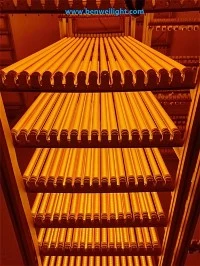
Leading agricultural technology providers, including Shenzhen Benwei Lighting's specialized horticultural division, have incorporated these advanced phosphor technologies into their commercial product lines. Their plant growth lighting systems now feature:
Customizable spectral recipes for different crop types and growth stages
Enhanced far-red emission for improved flowering and fruiting responses
Robust thermal management ensuring consistent performance in greenhouse environments
Scalable systems suitable for vertical farming, greenhouse supplementation, and research applications
Future Directions and Market Potential
The successful development of Gd₂ZnTiO₆:Cr³⁺ phosphors represents just the beginning of precision agriculture lighting optimization. Ongoing research focuses on:
Further refinement of emission spectra for specific crop varieties
Development of multi-phosphor systems providing full-spectrum optimization
Integration with smart control systems for dynamic spectral adjustment
Expansion into additional agricultural sectors including aquaculture and animal husbandry
The global market for LED grow lights is projected to exceed $10 billion by 2028, with advanced spectral optimization technologies driving increased adoption across commercial farming operations worldwide.
Conclusion: Transforming Agricultural Productivity Through Light Science

The development of Gd₂ZnTiO₆:Cr³⁺ far-red emitting phosphors represents a paradigm shift in agricultural lighting technology. By precisely aligning artificial light spectra with plant biological requirements, these advanced materials enable unprecedented control over crop growth, development, and productivity.
For commercial growers, agricultural technology providers, and investors in controlled environment agriculture, these innovations offer tangible improvements in operational efficiency, crop quality, and economic returns. As research continues to refine spectral optimization strategies, LED lighting systems incorporating advanced phosphor technologies will play an increasingly vital role in ensuring global food security and sustainable agricultural practices.
References
[1] Chen, Y., Wang, Y., Lu, Y., et al. (2025). Synthesis and Luminescence Properties of Red Phosphor Gd₂ZnTiO₆:Cr³⁺ for LED Plant Growth Lamp. Guangzhou Chemical Industry, 53(16), 50-52.
[2] Zhen, S., & van Iersel, M.W. (2017). Far-red light is needed for efficient photochemistry and photosynthesis. Journal of Plant Physiology, 209, 115-122.
[3] Han, Y., Wang, S., Liu, H., et al. (2020). Synthesis and luminescent properties of a novel deep-red phosphor Sr₂GdNbO₆:Mn⁴⁺ for indoor plant growth lighting. Journal of Luminescence, 220, 116968.
[4] Gao, P., Zhou, Z., Dong, P., et al. (2021). Tuning the luminescence properties of blue and far-red dual-emitting Gd₂MgTiO₆:Bi³⁺,Cr³⁺ phosphor for LED plant lamps. Journal of the American Ceramic Society, 104(12), 6444-6454.
FAQ
Have any questions or want to send an inquiry!
Q1. How soon is the lead time?
A: For a sample order, 7-17 days if no stock. For bulk orders, 15-30 days.
Q2. Can your products' label, packaging, and design be customized?
A: Yes, we offer customization service on these.
Q3. How can we guarantee quality?
A: Always a pre-production sample before mass production; always a final inspection before shipment.
Q4. How do you ship the goods and how long does it take to arrive?
A: We usually ship by DHL, UPS, FedEx, or TNT. It usually takes 3-5 days to arrive. Air and sea shipping are also optional.
Q5. What is your payment way?
A: PayPal / Visa / Western Union / online transfer / Apply Pay / T/T all work for us for payment.
https://www.benweilight.com/lighting-tube-bulb/grow-lights-for-houseplants.html
Shenzhen Benwei Lighting Technology Co., Ltd.
Telephone: +86 0755 27186329
Mobile(+86)18673599565
Whatsapp :19113306783
Email:bwzm15@benweilighting.com
Skype: benweilight88
Web: www.benweilight.com