Safety Protocols for UVA Lamps: Matching Power Density to 365nm/395nm Risks
UVA lamps (365nm/395nm) enable critical applications from forensic analysis to industrial curing, but their optical hazards demand precise power-based safety strategies. Here's how to mitigate risks at different energy levels:
1. Hazard Fundamentals
a) Wavelength-Specific Risks
365nm: Deeper skin penetration → DNA damage (cyclobutane pyrimidine dimers)
395nm: Higher radiant flux → Corneal inflammation (photokeratitis)
b) Power Density Thresholds
| Risk Factor | 365nm | 395nm |
|---|---|---|
| Skin Erythema | >3 mW/cm² (30s exposure) | >8 mW/cm² (60s exposure) |
| Ocular Damage | >0.1 mW/cm² | >0.5 mW/cm² |
| Ozone Generation | High (185nm secondary) | Negligible |
2. Safety Tiers by Power Density
Tier 1: Low Power (≤5 mW/cm²)
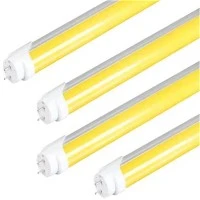
Example: 15W T12 tubes @30cm distance
Protocols:
EN 170 UV-blocking glasses (OD≥4 @365nm)
PVC gloves (UPF 50+)
No enclosure required
Tier 2: Medium Power (5-20 mW/cm²)
Example: 40W industrial spot lamps
Protocols:
Interlocked enclosures (IEC 62471 Cat. RG1)
Forced-air cooling (maintain lamp surface <45°C)
5-minute auto-shutoff after door breach
Tier 3: High Power (20-100 mW/cm²)
Example: 100W+ curing arrays
Protocols:
Full-spectrum face shields (OD≥7) + Tyvek suits
Ozone ventilation ≥50 CFM (365nm systems)
Thermal sensors disabling lamps >60°C
Tier 4: Extreme Power (>100 mW/cm²)
Example: Semiconductor lithography
Protocols:
Robotic handling (zero human exposure)
Lead-glass viewports (5cm thickness)
Continuous airborne ozone monitoring
3. Critical Engineering Controls
a) 365nm-Specific Measures
Cooling Imperative: Mercury vapor pressure shifts alter output by 15%/10°C → Active thermal regulation required above 20W
Secondary Emission Filtering: BG40 glass filters blocking <320nm radiation (eliminates 185nm ozone generation)
b) 395nm Optimization
Reflector design priority: ≥90% aluminum reflectivity prevents 50% power loss → Reduces needed input power
Phosphor-converted LEDs: Cut IR radiation by 80% vs fluorescent tubes
4. Compliance Benchmarks
| Standard | 365nm Requirement | 395nm Requirement |
|---|---|---|
| ACGIH TLV | 3 mJ/cm² (8hr) | 10 mJ/cm² (8hr) |
| IEC 62471 | RG2 (moderate risk) | RG1 (low risk) |
| OSHA 1910.97 | <1 hr exposure @1m | <4 hr exposure @1m |
5. Failure Case Analysis
Incident: Chemical plant UV curing station (365nm, 80 mW/cm²)
Flaws: Polycarbonate enclosure (degrades under UVA), no ozone extraction
Consequences:
Enclosure yellowing → 40% power drop in 6 months
Ozone accumulation → Worker respiratory injuries
Fix: Borosilicate glass + 100 CFM exhaust → Compliant operation
Implementation Checklist
Measure spectral irradiance with calibrated spectrometer (avoid low-cost UV meters)
Select PPE based on peak power density, not lamp wattage
Install wavelength-specific controls:
365nm: Cooling + ozone management
395nm: Precision reflectors
Validate with hazard distance mapping:
\text{MPE Distance} = \sqrt{\frac{\text{Total Power (W)}}{\pi \times \text{MPE (W/m²)}}}
Audit quarterly: UV output stability, filter degradation, interlock function
Conclusion
UVA lamp safety escalates exponentially with power density, demanding wavelength-specific protocols. While 395nm systems tolerate higher irradiance, 365nm requires rigorous thermal/ozone management above 5 mW/cm². Always prioritize engineering controls (enclosures, cooling) over PPE, and validate against ACGIH/IEC thresholds. Remember: Properly implemented, both wavelengths can operate safely at any industrial scale.