The Complete Guide to Retrofitting Traditional T5 Fluorescent Fixtures with Integrated LED Tubes: Compatibility, Ballast Bypass, and Bayonet Requirements
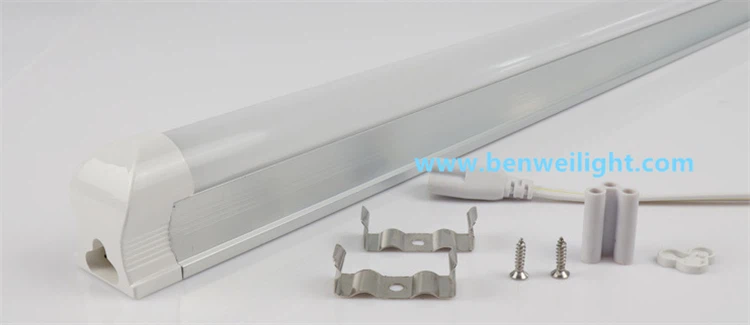
Installing modern T5 integrated LED tubes (Ø16mm) into legacy fluorescent fixtures seems straightforward-until you encounter electrical incompatibilities, mechanical mismatches, and safety hazards. Below, we dissect the critical technical considerations for a seamless retrofit.
1. Physical Compatibility: The 16mm Diameter Trap
While T5 fluorescent tubes and T5 LED tubes share identical outer diameters (Ø16mm), mechanical fitment fails if:
Fixture end caps use non-standard G5 sockets: Older fixtures may have deformed or oxidized sockets that resist new tube pins.
Tolerance stack-up exists: Manufacturing variances in legacy holders (±0.5mm) can cause jamming or poor contact.
Solution: Verify socket condition and replace damaged G5 bases. Force-fitting risks fracturing LED tube PCBs.
2. The Ballast Dilemma: Removal or Bypass is Mandatory
Why existing fluorescent ballasts are incompatible:
| Issue | Consequence |
|---|---|
| High-frequency output (20-60kHz) | LED drivers overheat, flicker, or fail instantly |
| Voltage mismatch | Ballasts output 300-600V vs. LEDs needing 120-277V AC |
| Power factor distortion | LED drivers malfunction, causing fire risk |
Two retrofit pathways:
Ballast Bypass (Type B LED tubes):
⚡ Disconnect ballast entirely, rewire sockets to direct AC line voltage.
✅ Pros: Eliminates ballast failure points, reduces energy loss by 10-15%.
⚠️ Cons: Voided UL certification if not done per NEC Article 410.130(G).
Hybrid Ballast-Compatible (Type A):
Rarely available for T5 due to ballast diversity. Not recommended.
Critical Safety Step: Lock out power, use multimeter to confirm zero voltage at sockets before rewiring.
3. Bayonet Size & Socket Mechanics: The G5 Pin Problem
T5 sockets use G5 bi-pin connectors (5mm pin spacing), but compatibility issues arise from:
Pin thickness variance: Fluorescent pins = 2.6mm vs. LED pins often = 2.3mm → Loose connections cause arcing.
Spring tension loss: Aged socket springs fail to grip thinner LED pins.
Misalignment risk: Fixtures bent from prior tube replacements may misalign pins.
Mitigation Strategies:
Use LED tubes with brass-reinforced pins (avoids bending during insertion).
Install LED-compatible G5 sockets (e.g., Leviton 93107) with corrosion-resistant springs.
Apply dielectric grease to pins to prevent oxidation.
4. Overlooked Failure Points: Heat, Vibration & Certification
Thermal Stress:
Integrated drivers in T5 tubes overheat in enclosed fixtures. Verify fixture IP rating (open vs. enclosed) matches LED tube's design (e.g., ≥60°C ambient rating).
Vibration Resistance:
Industrial environments demand LED tubes with silicone-damped drivers (vs. epoxy-potted).
Certification Gaps:
Non-UL1598C certified tubes risk fire. Look for UL Type B or DLC Premium listings.
5. Step-by-Step Retrofit Protocol
Audit existing fixtures: Check socket type (G5), ballast location, and wiring diagram.
Remove ballast: Cut input/output wires, cap leads individually.
Rewire sockets: Jump live/neutral wires to both ends per manufacturer schematics.
Test voltage: Confirm 120V/277V between pins at each socket.
Insert LED tubes: Align pins vertically, rotate 90° until seated.
⚠️ Never use shims or force tubes-misalignment damages drivers.
Conclusion: Beyond Plug-and-Play Assumptions
While T5 integrated LED tubes physically fit traditional fixtures, successful retrofits demand:
Full ballast removal and socket rewiring,
Verification of G5 socket integrity,
Selection of UL Type B-certified tubes with robust thermal design.
Ignoring these steps risks premature failure, safety violations, and 30-50% shorter lifespan. For high-vibration or wet environments (garages, cold storage), IP65-rated tubes with aluminum housings are non-negotiable. Always consult a licensed electrician for commercial installations.
Final Tip: Calculate ROI-replacing 40W fluorescent with 18W LEDs saves ~$15/tube/year (at $0.12/kWh). The labor investment pays back in <18 months.