The difference between fluorescent lamps and energy-saving lamps The characteristics of fluorescent lamps and energy-saving lamps
Lamps and lanterns are indispensable in life nowadays. In the past, it was usually the sunrise and the sunset. After the light is available, it can work at night. Now there are many types of lamps, such as fluorescent lamps, energy-saving lamps, and incandescent lamps. Wait, let's talk about the first two first, then what is the difference between fluorescent lamps and energy-saving lamps? What are the characteristics of fluorescent lamps and energy-saving lamps? Let’s take a look at BENWEI LIGHTING.
fluorescent lamp
The difference between fluorescent lamps and energy-saving lamps:
1. Life-span ratio
The average service life of a fluorescent lamp is 1000 hours. The glass bulb of a fluorescent lamp will turn black after a long time, and it will burn out after a while, because the filament used in the fluorescent lamp is made of tungsten wire. After power on, the temperature in the bulb is as high as 2000 degrees. The long-term high temperature causes the tungsten atoms on the surface of the tungsten filament to evaporate and diffuse continuously like water vapor, and then deposit layer by layer on the inner surface of the glass bulb, making the glass bulb Slowly darkening, becoming more and more opaque. The evaporation of tungsten also makes the tungsten wire thinner and thinner, and finally burns. The higher the working temperature of the filament, the faster the evaporation of tungsten, and the shorter the service life of the fluorescent lamp. The energy-saving lamp has a lifespan of up to 8,000 hours, and its luminous efficiency is 6 to 8 times that of ordinary bulbs.
2. Price ratio
The market price of fluorescent lamps is 25W to 100W, the price is 2 yuan to 3 yuan, the price of energy-saving lamps is from 8 yuan to tens of yuan, the price is several times that of fluorescent lamps, that is to say, 15 bulbs per family To calculate it, using fluorescent lamps is 3×15=45 yuan, and using energy-saving lamps is 15×15=225 yuan, but from the perspective of practical applications, a family’s use of energy-saving lamps is 864 yuan-225 yuan = 639 yuan a year. Energy-saving lamps are more economical.
3. The ratio of advantages and disadvantages
Although the luminous efficiency of the fluorescent lamp is low, it has good light color and light collection performance. It is easy to install and use, can be started immediately, and has low cost. It is the largest output and most widely used electric light source. The research, the continuous improvement of filament materials, filament structure, and filling gas, the luminous efficiency of fluorescent lamps is also improving with the times.
Energy-saving lamps. Under the premise of achieving the same light energy output, this light source only consumes 1/5 to 1/4 of the power consumption of ordinary incandescent lamps, which can save a lot of lighting power and costs. Compared with ordinary fluorescent lamps, energy saving is 70-80%, low voltage and quick start, no stroboscopic; using pure three-color phosphor tubes to make lighting objects bright and fresh; novel appearance design, with a number of patented technologies, brackets using aluminum alloy materials, compact and beautiful , Never rust, environmental protection, flame retardant.
Energy-saving lamps
Features of fluorescent lamps and energy-saving lamps:
Fluorescent lamp features
Fluorescent lamp is also called fluorescent lamp, its working principle: the fluorescent tube is simply a closed gas discharge tube. The main gas in the tube is argon gas (including neon neon or krypton krypton). The pressure is about 0.3% of the atmosphere. It also contains a few drops of mercury-forming a trace of mercury vapor. Mercury atoms account for about one-thousandth of all gas atoms.
The fluorescent material on the inner surface of the tube absorbs ultraviolet light and then releases visible light. Different fluorescent substances emit different visible light. Generally, the efficiency of converting ultraviolet light into visible light is about 40%. Therefore, the efficiency of the fluorescent lamp is about 60%×40%=24%-approximately twice that of the tungsten lamp with the same power.
The disadvantage of fluorescent lamps is that they pollute the environment during the production process and after they are scrapped, mainly mercury pollution, which is not environmentally friendly. With the improvement of the process, the mercury pollution caused by the use of amalgam has been gradually reduced.
Energy-saving lamp features
Energy-saving lamps are also called compact fluorescent lamps (abbreviated as CFL lamps abroad) with high luminous efficiency (5 times that of ordinary bulbs), obvious energy-saving effects, long life (8 times that of ordinary bulbs), small size, and convenient use.
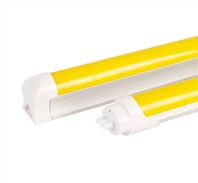
In addition to white (cold light) energy-saving lamps, there are now yellow (warm light). Generally speaking, under the same wattage, an energy-saving lamp is 80% energy-saving than an incandescent lamp, its average life span is 8 times longer, and its heat radiation is only 20%. Under non-strict circumstances, a 5-watt energy-saving light can be regarded as an incandescent lamp equal to 25 watts, a 7-watt energy-saving light is approximately equal to 40 watts, and a 9-watt energy-saving light is approximately equal to 60 watts.
The electromagnetic radiation of energy-saving lamps also comes from the ionization reaction between electrons and mercury gas. At the same time, energy-saving lamps need to add rare-earth phosphors. Because rare-earth phosphors themselves are radioactive, energy-saving lamps also generate ionizing radiation (ie, radioactive nuclear radiation). The uncertainty of electromagnetic radiation to the human body, and the harm of excessive radioactive nuclear radiation to the human body is more worthy of attention. In addition, due to the limitation of the working principle of energy-saving lamps, mercury in the lamp tube will inevitably become a major source of pollution. An ordinary energy-saving lamp contains about 5 milligrams of mercury, which is only enough to cover a ballpoint pen tip, but it may cause 1,800 tons of water to be polluted after it penetrates into the ground.
Energy-saving lamps
Let’s stop here for the explanation of the knowledge of the difference between fluorescent lamps and energy-saving lamps and the characteristics of fluorescent lamps and energy-saving lamps. I believe you will know more about it after reading it. The content is for your reference only, and I hope it can be useful to you. help.