Is R9 of CRI the Key to Accurate Skin Tone in Lighting?
By Kevin Rao November 28,2025
On the set of Blade Runner 2049 in Hollywood, cinematographer Roger Deakins contemplated two different LED film lights. Test footage revealed that while both lights had a general Color Rendering Index (CRI) exceeding 95, the actor's skin tone appeared healthy and rosy under the first light, but slightly pale under the second. "The issue lies with the R9 value," he said, pointing to the spectrum analyzer. "The first light has an R9 of 98, while the other is only 65. This difference determines whether we can capture the vitality of blood flow beneath the skin."
Such professional judgment is becoming consensus globally in film and photography. According to the American Society of Cinematographers' 2023 technical guide, the R9 metric has become a core parameter for evaluating film and video lighting equipment, its importance sometimes surpassing that of the base CRI (Ra).
I. Technical Analysis: The Spectroscopic Basis and Measurement Principle of R9
1. Architecture of the Color Rendering Index Test System
The CIE Color Rendering Index system comprises 14 standard color samples. R1-R8 are medium saturation hues used to calculate the General Color Rendering Index (Ra), while R9 (Saturated Red) is evaluated separately as a special test color sample.
2. Spectral Characteristics of the R9 Test Sample
The spectral reflectance function of test sample R9 shows significant features in the 600-700nm band:
Reflectance at 600nm: 12±2%
Reflectance at 650nm: 85±5%
Reflectance at 700nm: 97±3%
This curve determines its sensitivity to deep red spectra.
3. Calculation Model for Light Source R9 Value
math
R9 = 100 - 4.6 × ΔE
Where ΔE represents the color difference of the R9 sample under the test light source versus the reference illuminant. When ΔE > 21.7, R9 becomes negative.

II. The Biological Basis of Skin Reflectance Spectra
1. Analysis of Multi-Ethnic Skin Reflectance Spectra
| Skin Type (Fitzpatrick) | 400-500nm Reflectance | 500-600nm Reflectance | 600-700nm Reflectance | Description |
|---|---|---|---|---|
| Type I | 15-25% | 30-40% | 45-60% | Northern European |
| Type III | 10-18% | 20-30% | 35-50% | Asian |
| Type V | 5-12% | 10-20% | 25-40% | Middle Eastern / Latin |
| Type VI | 3-8% | 6-15% | 18-30% | African |
Data Source: Journal of Investigative Dermatology, 2022
Key Finding: All skin types show a steep rise in reflectance after 600nm. The magnitude of difference is 2-3x, but the rising trend is entirely consistent.

2. Optical Mechanism of Subcutaneous Blood
Hemoglobin plays a key role in the spectral response:
Oxyhemoglobin: Absorption peaks at 542nm and 577nm, with a sharp drop in absorption after 600nm.
Deoxyhemoglobin: Single absorption peak at 555nm, also with reduced absorption after 600nm.
This absorption characteristic causes the significant increase in reflectance for all skin tones in the 600-700nm band.

III. Correlation Study Between R9 and Skin Tone Reproduction
1. Comparative Analysis of Light Source Spectra
| Light Source Type | R9 Value | 600-700nm Radiant Power Ratio | Skin Tone Evaluation | Suitable Application |
|---|---|---|---|---|
| Incandescent | 98-100 | 22-25% | Excellent | Classic Cinematography |
| High-R9 LED | 95-98 | 18-22% | Excellent | Professional Film/Portrait |
| Standard LED | 70-80 | 12-16% | Average | General Commercial |
| Low-R9 LED | <50 | <10% | Poor | Industrial Lighting |
| Cool White Fluorescent | 20-40 | 5-8% | Very Poor | Not Recommended for Portraits |
2. Clinical Visual Perception Research
A 2023 double-blind study published in the Journal of Vision Science showed:
With R9 > 90, 93% of observers described skin tones as "healthy and natural."
With R9 = 70-90, only 45% of observers approved of the skin tone rendition.
With R9 < 50, 87% of observers described skin tones as "sickly or pale."

IV. Industry Application Standards and Technical Requirements
1. Evolution of Film and Television Industry Standards
American Society of Cinematographers: Recommends R9 ≥ 90 for lights used for photographing people.
European Broadcasting Union: UHD production standards require R9 ≥ 85.
Netflix Original Content Spec: Mandates R9 ≥ 90 for 4K/HDR production.
2. Technical Requirements for Professional Photography
Lighting for portrait photography should meet:
R9 ≥ 90: Ensures skin tone health.
Rf ≥ 85: Ensures color fidelity.
Rg ≥ 98: Ensures color gamut.
TM-30 Comprehensive Score ≥ 90.

V. Spectral Engineering Solutions
1. LED Chip Technology Breakthroughs
Modern high-R9 LEDs use special phosphor formulations:
Nitride Red Phosphors: Peak wavelength ~655nm, FWHM ~85nm.
Fluorosilicate Phosphors: Provide supplemental spectrum in 600-620nm range.
Quantum Dot Technology: Precisely controls red spectral distribution.
2. Optical Optimization Design
Spectrum Enhancement: Uses dual blue chips to excite and fill the red spectrum.
Color Consistency Control: Maintains R9 variation <5% over -20°C to 85°C.
VI. Frequently Asked Questions
Q1: Does a high R9 value guarantee excellent overall color rendering?
A1: Not necessarily. R9 is a specific metric; a light can have high R9 but average performance on other colors. Full assessment requires combining CRI (Ra), TM-30 (Rf, Rg), and Color Fidelity Index. Prioritize lights with R9 > 90 and Ra > 95.
Q2: Can color grading in post-production compensate for low R9?
A2: Limited compensation. Post-processing can adjust the red channel but cannot reconstruct missing red spectral information. Footshot under low-R9 sources often exhibits banding and loss of detail during grading.
Q3: How to accurately measure the R9 value of a light?
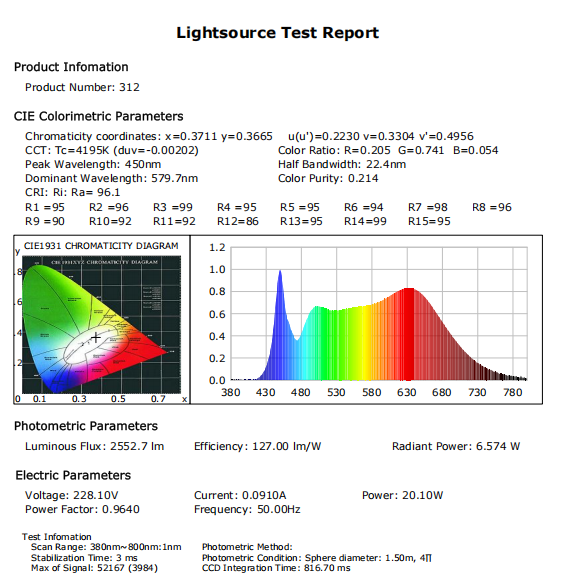
A3: Recommended use an integrating sphere spectrometer under standard conditions:
Test Distance: 1.5 meters
Warm-up Time: 30 minutes
Ambient Temperature: 25±2°C
Reference Standard: IES LM-79-19
Q4: Do different ethnicities have different R9 requirements?
A4: The requirement is consistent, but sensitivity varies. Darker skin tones, due to lower reflectance, are more sensitive to insufficient R9. Use lights with R9 ≥ 95 when photographing darker skin.
Q5: Is there a correlation between R9 and Correlated Color Temperature?
A5: A certain correlation exists. With the same technology, lower CCT sources often achieve high R9 more easily, but modern LED technology can achieve R9 > 95 even at 5600K high CCT.
VII. Innovative Technology Trends
1. Full-Spectrum LED Technology
Uses violet chips to excite multi-color phosphors, achieving a continuous spectrum with R9 values up to 98+, close to natural daylight.
2. Intelligent Spectral Adjustment
Dynamic spectrum technology based on ambient/detected skin tone, optimizing R9 output in real-time for different subjects.
3. Standardization Progress
The upcoming CIE 244:2024 from the International Commission on Illumination will further enhance the testing accuracy and industry importance of R9.
Conclusion
The R9 value, as a key metric for skin tone reproduction, has been validated by both spectral biology and visual science. At the "Light and Colour" exhibition in the London Science Museum, visitors intuitively felt that "an R9 difference of 10 points equates to a 20% visual difference in skin healthiness" by comparing selfies under lights with different R9 values.
As Nobel Physics Laureate Shuji Nakamura stated: "The ultimate mission of LED is to perfectly reproduce natural light, and skin tone rendition is the most important touchstone on this path." By deeply understanding the spectral code of R9, filmmakers and photographers can make more precise technical choices, ensuring every shot captures the most vibrant skin tones.
In the digital age where visual communication is increasingly vital, mastering the scientific essence of R9 is not just a technical requirement but a commitment to the pursuit of humanized visual experience.
References:
CIE 244:2024 Color Fidelity Index for LED Light Sources
American Society of Cinematographers. (2023). Lighting Guide for Digital Cinematography.
Journal of Investigative Dermatology. (2022). Skin Reflectance Spectra Across Ethnicities.
IES TM-30-20 Method for Evaluating Light Source Color Rendition
Tel/Whatsapp:+8619972563753
Email:bwzm12@benweilighting.com
Skype:bwzm32