Understanding LED Grow Light Metrics: Lumens, PPF, and PPFD

Choosing the right LED grow lights for your indoor growing project can be overwhelming. With technical terms like watts, lumens, PAR, PPF, and PPFD, it's easy to get confused. This guide breaks down these important metrics to help you make an informed decision-whether you're starting a vegetable garden, nurturing houseplants, or diving deeper into indoor horticulture.
What Is Light? A Quick Science Refresher
Light is a form of energy called electromagnetic radiation, which includes gamma rays, X-rays, microwaves, radio waves, and visible light. Each type is defined by its wavelength and frequency, measured in nanometers (nm) and Hertz (Hz), respectively.

Visible Light vs. PAR: What Plants Really "See"
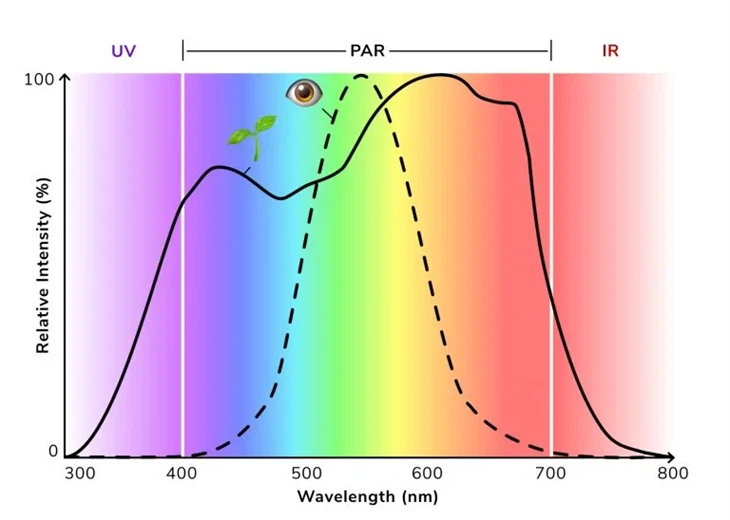
Visible light refers to wavelengths between 380–700 nm that humans can see. However, plants respond to a broader spectrum-some detect wavelengths as low as 260 nm (UV-C) and as high as 730 nm (far-red).

The range most critical for plant photosynthesis is between 400–700 nm, known as Photosynthetically Active Radiation (PAR). Although PAR overlaps with the human visible spectrum, plants are more sensitive to red and blue light, while human eyes are more responsive to green and yellow.

This is why many grow lights use red and blue LEDs-what looks bright to us may not be the most efficient for plant growth.
Lumens: A Metric for Humans, Not Plants
Historically, lighting was measured in watts (W), referring to the power consumption of incandescent bulbs. However, this is misleading for modern LEDs because it doesn't indicate useful light output.
Lumens measure luminous flux-how bright a light appears to the human eye. This unit is weighted toward green and yellow wavelengths, to which our eyes are most sensitive. As a result, lumens undervalue red and blue light, which are essential for photosynthesis.
Therefore, lumens (and related units like lux or foot-candles) are not suitable for evaluating grow lights.
Photon-Based Metrics: How We Measure Light for Plants
Since plants rely on specific light wavelengths for photosynthesis, we use photon-based measurements that count light particles (photons) within the PAR range.

1. PPF (Photosynthetic Photon Flux)
PPF measures the total amount of PAR produced by a light source per second, expressed in micromoles per second (μmol/s). One micromole represents about 602 quadrillion photons.
However, PPF only indicates output at the source. It doesn't account for how much light actually reaches the plants. While better than lumens, PPF alone is insufficient for evaluating a grow light's real-world performance.
2. PPFD (Photosynthetic Photon Flux Density)
PPFD measures the number of PAR photons reaching a specific area (per square meter per second-μmol/m²/s). This makes it a much better indicator of usable light for plants.
Still, PPFD has limitations:
It treats all photons between 400–700 nm equally, even though red and blue light drive photosynthesis more efficiently.
It ignores UV and far-red wavelengths, which influence plant morphology and secondary metabolite production.
PPFD values can be misleading if measured at unrealistically short distances between the light and plant canopy.
When comparing grow lights, always check the PPFD value and the distance at which it was measured. Reputable manufacturers provide PPFD distribution maps showing average values across the growth area.

Conclusion: What Should You Look For?
For indoor growing, prioritize PPFD over lumens or watts. Ensure the manufacturer provides realistic PPFD values at appropriate hanging heights and offers spectral details that emphasize blue and red wavelengths.
While no single metric tells the whole story, understanding PPF and PPFD will help you choose a grow light that truly supports healthy and efficient plant growth.