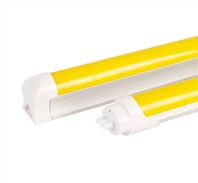
An LED tri-proof light: what is it?
An LED tri-proof light is a gasketed, enclosed light fixture made to be used in places with high environmental standards. The fixture is said to be "tri-proof" if it is resistant to corrosion, dust, and water. There is some Chinese-style English in it. Actually, practically all tri-proof lamps are designed to keep out vapor, water, and dust, making them dust-, water-, and vapor-tight. A waterproof or dust-proof luminaire, on the other hand, is built or protected in a way that allows water or dust to enter the enclosure without impairing its ability to function. These kinds of light fixtures are referred to as vapor-tight fixtures in North America.

Numerous applications
Unlike other kinds of lighting systems, 30W tri-proof lights offer a wide range of applications. Tri-proof lights can be used in a wide range of settings, including outside covered structures, commercial, industrial, and retail sectors, institutional buildings, and hospitals. Because of the high humidity, dusty or caustic atmosphere, splashing water, hose-directed water, spills, and other soiling that occurs with regular use, lighting in these facilities frequently needs to meet unique standards. Car washes, warehouses, parking garages, cleanrooms, food processing facilities, stairwells, pool areas, saunas, laundry rooms, utility rooms, mechanical shops, industrial kitchens, buildings used for animal containment, breweries, underpasses, tunnels, etc. are common examples of these types of spaces. The sturdy, waterproof lighting systems can be suspended from a chain, cable, or stem, or they can be surface affixed to a wall or ceiling.
The drawbacks of HID and fluorescent technologies
Solid-state LED lighting has drastically replaced high-intensity discharge (HID) and conventional fluorescent lighting in the last ten years, which is what is used in tri-proof lights. Many facilities face significant lighting issues as a result of long operating hours, challenging environmental conditions, distinctive building attributes, and the need to adhere to current fire, safety, and material rules. Due to the limited lifespan and inefficiency of conventional vacuum-based lighting solutions, maintenance and relamping are essential routines. HID and fluorescent fixtures age more quickly when they are turned on and off often. Moreover, it takes a long time for HID bulbs to warm up to their maximum power. It is unable to incorporate controls into the fixtures to make lighting adaptive to demand or the environment due to poor switching performance. In areas where there are flammable gasses or vapors, easily ignitable fibers, or combustible dusts, metal halide lamp envelope failures and overheated ballasts from fluorescent fixtures provide a significant risk of fire and explosion.
LED tri-proof lights' benefits
In almost every category, including energy efficiency, longevity, controllability, and durability, LED tri-proof lights perform better than HID and fluorescent light fixtures. Lighting systems that are energy-efficient, durable under the most demanding conditions, and provide the highest level of safety and reliable illumination for crucial operations have long been required by commercial and industrial establishments. In addition to LED technology's luminous efficacy of more than 200 lm/W at the component level, LEDs' quick switching and immediate dimming capabilities enable lighting controls to save energy. LED tri-proof lights can offer completely customizable lighting by connecting to sensors and networks. Whether or not lights are required, facility managers are not required to keep them on all the time. By definition, LEDs don't pose a risk of fire or explosion. LEDs produce optical radiation using electroluminescence within a semiconductor package, in contrast to fluorescent lamps that require a high voltage spike to initiate the arc and HID lamps, which use a quartz arc tube that runs at high pressures.

Lamp-based systems
Tri-proof lights are normally linear in shape, with the exception of the wall-mounted kind, which typically resembles a jelly jar. In the past, LED tri-proof lights were lamp-based systems that used retrofit LED lamps, like T8 or T5 LED tubes. They are built using linear fluorescent fixtures in the same arrangement. The issue with lamp-based LED systems is that the retrofit LED bulbs control the luminaire's performance. However, due to low-cost system designs and size restrictions, retrofit LED bulbs frequently suffer from degraded circuit efficiency, light quality, thermal management, and system reliability.
In most cases, LED tubes are just marginally more efficient than fluorescent bulbs and have a somewhat longer lifespan. When self-contained LED bulbs are used in an enclosed space, their thermal design is compromised. The inability to effectively release the heat produced by the LEDs in the lamps into the surrounding air reduces the lifespan of the temperature-sensitive driver components and the LEDs themselves. This kind of switch from traditional to LED technology isn't as significant as the technology itself.
Systems that are integrated
However, integrating LEDs into the system is essential to optimizing its dependability and efficiency. The system design must simultaneously consider thermal management and the best driver circuit architecture. By mounting LEDs directly onto the luminaire housing, the entire housing can act as a heat sink, increasing the effective surface area and facilitating the shortest thermal path for heat generated by the LEDs to be transmitted to the luminaire's surrounding environment. The crucial junction temperature is always maintained under all working conditions thanks to efficient heat dissipation and strict drive current management.
Because the luminaires usually have a bigger capacity to incorporate driver and control circuitry, the integrated approach to system enables greater integration flexibility. An LED tri-proof light's performance and lifespan are greatly influenced by its LED driver. Regardless of the input voltage and power quality, it must offer superior line and load regulation, low total harmonic distortion (THD), and a high power factor (PF). The LED driver must be compatible with particular dimming protocols when dimming is necessary as part of a control strategy. Typically, dimmable LED tri-proof lights have 0–10V dimming built in.
Building
The housing of an LED tri-proof light is made of fiberglass-reinforced polyester, stainless steel, or extruded aluminum. For the light engine, the metal housing offers superior heat dissipation, while the non-metallic structure offers superior corrosion resistance. For luminaires with a polycarbonate housing, the LED modules-linear MCPCB assemblies of soldered mid-power LEDs-are fixed to a die-formed steel tray or metal housing that serves as a heat sink. The LED driver can be installed in a location that is thermally separated from the light engine or attached to an aluminum rail. It is possible to install LED tri-proof lights with emergency capabilities, control systems, and occupancy sensors. Injection-molded, impact-resistant, high transmission frosted acrylic lenses, clear acrylic lenses with linear prisms, or UV-stabilized polycarbonate lenses are used in these low bay, ambient lighting systems to reduce glare and distribute light evenly.
Protection against intrusions (IP)
Completely gasketed, vapor-tight lights offer complete defense against the infiltration of dust, grime, water, and moisture. The flanged lens fits securely for a tight, continuous seal thanks to a silicone gasket that is poured in place. Stainless steel or polycarbonate latches are typically used to hold the lens to the housing. For continuous feed, the fixtures may have watertight, vapor-proof IP68 connectors at both ends.
The ingress protection (IP) rating of LED tri-proof lights is 65 or higher. Fixtures with an IP65 rating are shielded against low pressure jets coming from all sides. Lights with an IP66 rating are shielded from powerful water jects. Fixtures with an IP67 rating can survive brief submersion in water up to 15 cm to 1 m. IP68-rated lights can survive prolonged submersion in water. Pressure equalizing vents may be included with the waterproof fixtures to prevent early seal failure and ensure the enclosure's long-term integrity.


Our address
No. 5-3 Niujiao Road, Yanchuan Community, Yanluo Street, Bao'an District, Shenzhen
Phone Number
+86 18659785153
bwzm04@ledbenweilighting.com