Watch Out! Your Home Lighting Could Be an "Invisible Vision Killer"
1. What Is Flicker? – The "Shadow" Hiding Behind the Light
Have you ever felt eye strain, dizziness, or headaches after working under a lamp for a while? Have you ever wondered – could the problem be the light itself?
Flicker refers to the rapid, repeated variation in light output from a lighting source. Because the mains electricity we use daily is alternating current (AC) with a fixed frequency (50 or 60 cycles per second), almost all lighting and display devices – TVs, computer monitors, fluorescent lamps, and LED lights – suffer from flicker to some degree.
But here's the important point: not all flicker is harmful. When the light changes so fast that our eyes cannot perceive it, it has no effect on us. The truly harmful flicker comes in two forms:
- Visible flicker – fluctuations below 80 Hz, which our eyes can detect. This can reduce visual performance, cause eye fatigue, and even trigger serious health issues such as epilepsy or migraines.
- Stroboscopic effect – fluctuations between 80 Hz and 2000 Hz, which are invisible to the naked eye but can create optical illusions, making moving objects appear stationary or moving differently. This poses potential risks to both physical safety and behavioural health.
The scariest part is the latter – you can't see it, but it's quietly harming you.

2. Why Are LED Lights Particularly Prone to Flicker? – The Hidden Technical Culprit
As semiconductor light sources, LEDs respond extremely quickly. Even tiny fluctuations in the driver circuit can instantly translate into light output variations. The main causes of flicker include power supply noise, external coupling noise, unstable dimming phase, unstable drivers, and driver design.
Worse still, dimming is a major trigger for flicker. When a product incorporates dimming, flicker often worsens – especially at lower brightness levels where the modulation depth becomes greater. To cut costs, some manufacturers use overly simple driver circuits, making the flicker problem even more pronounced.
In other words: poor driver = flicker hazard = health risk.
3. How Flicker Harms Your Health – More Serious Than You Imagine
3.1 Visual System: From Fatigue to Myopia, a Step‑by‑Step Threat
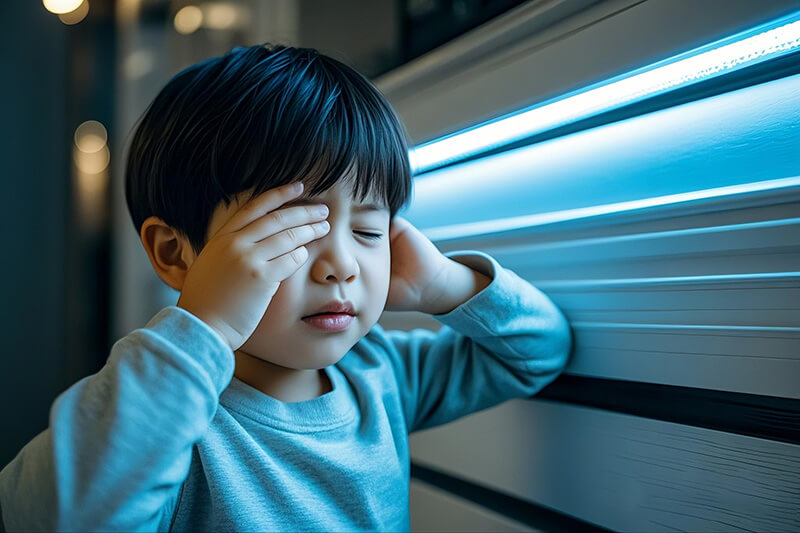
Flicker causes eye fatigue, increased intraocular pressure, blurred vision, and reduced visual acuity. When we stay in a flickering environment for prolonged periods, our visual system constantly adapts to the changing light, keeping eye muscles tense – leading to diminished visual performance.
Children are particularly at risk. Excessive flicker in classroom lighting can easily trigger visual fatigue and myopia in students. Many parents believe that LED desk lamps are good for their children's eyes – but in reality, some LED lamps have severe flicker. Long‑term study under such lights can cause eye fatigue, headaches, reduced concentration, and even permanent vision damage.
Scientific studies also show that flickering blue light causes more persistent and severe retinal damage than non‑flickering blue light – even frequencies as low as 20 Hz can be a risk factor for retinal degeneration.
3.2 Nervous System: Migraines, Epilepsy – Alarming Facts
The impact of flicker on the nervous system is backed by solid data:
- Low‑frequency flicker (3–70 Hz) – can trigger photosensitive epilepsy. Photosensitive epilepsy is the most common form of stimulus‑induced epilepsy. Studies indicate that 2% to 14% of epilepsy patients are susceptible to seizures under flickering light.
- Flicker at 100 Hz – has been identified as a cause of headaches and migraines. The American Headache Society notes that many migraine sufferers are more sensitive to flickering sources, with low‑frequency flicker being more severe than high‑frequency.
- Flicker at 120 Hz – can affect mood, leading to irritability, anxiety, and other emotional disturbances.
A shocking real‑world case: in late 1997, over 700 Japanese children were hospitalised with simultaneous epileptic seizures – traced back to intense flashing scenes in a cartoon shown on TV. The danger of flicker is no exaggeration.
3.3 Psychological and Behavioural Effects: Anxiety, Panic – Invisible Trauma
Flicker also triggers a range of psychological and behavioural issues: it can increase repetitive behaviours in individuals with autism, provoke panic attacks, accelerate heart rate, and cause dizziness. Research suggests that about 75% of the population is light‑sensitive for life. Even without visible interference, the retina can detect temporal light modulation, which alters brain activity and influences eye movement and cognitive performance.
3.4 Safety Hazards: Optical Illusions, Lethal Risks
The stroboscopic effect can create the illusion that high‑speed moving objects are standing still. Such visual misperceptions in industrial settings can lead to severe accidents. Moreover, flicker can interfere with machine vision and imaging equipment (e.g., surveillance cameras, security systems), compromising their proper operation.
4. How to Identify and Prevent Flicker Hazards? – Safeguard Yourself and Your Family
4.1 Know the National Standards
According to Chinese national standards, qualified LED luminaires should have flicker frequencies above 3125 Hz. The General Code for Building Environment (GB 55016‑2021) and the Standard for Lighting Design of Buildings (GB/T50034‑2024) stipulate that:
- The short‑term flicker indicator (PstLM) shall not exceed 1.
- For workplaces where adults stay long‑term, the stroboscopic visibility measure (SVM) shall not exceed 1.3.
- For places where children and teenagers study for extended periods (e.g., classrooms, reading rooms), SVM shall not exceed 1.
The internationally recognised IEEE 1789 standard (Recommended Practices for Modulating Current in High‑Brightness LEDs for Mitigating Health Risks to Viewers) also provides clear risk thresholds.
4.2 Practical Buying Guide
① Check the key specifications
When purchasing, prioritise products marked "no visible flicker" or with "flicker‑free certification" (e.g., IEEE compliant). Flicker parameters should be 3125 Hz or above, or rated as "no significant effect".
② Understand the driver design
Flicker often stems from inferior driver power supplies. Choose products with constant‑current drivers rather than constant‑voltage types. Quality luminaires use added capacitors and improved circuits to stabilise current and eliminate flicker.
③ Ensure a high colour rendering index (CRI)
A healthy light source should have a CRI of 90 or above. The national standard for reading lamps requires a general colour rendering index (Ra) of no less than 80.
④ Don't rely on your phone to test flicker!
The popular "use your phone camera to detect flicker" method is not scientific. Phone cameras vary widely in sampling rate and image processing; results differ significantly. Even if you cannot see flicker with your naked eye or on your phone, it may still be present.
⑤ The right way to buy
Always ask the seller for flicker safety test reports. Choose reputable brands and products with recognised certifications. Especially for children's rooms, studies, and any space where you spend long hours reading or working, pay extra attention to light quality.
Conclusion: Don't Let "Invisible Damage" Ruin Your Family's Health
Flicker – the "invisible killer" hiding behind light – is quietly eroding our visual health, nervous system, and quality of life. From eye fatigue to myopia, from migraines to epilepsy, from anxiety to safety risks – its harm goes far beyond what we imagine.
Choosing a truly healthy light is choosing to take responsibility for yourself and your loved ones. Next time you shop for a lamp, take an extra minute to check the specs and ask for certification – that one minute could safeguard your and your family's health for a lifetime.
Remember: a truly good lamp not only lights up your world – it protects your health.
Related product links: https://www.benweilight.com/ceiling-lighting/flat-led-panel/non-flickering-square-ceiling-led-light.html