Wet Space Best LED Tri Proof Lights – Complete Guide
What do the terms triproof lights mean?
The most iconic quality of the led tri-proof light is its ability to withstand corrosion, dust, and water ( also called led vapor tight, vapor proof or waterproof light). Special anti-oxidation and anti-corrosion materials and silicone sealing rings are employed to meet the fixtures' protection needs. greatest luminaire sealing possible without compromising illumination.
What benefits come with using tri-proof light?
A healthy working environment is created by low risk and the absence of UV and infrared radiation.
Long longevity; the life expectancy can exceed 54,000 hours with a set of aging tests.
Compared to conventional lamps, energy-saving, led tri-proof lighting can save users 85% of their energy.
The fixtures require less maintenance, are highly impact resistant, and were specifically created to survive tough circumstances.
High-quality driver technology eliminates flicker, stabilizes current, and guards against glare and the stroboscopic phenomenon.
Bright LEDs, which are energy-efficient and environmentally beneficial, will not release the dangerous mercury fumes, protecting the environment.
Simply open the lid, wire it, and then close it to complete the installation.
Installations that are multi-mounted, suspended, or ceiling-mounted can change to fit various application scenarios.
How are led tri-proof lights installed?
Led waterproof lighting can be installed in two different methods. One option is to place the fixtures directly on the wall using the kit on top of them, or you can suspend them from the ceiling by using the wire rope that is attached. The application determines the best installation technique.
Where is led tri-proof lighting used?
The warehouse facility, supermarket, indoor parking garage, car wash, swimming pool, dusty factories, pedestrian bridges, high humidity locations, and high dirt & dust places are all good candidates.
How many different types of tri-proof lights are there?
1. A tri-proof fluorescent lamp
The first of three anti-lights is the vapor tight fluorescent. You can see the LED light source being used in tough locations, thus its place in the lighting market prior to the debut of the LED light source should not be discounted. The first generation of tri-proof luminaires had a tightly sealed outer housing and 0-4 fluorescent lights. The single benefit is that it is less expensive, but the drawbacks include high maintenance expenses, environmental pollutants, and poor water resistance.
2. A tri-proof LED tube light
The waterproof vapor lamp was the first to use an LED tube in place of a fluorescent tube. This approach is really simple to use from a replacement standpoint; simply open the cover and swap out the tube within. However, since its wiring is not straightforward, you must particularly redesign the wiring diagram for it. Due to its limited replacement wattage and power, the level of illumination is constrained.
3. Replacement for IP65/IP66 classic vapor proof lights
The IP65/IP66 tri-proof light was created to address the flaws of the previous two lamps. The PC cover, die-casting aluminum housing, led light source board, and led driver make up this component. Higher energy conversion efficiency due to the absence of ballast obstructions. Its price will unavoidably be higher than the prices of the first two. However, it also has extra utility in that it can accomplish the sensing function of a -1-10v dimming or motion sensor and even install an emergency power pack, allowing durability lights to continue to function for a number of hours during an outage.
4. A slim batten lamp
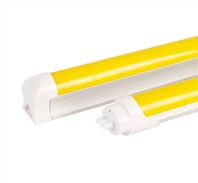
This flat-shaped slender batten, as seen in the image, also goes by the name of batten light. Due to its thin shape, it uses less material and is therefore better suited for applications with limited resources. The shape's modest size makes it possible for it to illuminate tight locations. Petite is one of the key advantages, but it is also the biggest disadvantage because the lighting area is constrained and cannot support high power, resulting in low light efficiency—the highest value is only 110 lumens per watt.
5. A tri-proof integrated aluminum led fixture
The aluminum alloy case of this led tri-proof light exhibits greater heat dissipation performance and a longer lifespan, making it the best-equipped of its kind. Since the luminaire has two end caps on each end, the lighting is more focused. With the exception of the greatest price, it hardly has any flaws.
6. Tri-proof lamp with external wiring
Although they have a similar outward appearance to the one above, they are different. At both ends of these tri-proof lights have removable connectors. Their primary function is to speed up installation and facilitate wiring. Another distinction is that all the lights can be wired together and installed in series.
7. LED tri-proof IP69k lamp
This vapor-tight fixture has the greatest level of protection currently offered, IP69k, which means it can resist the demanding high-pressure, high-temperature flushing process. The seamless construction and the three anti-lights' smooth surfaces simultaneously minimize the likelihood of water and dust getting inside. Particularly necessary businesses for this product protection are the food processing and poultry farming sectors (health and cleanliness are critical).
How do I pick the best tri-proof light?
First off, it is advised against purchasing fluorescent triproof lights since doing so would subject you to high electricity and maintenance costs. Use a traditional tri-proof product replacement that will satisfy your lighting needs and generate a long-term return on investment if you are currently using it and seeking for alternatives. Undoubtedly, aluminum alloy and three anti-lights with external wiring are the most durable, but they are also the most expensive. Please consider that the IP69K tri-proof lamp can play its biggest part in ensuring the environment is clean and hygienic when you own a food processing factory or take over the lighting project in such a place.