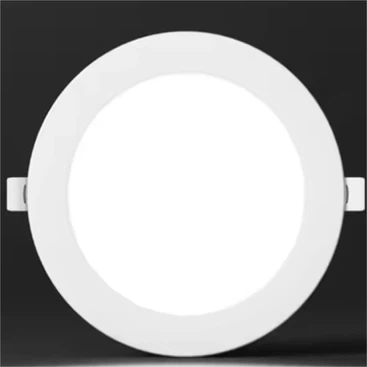
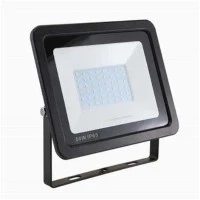
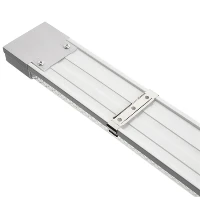
Without sacrificing lumen output or glare control, a flat panel LED downlight is a low profile recessed ceiling light that can fit in plenums with little depth. Any commercial, residential, or institutional space can be transformed into a visually pleasant setting with gentle, balanced light thanks to the totally luminous flat panel downlight. Additionally, a large, fire-rated or IC (insulation contact)-rated housing is no longer necessary with this downlighting option. The canless, wafer-thin form offers a clean architectural appearance that permits surface mount applications as well as lower material costs and easier installation. These small ceiling lights, which come in round and square aperture options, can compete with any new construction or renovation installation. They can be used for general lighting in offices, shopping malls, restaurants, hospitals, living rooms, kitchens, and bathrooms, or for applications in small, difficult-to-reach areas like closets, basements, hallways, stairwells, elevators, and exterior soffits.

Managing LEDs' extremely high brightness
Ultra-thin LED downlights are typically surface emission devices that harness a complex optical system to produce constant uniformity over the whole span of the panel. LEDs are directional emitters with a very high brightness and a high flux density. The traditional backlit design uses a high degree of diffusion, which results in significant optical scattering loss, to get rid of LED hot spots and glare. Although it results in a thicker fixture profile, increasing the distance between the light source and a higher efficiency diffusing lens can produce a more even distribution of light. The LEDs are regressed deeply into the casing in conventional LED downlights. These luminaires control glare by masking the bright LEDs from direct view, however there's strong glare when looking up into the luminaire. At the expense of less illuminance coverage, the cutoff optics lessen the irritating luminance. Because conventional downlights require a high fixture density due to their narrow beam distributions, they are not a good option for general lighting applications.
The optical architecture with edge lighting
The edge-lit design of the wafer-thin downlight uses a light guide panel (LGP) to evenly distribute light throughout the light emitting surface (LES) and places light sources along the luminaire's side. Light from edge-mounted LEDs enters an LGP from the side. A light guide's entry interface needs to be made to match the mating SMD LEDs' package configuration and light output radiation pattern in order to gather light efficiently. Total internal reflection (TIR) is used to move the captured light to the exit points. The exit points are light extraction elements that allow a controlled amount of light to escape from the light guide. In order to guarantee consistent surface emission, a light guide features a matrix of exit points that are evenly distributed around the panel. By refracting the beams downward toward a high-transmittance bottom diffuser, the LGP produces a homogeneous distribution of illumination and a gentle, aesthetically pleasing luminous surface. Any spill light is directed downward by the top reflective layer of the multi-layered optical system.
Construction of optical systems
In summary, an LGP is positioned between a white PET top reflector and an opal white bottom diffuser in the multi-layered optical system of an edge-lit LED downlight. The LGP is the part of the luminaire that is most important to its optical performance. Its light capture efficacy, extraction efficiency and distribution pattern have a great influence on luminaire efficiency and beam quality. A light guide is manufactured from an optically clear polymer, such as polycarbonate (PC) or acrylic (PMMA). The coupling surface (input interface) and light extraction features (exit points) are the main design elements of an LGP. Over 90% coupling efficiency can be achieved with a well-designed entry interface. Selecting the right light exit point design and density is crucial because it affects both the extraction effectiveness of the LGP and the distribution of light output from the luminaire.
For those uninformed, the LGP is a crucial life-limiting element of an edge-lit LED system. Cheap polystyrene (PS) LGPs, which will become yellow in two years, are used in many commodity products. LGP discolouration indicates that the product's life is coming to an end. When assessing an edge-lit product, it is crucial to determine the material utilized to create the LGP. So far the best material for LGP applications is UV-stabilized PC, whereas PMMA is the most often used LGP material because of its cost, outstanding thermal stability and excellent optical clarity.
Thermal control
The fixture-as-heat-sink design of an ultra-thin LED downlight reduces the thermal path for more effective heat extraction. The die-cast aluminum casing that houses the LEDs along the aperture's inside doubles as a heat sink. In order to maximize the effective surface area for heat dissipation, the heat sink has integrated fins. The thermal transfer rate of the passive heat sink must surpass the rate at which thermal energy is introduced to the system by the LEDs. Ultra-thin LED downlights use mid-power SMD LEDs that require careful control of the junction temperature. Due to heat-induced discolouration of the plastic housings, operating these LED packages over the maximum rated junction temperature may accelerate the deterioration of light output and cause color shift. It's important to have a strong heat path and avoid overdriving the LEDs. LEDs will exhibit efficiency droop at high drive current, which can greatly increase the thermal burden.


Rendering in color
Edge-lit LED downlights can have SMD LEDs of different specs. The choice of light source is influenced by numerous factors. One of these elements that needs to be properly taken into account for a certain application is the color characteristics of the LEDs. The majority of edge-lit LED downlights are marketed as mass-produced goods, and luminous efficacies frequently trump color quality. The color rendering index (CRI) for these goods is in the low to mid-80s. In addition to having a high color temperature, the low CRI luminaires provide a high luminous efficacy that appeals to consumers who lack education. But because the LEDs are oversaturated in the blue and green spectrums, they are unable to produce saturated colors, which are essential for displaying skin tones, goods, artwork, and anything else that is colorful. It is recommended to use light sources with a minimum CRI of 90 when edge-lit LED downlights are the main source of illumination in a living, working, or retail space.
Temperature and consistency of color
A correlated color temperature (CCT) of 2700K, 3000K, 3500K, 4000K, or 5000K can be set for LEDs. Commercial lighting usually uses cooler or high CCT light sources. Due to their strong suppression of melatonin, which is an essential human defense mechanism, these light sources are not advised for residential use. When it comes to domestic lighting, hospitality lighting, and applications that prioritize relaxation, warm light sources (2700K to 3200K) are frequently selected. Warm light which contains a very low percentage of blue does not hinder the nightly production of melatonin, thereby fostering a restorative sleep. The LGP's edge-lit architecture enables color mixing. By doing this, color fluctuation throughout the whole luminous surface is eliminated. If the LEDs in backlit systems are not binned to a strict tolerance, there will be significant color variances between the LEDs. Edge-lit LED downlights' exceptional color mixing capabilities enable them to be used in dynamic white lighting applications including human-centric lighting and dim-to-warm atmospheric lighting.
LED dimming and driving
An off-board LED driver that may be remotely deployed for shallow ceiling installations powers edge-lit LED downlights. A variety of input voltages, such as 120–277 volts, can be supported by the driver, or it can be made to run on a certain voltage, like 120 volts. It is crucial that the driver produces as few ripples as possible in the output current that is supplied to the LED load. Flicker and other visual abnormalities caused by large ripples in the DC current can contribute to headaches, eyestrain, and blurred vision.
In order to adjust the light output to the needs or preferences of the user, it is frequently desirable to be able to dim the LED load. Constant current reduction (CCR) dimming circuitry, which enables smooth dimming via 0–10V or DALI controls, may be incorporated into the driver. It is crucial that the dimming control and the LED driver work together. The issue frequently occurs when an electronic low voltage (ELV) or forward phase (TRIAC) dimmer is used to dim the LED load. LEDs may flicker, drop out, pop on, or dead travel as a result of an incompatible phase control dimmer and switch mode power supply (SMPS) interaction.