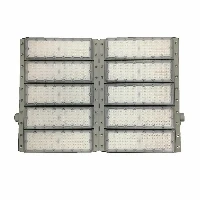
For lighting expansive spaces like parking lots, stadiums, and outdoor events, LED flood lights are crucial. The beam angle and light dispersion are two crucial factors that determine how successful they are. Light distribution explains how the light is distributed around a place, whereas beam angle, expressed in degrees, relates to the spread of light emitted from the fixture. A thorough understanding of the variables affecting these components guarantees peak performance, energy economy, and application appropriateness. The technical, environmental, and design elements that influence the beam angle and light dispersion of LED flood lights are examined in this article.
Design and Configuration of LED Chips
The LED chip itself is the starting point for light output.
Type of Chip:
Chip on Board (COB): Creates a broad, consistent beam (e.g., 120°) by grouping many LED diodes on a single substrate. Perfect for illuminating a large area.
SMD (Surface-Mounted Device): Narrower beams (e.g., 30°–60°) are made possible by directional control provided by individual diodes spaced apart.
Setting up:
Brightness is increased by dense arrangements (such as matrix layouts), however beam refinement may be necessary with optics.
Smoother light gradients and less glare may be achieved with careful spacing.
Impact: SMDs provide flexibility for focused or adjustable lighting, whereas COB LEDs are excellent for wide flood applications.
Lenses and Reflectors
In order to guide light, optical components are essential.
Reflectors:
Parabolic reflectors are perfect for spotlighting since they concentrate light into a concentrated, narrow beam (such as 15° to 30°).
Surfaces that are smooth or textured: Textured reflectors soften harsh shadows by dispersing light for greater coverage.
Lenses:
Collimating lenses: For long-distance projection, create parallel light beams using Total Internal Reflection (TIR).
Frosted lenses: Disperse light to increase the beam angle and soften edges.
Impact: From diffused area illumination to strong architectural highlights, high-precision optics allow for customisation.
Thermal Management and Housing
Performance and lifespan are both impacted by the fixture's design.
Dissipation of Heat:
Poor thermal management causes LED efficiency to deteriorate (lumen depreciation), affecting light distribution over time.
Heat sink-equipped aluminium housings dissipate heat to ensure steady output.
Durability and Sealing:
Housings with an IP rating guard against moisture and dust, avoiding internal damage that might skew light output.
Impact: Stable beam angles and an extended LED lifespan are guaranteed by a robust thermal design.
Power Supply and Drivers
For dependable functioning, power delivery must be constant.
Quality of Driver:
By reducing flicker, high-frequency drivers preserve even illumination.
Without changing the beam angle, dimming capabilities enable intensity adjustment.
Stability of Voltage:
Perceived light spread may be impacted by fluctuations that result in uneven brightness.
Impact: High-quality drivers provide consistent operation while maintaining the desired beam characteristics.
Angle and Height of Installation
Light spread is directly influenced by mounting settings.
Height:
According to the inverse square law, higher installations increase coverage area but decrease intensity.
Lower altitudes focus light, making certain areas brighter.
Orientation and Tilt:
The hotspot is shifted by changing the fixture's angle, which is helpful for emphasising architectural details.
Impact: A 90° flood light may be turned into a targeted route illumination with a 30° tilt at a height of 10 meters.
Environmental Factors
Performance is subtly changed by external circumstances.
The temperature
While extreme cold boosts LED efficiency, it can also make lenses brittle.
Heat reduces effective beam angles by exacerbating lumen decay.
Light in the Ambience:
The intended dispersion of the LED may be obscured by competing light sources, such as streetlights.
Impact: To counteract environmental pressures, outdoor installations need weather-resistant designs.
Optical Technologies and Innovations
Improvements keep improving light control.
Adaptive Optics:
Beam angles (such as 15° to 60°) are dynamically adjusted by zoomable lenses.
Arrays of microprismatic
Divide light into tiny beams to ensure even distribution free of hot spots.
Intelligent Systems:
Real-time beam angle adjustments are made by sensors and algorithms in response to daylight or occupancy.
Impact: Versatile solutions, including stadium lights that alternate between player monitoring and wide coverage, are made possible by state-of-the-art optics.
Requirements Particular to the Application
Design priorities are determined by use cases.
Lighting for Security:
Wider angles are triggered by motion sensors, whereas entrance sites are highlighted by narrow beams (≤30°).
Lighting in Architecture:
Textures are highlighted by medium beams (45° to 60°) without spilling over.
Athletic Fields:
Player visibility is given precedence over spectator regions in asymmetric distributions.
Impact: By adjusting beam angles to jobs, such as a 120° flood light for parking lots vs a 25° flood light for monument illumination, usefulness is improved.
Industry Rules and Guidelines
Design decisions are influenced by compliance.
NEMA Groupings:
Type V (circular symmetry) for roundabouts and Type III (110° lateral spread) for roads.
Compliance with Dark Sky:
By limiting upward light pollution, shielded designs frequently reduce the effective beam angles.
Impact: Standards influence the choice of fixtures for public projects by guaranteeing sustainability and safety.
Evaluation and Quantification
Manufacturers follow strict procedures.
The measurement of goniophotometry
reveals beam angles and intensity gradients by mapping the dispersion of light in 360 degrees.
Reports from LM-79:
Verify photometric data to make sure beam spread and efficiency claims are true.
Impact: Clear testing helps choose fixtures for specific applications and fosters confidence.
The engineering, environmental, and application requirements work together to define the beam angle and light dispersion of LED flood lights. Every element contributes to lighting optimisation, from chip design to smart optics. Whether lighting a busy sports stadium or a comfortable backyard, users may choose lights that combine efficiency, aesthetics, and utility by being aware of these factors. Anticipate even more accuracy in utilising light as technology advances to satisfy the needs of a world that is becoming brighter by the day.