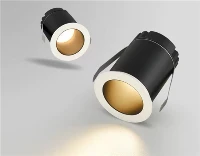
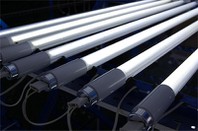
Both fluorescent lamps and LED lights are readily accessible for the majority of installations and uses for UV blacklights. Blacklights made of fluorescent lamps were the standard up until recently, but UV LED lights are now gradually overtaking them as the preferred choice because to significant advancements in LED technology.
The following are some benefits of UV LED blacklights:
Higher efficiency: Compared to fluorescent UV blacklights, UV LED lights are generally 1.5x to 3.0x more efficient.
Longer lifespans: UV LED lights have an average lifespan of 25,000 hours or more and progressively lose UV light output over time rather than "burning out" like fluorescent lamps. Fluorescent blacklights frequently fail catastrophically after just 5000 hours of use.
No mercury or other harmful elements are present in UV LEDs, unlike those that are often found in fluorescent lights. As a consequence, you won't need to handle the cleaning differently or be concerned about accidently destroying a UV LED light.
If money is limited, fluorescent UV blacklights could be the best option, particularly for short-term usage. Fluorescent blacklights are often less expensive than LED blacklights. In any cost of ownership estimates, remember to take the lifespan and efficiency into account.
How Much UV Do I Need?
Given that UV light energy cannot be seen with the naked eye, UV blacklight "brightness" is a challenging criterion to define. Although lumens is the standard unit of measurement for the quantity of visible light, because ultraviolet light is invisible, this unit of measurement is virtually worthless. The most precise measurement for UV lamps is "watts" of UV light output.
What does a UV light "watt" mean? Watts are just measurements of energy, and as you may remember from your early physics lessons, energy may take on many different forms, such as electrical, kinetic, chemical, or light energy. In this instance, we are determining the quantity of UV light energy released.
One watt of UV light energy output is adequate to produce strong fluorescence effects across a 100 square foot area for the majority of fundamental applications. Simply multiply the desired UV levels by two to obtain an estimated 2 watts of UV light energy for a 200 square foot area.
Important: UV light watts are not the same as electricity watts! We are most used to characterizing UV light bulb power in terms of its electrical energy consumption, similar to how we describe conventional home light bulbs (such as 60 Watts). The quantity of light energy generated is what counts most, just as with ordinary light bulbs.
Unfortunately, the majority of manufacturers only specify the electrical watts input rather than the UV light output. For instance, you could come across a device advertised as a 40 Watt UV blacklight. Unfortunately, this only implies that the lamp uses 40 watts of electricity; it tells us nothing about how effective the lamp is or how much UV light energy is generated. We can't tell from the 40 watts of power usage alone whether it's a fantastic, effective light that emits 10 watts of UV (25% efficiency) or a bad light that emits 1 watt of UV (2.5%).
You may use a product's listed UV light output in watts to calculate how much UV light is required for a certain area. If so, you may need to make some hazy estimations of efficiency.
Fluorescent blacklights have an efficiency range of 5–15%, roughly speaking. In other words, the blacklight will output 5–15 Watts of useable UV light energy for every 100 Watts of electrical energy it uses.
On the other hand, UV LED blacklights have enhanced efficiency values of 15–25%. UV LEDs will provide 15–25 Watts of usable UV light energy for every 100 Watts of electrical energy used.
Try to stay with items for which you can locate the real UV light output values mentioned on a product's specs sheet since efficiency values may vary greatly depending on the quality and design of UV blacklights. In the event that you decide to go on without this information, you could wish to use an approximate estimate of 20% for UV LED efficacy and 10% for fluorescent blacklight efficacy.
A fast lookup table based on 20% and 10% efficiency predictions for UV LEDs and fluorescent blacklights is provided below. Remember that specific goods' actual efficiency levels might vary, and these efficiency estimates are simply rough approximations.
Here are two instances to help you calculate how much UV light you require:
Example 1: How many feet of realUV 395 nm LED Strips are needed to cover a 200 square foot area?
First, we should mention that the product's UV output is 0.9 watts per foot. We calculate that we will need 2 W for our 200 sq. ft. area based on our anticipated UV light demands of 1 W per 100 sq. ft (multiply by 2x).
We get 2.2 feet when we divide 2 watts by 0.9 watts per foot.
Therefore, we anticipate that we will need a realUV LED strip that is around 2.2 feet long.
Example 2: How many 20W UV Fluorescent Blacklight bulbs are needed for a 400 sqft room?
The efficiency rating of the fluorescent UV lamps is assumed to be unknown in this example.
We will thus assume that each blacklight bulb produces 2 watts of UV light based on our preliminary estimate of 10%.
In order to get the desired UV lighting effect in a 400 sqft space, you will probably need anything from 2-3 of these fluorescent UV blacklight bulbs that each generate 2 watts of UV. Our advice for a 100 sqft area is 1W.

Benwei UV 120cm led tube light Product Specification:
|
Item |
UV led light tube bulb T8 |
|
Input Volt |
AC85-265V |
|
Power |
10W,18W,24W |
|
Length |
60cm/2ft, 120cm/4ft, 150cm/5ft |
|
Bean Angle |
120°, 180° |
|
Lifespan |
50000 hrs |
|
Wavelength |
365nm 395nm 254nm 280nm |
|
Warranty |
3-5 years |