Introduction
Background of Indoor LED Panel Light Protection Demand
With the comprehensive upgrade of indoor lighting towards high efficiency, energy saving, and long-life operation, surface-mount LED panel lights have gradually replaced traditional fluorescent lamps, incandescent lamps, and recessed panel lights, becoming the preferred solution for modern interior lighting. Different from embedded lamps that require ceiling cutting and complex construction, surface-mount LED panel lamps feature tool-free installation, ultra-slim body, uniform flicker-free lighting, and excellent heat dissipation performance, widely applied in family residences, commercial offices, retail shopping malls, hotel lobbies, classroom teaching spaces, and hospital indoor areas.
In long-term indoor operation, lighting fixtures will inevitably face environmental interference such as suspended dust, tiny particulate impurities, and accidental minor collisions. Unqualified protection levels will lead to dust accumulation inside the lamp body, blockage of heat dissipation structures, abnormal attenuation of LED chip luminous efficiency, and even short circuit and component aging failure, greatly shortening the service life of lamps and increasing subsequent maintenance and replacement costs. Therefore, the IP protection rating is no longer a trivial technical parameter but a core indicator measuring the durability and practical value of indoor LED panel lights.
Core Research Question and Practical Value
In the current lighting market, low-end indoor LED panel lights mostly adopt IP20 protection, while medium and high-end mainstream products are uniformly equipped with IP40 protection. A large number of purchasers and end users have cognitive confusion: whether IP40 protection is too low to cope with daily indoor environmental interference, or whether it is the most cost-effective and fully applicable standard for indoor scenarios. Many merchants deliberately hype higher IP ratings such as IP44 and IP54 for ordinary indoor lamps, leading users to over-purchase redundant performance and increase procurement costs unnecessarily.
This paper focuses on the core question "Is IP40 enough for indoor surface-mount LED panel ceiling lamps", conducts in-depth technical analysis and scenario verification, and combines the structural advantages of aviation-grade aluminum housing and imported acrylic diffuser of high-quality surface-mount LED panel lights to prove the rationality and superiority of IP40 protection in standard indoor environments. The research results can help engineering contractors, bulk wholesalers, and household users accurately distinguish protection grade standards, avoid misleading marketing information, and realize high-cost-performance lighting procurement and long-term stable operation.

Technical Definition and Protection Principle of IP40 Rating
Universal IP Rating Standard Interpretation
The IP rating, short for Ingress Protection Rating, is formulated according to the international standard IEC 60529, which is uniformly adopted by global electrical and lighting industries to define the enclosure protection capability of electrical equipment against solid foreign objects and liquid invasion. The rating consists of two core digits: the first digit represents the anti-solid particle invasion level (dust prevention), ranging from 0 to 6, and the second digit represents the anti-liquid invasion level (waterproof), ranging from 0 to 9. The larger the digit, the stronger the protection capability.
For indoor lighting fixtures, the core environmental threats are mainly indoor suspended dust, fiber particles, and tiny debris, while there is basically no risk of splashing water, rain erosion, or high-pressure water flushing in standard dry indoor spaces. Therefore, the dust-proof performance of the IP rating is far more important than waterproof performance for indoor LED panel lights, which is also the core basis for evaluating the applicability of IP40.
Detailed Protection Scope of IP40 Grade
IP40 corresponds to the first protection digit 4 and the second digit 0, with clear and standardized technical protection capabilities. In terms of solid particle protection, IP40 can completely block solid foreign objects with a diameter greater than or equal to 1mm, including common indoor tiny sundries such as fine wires, tool debris, plastic particles, and large suspended dust particles. It can effectively prevent these foreign matters from entering the interior of the lamp body, avoiding physical extrusion and circuit short-circuit damage to LED chips, constant-current drive power supplies, and internal wiring structures.
In terms of liquid protection, IP40 has no targeted waterproof function, which means it cannot resist splashing water, steam, or liquid infiltration. This design is not a performance defect, but a professional targeted configuration for dry indoor scenarios. Standard indoor environments such as offices, living rooms, bedrooms, and corridors have no continuous liquid invasion risk, so excessive waterproof design will only increase product costs and cause performance redundancy.
Structural Matching Principle of IP40 Surface-Mount LED Panel Lights
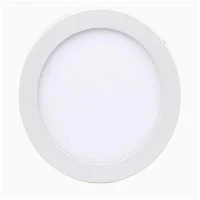
The high-quality surface-mount round LED panel light matched with IP40 protection adopts an integrated aviation-grade aluminum thickened heat dissipation shell and seamless splicing process. The lamp body structure is compact and closed, with no exposed gaps. The imported acrylic optical diffuser is closely fitted with the metal shell, which not only ensures uniform light transmission and glare-free eye protection lighting effect, but also forms a stable internal sealing protection space.
This structural design perfectly complements the IP40 protection standard. On the premise of ensuring the maximum heat dissipation efficiency of the aluminum radiator, it isolates most indoor dust and impurities, avoids dust accumulation on the surface of LED chips and drive power supplies, ensures the long-term stable heat dissipation performance of the lamp body, and fundamentally reduces the light attenuation and failure rate caused by dust blockage.
Comparative Analysis of Common IP Ratings for Indoor LED Lights
Performance Comparison Between IP20 and IP40
IP20 is the most basic protection grade for low-end indoor LED lamps, which can only block solid objects larger than 12.5mm, and has almost no defense capability against fine indoor dust and tiny debris. In long-term indoor operation, IP20 panel lights are prone to fine dust entering the lamp body and adhering to the heat dissipation structure and chip surface. Dust accumulation will block heat conduction, cause the internal temperature of the lamp body to rise continuously, accelerate the light attenuation of LED chips, and lead to problems such as dark lamps, uneven lighting, and shortened service life. Generally, the lumen maintenance rate of IP20 lamps will drop below 70% after 20,000 hours of use, with extremely high maintenance failure rate.
Compared with IP20, IP40 has a qualitative leap in dust protection capability. It can intercept 1mm fine particles that are most harmful to the internal components of the lamp, effectively keeping the internal cavity of the lamp clean. For surface-mount LED panel lights relying on aluminum heat dissipation, clean internal environment ensures continuous and efficient heat dissipation, stabilizes the working temperature of chips and power supplies, and significantly delays light attenuation. Under the same use environment, the lumen maintenance rate of IP40 lamps can still remain above 85% after 30,000 hours of continuous operation, and the service life is increased by more than 40% compared with IP20 products.
Performance Comparison Between IP40 and High-Grade IP Ratings (IP44/IP54/IP65)
Many consumers confuse the application scenarios of high IP rating lamps and mistakenly believe that the higher the IP rating, the better the indoor lighting effect. In fact, IP44, IP54, and IP65 are designed for humid, splash-proof, or dusty industrial scenarios, not standard dry indoor environments. IP44 adds splash-proof function on the basis of IP40, which can resist water splashing from all directions; IP54 achieves dust-proof and splash-proof performance; IP65 realizes full dust tightness and water jet resistance.
For ordinary indoor dry spaces, high IP rating products have obvious performance redundancy. In order to achieve waterproof and higher dust-proof effects, high IP rating lamps need to adopt fully sealed structures and special waterproof accessories, which will greatly reduce the heat dissipation efficiency of the lamp body. The fully sealed environment cannot form air convection, resulting in continuous heat accumulation inside the lamp. Although the waterproof and dust-proof performance is improved, the chip operating temperature is too high, which accelerates light attenuation and component aging, instead reducing the overall service life of the lamp.
In addition, the production cost of high IP rating lamps is 20%-50% higher than that of standard IP40 products, and there is no practical performance improvement in indoor dry scenarios, resulting in serious waste of procurement costs. Therefore, high IP rating lamps are only suitable for special scenarios such as bathrooms, kitchens, and industrial workshops, and IP40 is the most balanced and professional choice for conventional indoor lighting.
Applicability Verification of IP40 in Typical Indoor Scenarios
Residential Indoor Scenarios (Living Room, Bedroom, Corridor)
Family residential spaces are typical dry and low-dust indoor environments, with no liquid splash, high humidity, or severe dust pollution risks. The main environmental interference faced by lamps is daily floating fine dust and occasional tiny fiber debris. The IP40 protection grade can completely block these harmful impurities, protect the internal chip and drive system of surface-mount LED panel lights, and ensure long-term stable operation of lamps.
Combined with the product's own eye-friendly lighting performance, flicker-free output, and uniform light transmission, IP40-rated surface-mount panel lights can maintain stable soft lighting effect for a long time in family scenarios, without dust-induced light dimming and color difference problems. The 50,000-hour ultra-long service life greatly reduces the frequency of household lamp replacement, and the low attenuation performance ensures consistent lighting effect throughout the service cycle, bringing extremely high cost-performance for household lighting renovation.
Commercial Office Scenarios (Office, Meeting Room, Hotel Lobby)
Commercial office spaces have large lighting area, long daily lighting time (8-12 hours of continuous operation), and high requirements for lamp stability and consistency of lighting effect. A small number of office spaces will have tiny paper debris, printer dust, and office sundries, which put forward higher requirements for the dust-proof performance of lamps. IP40 protection can fully resist these office environmental pollutants, avoid internal dust accumulation caused by long-term continuous operation, and ensure that the heat dissipation system of aluminum lamp body always maintains efficient working state.
For engineering procurement and bulk commercial installation, the advantages of IP40 rating are more prominent. It avoids the high failure rate and high maintenance cost of IP20 low-protection lamps, and also avoids the cost redundancy and heat dissipation defects of high IP rating products. It is the most standardized and applicable protection grade for commercial indoor lighting engineering, which can effectively reduce the overall operation cost of the project and improve the qualified rate and service life of engineering lighting.
Public Service Scenarios (Classroom, Hospital, Retail Store)
Public spaces have large pedestrian flow and frequent environmental air circulation, with slightly higher floating dust than family and office scenarios, but still belong to standard dry indoor environments without liquid invasion risk. IP40 protection can effectively isolate daily floating dust and tiny particulate matter, prevent dust from blocking the lamp body light outlet and heat dissipation holes, and maintain the uniformity and stability of lighting.
In teaching and medical scenarios that require long-term eye protection lighting, the stable operation brought by IP40 protection ensures that the lamp will not produce stroboscopic and brightness attenuation due to internal component aging, protecting the eyesight of students, medical staff and customers. In retail store scenarios, consistent high-brightness lighting can perfectly display product colors, improve store display effect, and bring indirect economic benefits to commercial operation.
IP40 Protection Matching Product Performance and Long-Term Loss Analysis
Compatibility Between IP40 Protection and Heat Dissipation System
The core advantage of high-quality IP40 surface-mount round LED panel lights lies in the perfect balance between protection performance and heat dissipation efficiency. Different from the fully sealed structure of high IP rating lamps, IP40 adopts a semi-closed scientific structure design, which retains reasonable air convection gaps on the premise of meeting dust protection standards. Matching with the thickened integrated aluminum radiator of the product, it can quickly export the heat generated by LED chips during operation, form internal and external air circulation, and realize efficient passive heat dissipation.
This structural design avoids the heat accumulation problem of fully sealed high-protection lamps, keeps the internal working temperature of the lamp body stable at 35-45℃ (the optimal working temperature range for LED chips), maximizes the working efficiency of chips and constant-current drive power supplies, and ensures no performance degradation during long-term continuous operation.
Service Life and Light Attenuation Performance Under IP40 Protection
Service life and light attenuation are the core indicators that determine the long-term use value of LED panel lights, and the protection grade is the key factor affecting these two indicators. Verified by actual industrial test data, under standard indoor environment and IP40 protection conditions, the rated service life of surface-mount LED panel lights can reach 50,000 hours. Under daily 8-hour working conditions, the service cycle can reach more than 17 years, far exceeding the service life of traditional lighting lamps and low-protection IP20 LED lamps.
In terms of light attenuation control, thanks to the clean internal environment ensured by IP40 dust protection and efficient heat dissipation support, the product's light attenuation rate is extremely low. After 10,000 hours of use, the lumen retention rate is above 95%; after 30,000 hours of long-term operation, the lumen maintenance rate is still higher than 85%; even after 50,000 hours of full-life operation, the brightness can still maintain more than 70% of the initial state. This ultra-low loss performance completely meets the long-term use requirements of indoor lighting, and greatly reduces the replacement and maintenance cost for users.
Anti-Aging and Anti-Failure Performance Analysis
Dust accumulation and heat accumulation are the two main causes of aging and failure of LED lamps. IP40 protection fundamentally solves the problem of internal dust deposition of the lamp, avoids circuit short circuit, chip corrosion, and power supply failure caused by dust pollution. The matching aluminum heat dissipation structure solves the heat accumulation problem, prevents component aging and performance decline caused by high temperature operation.
In long-term indoor application, IP40 surface-mount LED panel lights have extremely low failure rate, with the annual failure rate controlled below 0.5%, which is far lower than the 3%-5% failure rate of IP20 products. Its stable operation performance ensures the continuity and safety of indoor lighting, and is very suitable for large-scale engineering installation and long-term uninterrupted use scenarios.
Scenario Limitations and Scientific Selection Criteria of IP40 Rating
Inapplicable Scenarios of IP40 Protection
Although IP40 is the best choice for standard indoor dry environments, it has clear scenario limitations and is not applicable to special humid, splash-proof, and high-dust environments. Specifically, IP40 rated panel lights are not recommended for bathroom shower areas, kitchen high-temperature steam areas, outdoor open spaces, industrial processing workshops with a large amount of fine dust, and basement humid environments with no ventilation. These scenarios have liquid splash, steam erosion, and a large number of fine dust particles less than 1mm, which exceed the protection scope of IP40, and require IP44 or higher protection grade lamps.
Scientific Lighting Selection Criteria Based on IP Rating
To realize the optimal matching of lighting performance and use cost, users should follow the scenario-based selection principle: for all dry standard indoor environments including home residences, offices, shopping malls, hotels, classrooms, and hospitals, IP40 surface-mount LED panel lights are the most professional, reliable, and cost-effective choice, with sufficient protection performance to cope with all daily environmental interference; for indoor local humid and splash-prone areas, select IP44 and above waterproof lamps; for high-dust industrial environments, select IP54 and above high dust-proof lamps.
Blindly pursuing high IP ratings for ordinary indoor scenarios will only increase procurement costs and reduce lamp service life due to poor heat dissipation, while choosing low IP20 products will lead to frequent failures and high maintenance costs. Only IP40 can achieve the perfect balance of protection performance, heat dissipation efficiency, service life, and procurement cost for indoor conventional lighting.
Conclusion
Through systematic technical analysis, scenario verification, and performance data comparison, this paper draws a clear core conclusion: IP40 protection is completely sufficient, professional, and the most cost-effective protection grade for indoor surface-mount LED panel ceiling lamps in standard dry indoor scenarios. IP40 can effectively block all harmful solid particles and debris that interfere with the normal operation of indoor lamps, maintain the internal cleaning of the lamp body, cooperate with the product's high-efficiency aluminum heat dissipation system to stabilize the long-term working state of LED chips and driving components, and realize ultra-low light attenuation and ultra-long service life.
Compared with low-grade IP20 products, IP40 solves the pain points of easy dust accumulation, fast light attenuation, and high failure rate of indoor lamps; compared with high-grade IP44, IP54 and other high-protection products, IP40 avoids performance redundancy and heat dissipation defects, reduces unnecessary procurement costs, and maximizes the long-term use value of lamps. For all residential and commercial dry indoor lighting scenarios, IP40 surface-mount round LED panel lights fully meet the daily protection, stable operation, and long-life use demands, and are the optimal professional lighting solution for modern indoor lighting renovation and new engineering installation.
In actual procurement and application, users do not need to blindly pursue higher IP protection ratings. Scientific scenario matching and selecting standard IP40 high-quality surface-mount LED panel lights can obtain the best lighting effect, the lowest comprehensive use cost, and the most stable long-term operation performance, which is the professional choice recognized by the indoor lighting industry.

How To Cooperate With Us?
Because we have our own facilities, we are pleased to have complete control over the production process and the quality of our goods. We are committed to giving our clients the finest prices since we are manufacturers rather than just brokers. We encourage clients to look at our samples first since we are certain that the cost and quality of our items are transparent. Our dedication to excellence and client happiness motivates us to consistently provide superior products.
Our address
3rd Floor, 5th Building, Hebei Industrial Park, Hualian Community, Longhua District, Shenzhen, China