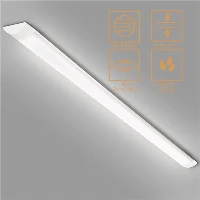
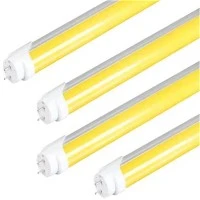
The chicken house uses IP67 or IP69K grade LED tubes. The core reason is the special characteristics of the breeding environment - high humidity, strong corrosion, frequent flushing and animal physiological sensitivity. The following is a specific analysis:
1. Resist high-pressure water flushing to prevent water damage
Chicken house cleaning requirements: Each batch of chickens needs to be thoroughly cleaned after they are released, and high-pressure water guns (pressure can reach 10-15MPa) are standard tools. IP67 tubes can withstand immersion in 1 meter of water for 30 minutes, and IP69K can withstand direct spraying of 80℃ high-temperature and high-pressure water (100 bar) to ensure that the internal circuit does not short-circuit with water.
Case: BENWEI Lighting 's IP66 tubes are clearly marked "can be cleaned with a high-pressure water gun", while IP69K is more suitable for modern chicken houses that require steam disinfection.
2. Protect against corrosive gases (ammonia, hydrogen sulfide)
Chicken manure decomposition produces highly corrosive substances: the concentration of ammonia (NH₃) and hydrogen sulfide (H₂S) released by chicken manure fermentation can reach 100-200ppm, and ordinary metal lamp shells are easily corroded and rusted. IP67/IP69K lamp tubes use polycarbonate (PC) or PMMA all-plastic shells, which are resistant to chemical corrosion and oxidation aging.
Experimental support: For example, the lamp tubes of BENWEI Lighting have passed the ammonia resistance test and have a lifespan of more than 50,000 hours.

3. Meet the physiological needs of poultry and avoid stroboscopic stress
Chickens are extremely sensitive to light: chicken eyes can recognize stroboscopic light as low as 205Hz (human eyes can only reach 80Hz), which can cause pecking and reduced egg production. IP67/IP69K lamps are usually equipped with DC power supply (DC48V) and flicker-free drive (stroboscopic index <0.001), smooth dimming (0-100%) and simulated sunrise and sunset.
Impact on animal welfare: Flickering can cause anxiety and loss of appetite in chickens, while high-protection-level lamps can stably provide 3000K warm white light (for laying hens) or 6500K white light (for broilers), increasing egg production by 5-10%.
4. Ensure electrical safety
Risk of electric shock in humid environments: Humidity in chicken houses often exceeds 80%, and 220V AC lamps have a high risk of leakage. IP67/IP69K lamps are mostly matched with safe voltage (DC30-48V), and there is no risk of electric shock even if the shell is damaged.
Simplified grounding requirements: High protection levels reduce dependence on leakage protectors and reduce circuit failure rates.
5. Long-term economic efficiency and maintenance convenience
Comparison items IP67/IP69K LED tubes Ordinary waterproof lamps
Lifespan 35,000-50,000 hours (warranty 2-5 years) ≤10,000 hours (prone to moisture corrosion)
Maintenance cost Almost maintenance-free (such as Tungsten tubes connected in series, easy to replace) Frequent replacement of drivers/tubes
Comprehensive energy consumption Energy saving of more than 50% (no flicker DC drive) High conversion loss (AC-DC multiple voltage reduction)
Anti-environmental interference Resistant to -20℃~55℃ temperature difference, dust, chemical gas Large temperature drift, fast light decay (annual decay>15%)
Case: Tungsten IP66 tubes are pre-installed with 10 in a string, directly connected with waterproof connectors, reducing wiring costs by 70%, and supporting automatic program control of smart dimming boxes
How to choose IP67 vs IP69K?
IP67: Suitable for most chicken houses, protecting against high-pressure water washing and ammonia corrosion (such as Shandong Hengyi's IP67 lamps).
IP69K: Suitable for biosafety chicken houses that require steam sterilization (such as breeder farms), or where strong acid/alkaline cleaners are used.
The rigid demand for lighting in modern chicken houses
Chicken house lighting needs to take into account animal welfare (no flicker dimming), extreme environmental tolerance (water, corrosion, temperature difference) and economic benefits (long life + low maintenance). IP67/IP69K LED lamps are the optimal solution for large-scale farming through the triple design of materials (polycarbonate shell), circuit (DC48V no flicker) and structure (waterproof connector series connection). If the budget is limited, IP67 basic protection can be selected; if you pursue extreme durability and biosafety, IP69K is the future upgrade direction , you can know more information on https://www.benweilight.com/professional-lighting/poultry-led-light/poultry-house-light.html